NIOS Class 10 Social Science 213 Notes 2026 – Chapter Wise Short Notes with Sample Preview

The NIOS Class 10 Social Science 213 Notes on this page are prepared by the Unnati Educations team for the 2026 examination. We read the complete textbook for code 213, analysed every lesson, and rewrote each topic into short and easy to revise notes.
This page shows a real sample of our work across History, Geography and Political Science so you can judge the quality first, then request the complete set on WhatsApp when you are ready. We prepare these notes strictly around the official NIOS Syllabus so nothing important is missed.
Chapters Covered in the Social Science 213 Notes
The Social Science 213 course is divided into four modules and twenty seven lessons. Our notes are built around this full structure, and you can cross check it against the official NIOS Class 10 Syllabus at any time.
| Module | No. | Lesson | Sample on this page |
|---|---|---|---|
| 1. India and the World Through the Ages | 1 | Ancient World | — |
| 1. India and the World Through the Ages | 2 | Medieval World | — |
| 1. India and the World Through the Ages | 3 | Modern World I | Yes |
| 1. India and the World Through the Ages | 4 | Modern World II | — |
| 1. India and the World Through the Ages | 5 | Impact of British Rule on India 1757 to 1857 | — |
| 1. India and the World Through the Ages | 6 | Religious and Social Awakening in Colonial India | — |
| 1. India and the World Through the Ages | 7 | Popular Resistance to the British Rule | — |
| 1. India and the World Through the Ages | 8 | Indian National Movement | — |
| 2. India, Natural Environment, Resources and Development | 9 | Physiography of India | Yes |
| 2. India, Natural Environment, Resources and Development | 10 | Climate | Yes |
| 2. India, Natural Environment, Resources and Development | 11 | Bio-diversity | — |
| 2. India, Natural Environment, Resources and Development | 12 | Agriculture in India | — |
| 2. India, Natural Environment, Resources and Development | 13 | Transport and Communication | — |
| 2. India, Natural Environment, Resources and Development | 14 | Population, Our Greatest Resource | — |
| 3. Democracy at Work | 15 | Constitutional Values and Political System in India | — |
| 3. Democracy at Work | 16 | Fundamental Rights and Fundamental Duties | — |
| 3. Democracy at Work | 17 | India, A Welfare State | — |
| 3. Democracy at Work | 18 | Local Governments and Field Administration | — |
| 3. Democracy at Work | 19 | Governance at the State Level | — |
| 3. Democracy at Work | 20 | Governance at the Union Level | — |
| 3. Democracy at Work | 21 | Political Parties and Pressure Groups | — |
| 3. Democracy at Work | 22 | People's Participation in the Democratic Process | — |
| 4. Contemporary India, Issues and Goals | 23 | Challenges to Indian Democracy | — |
| 4. Contemporary India, Issues and Goals | 24 | National Integration and Secularism | — |
| 4. Contemporary India, Issues and Goals | 25 | Socio-Economic Development and Empowerment of Disadvantaged Groups | — |
| 4. Contemporary India, Issues and Goals | 26 | Environmental Degradation and Disaster Management | — |
| 4. Contemporary India, Issues and Goals | 27 | Peace and Security | — |
The complete set covers every lesson above. The samples below are drawn from three different modules so you can see how we treat History, Geography and civics topics.
Sample Preview of the Social Science 213 Notes
Below are genuine extracts from our material. Read them, test the clarity for yourself, and you will see why learners rely on these pages during their final revision.
Sample 1 · History · Lesson 3 Modern World I
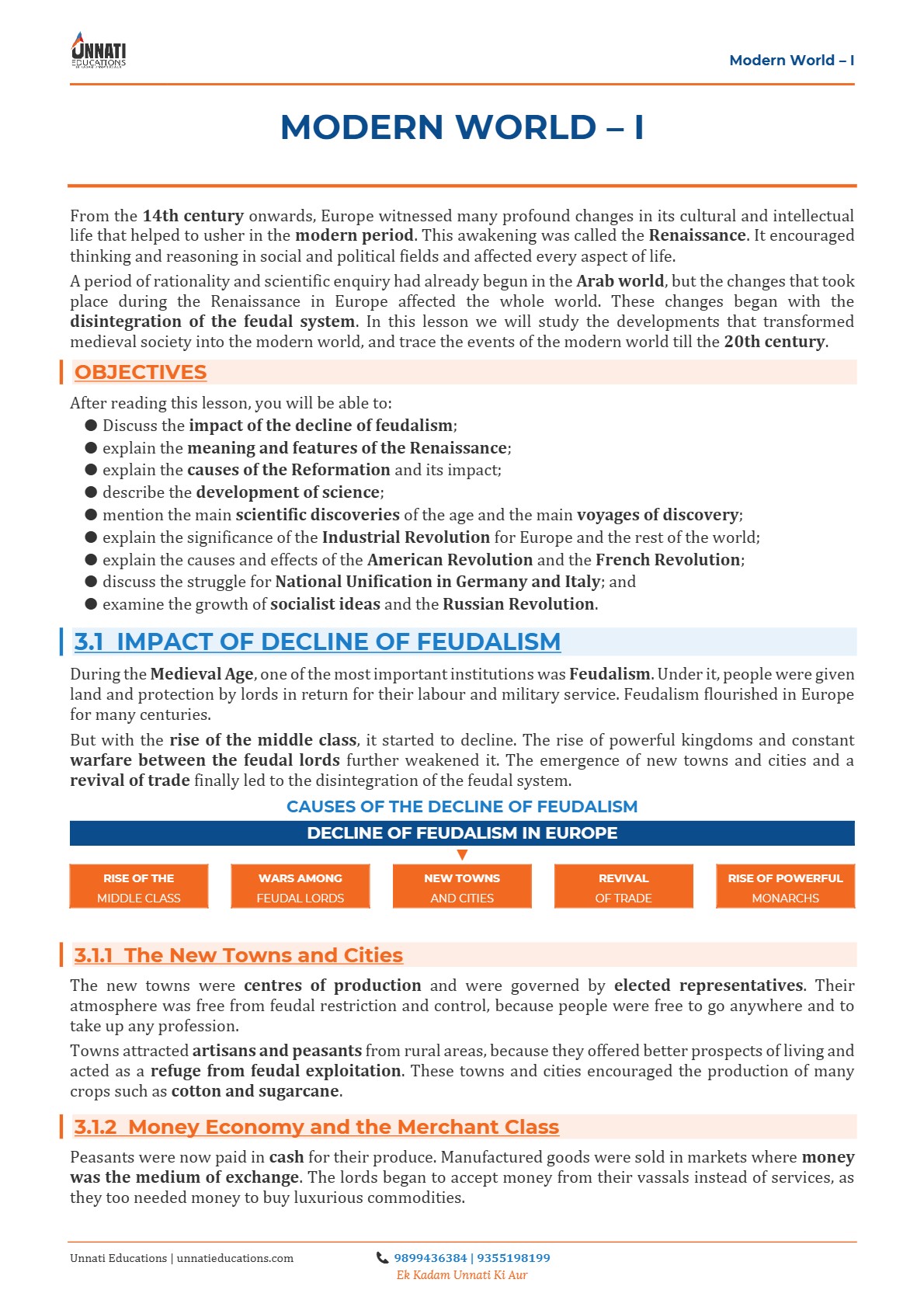
Impact of the Decline of Feudalism
Feudalism was the dominant social and economic system of the European Middle Ages, where landowners gave land to vassals in return for military service while peasants worked the land.
Causes of decline:
- New towns and cities grew as trade centres and weakened the manorial system.
- A rising merchant class sought more power and wealth.
- Towns offered freedom from feudal restrictions and drew peasants from villages.
- A money economy replaced barter, so peasants paid taxes in money rather than service.
- Royal power increased as kings undermined the feudal lords.
This shift gave birth to a strong middle class and encouraged new ways of thinking, which led directly into the Renaissance.
Sample 2 · Geography · Lesson 9 Physiography of India
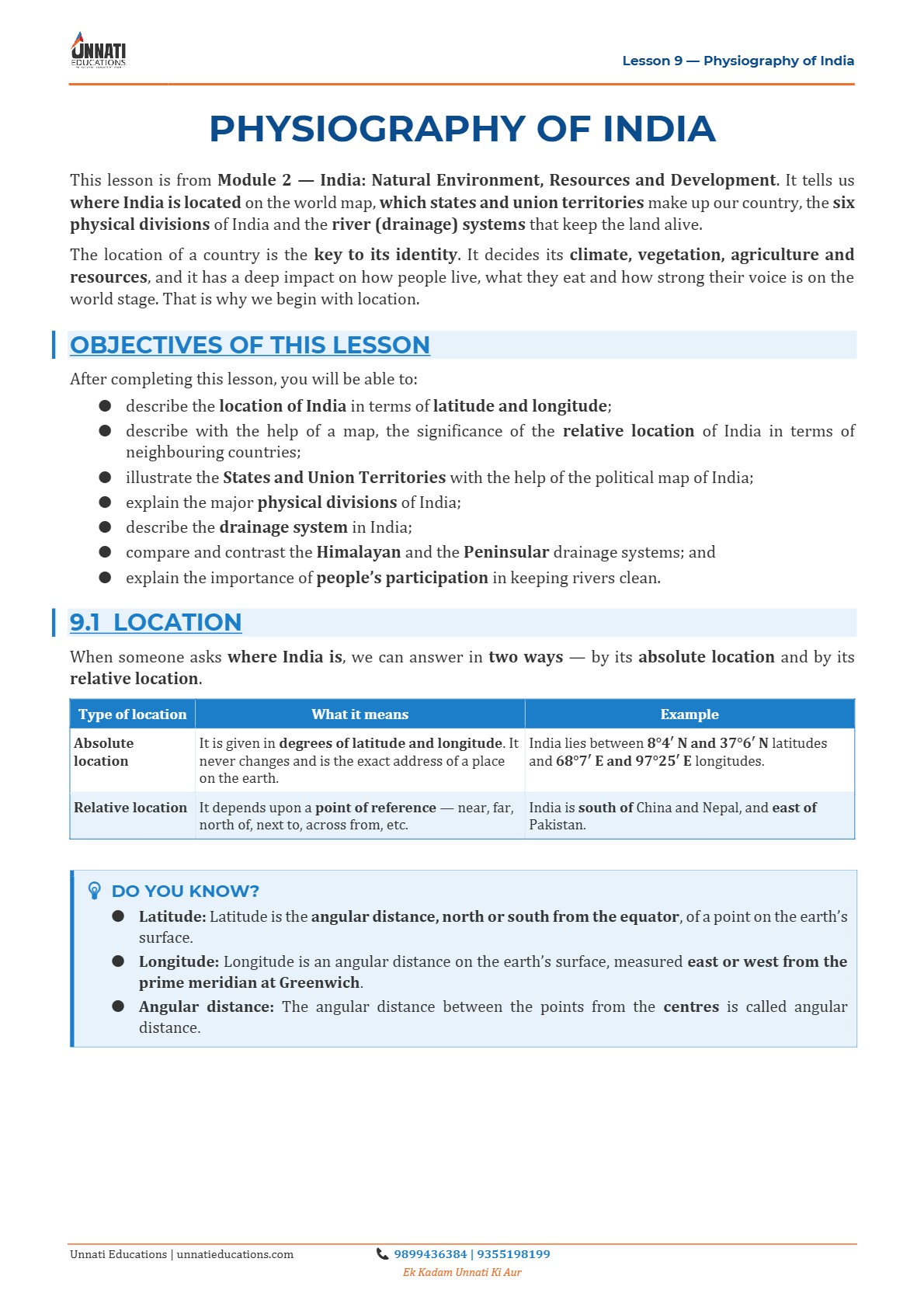
Location of India
To understand India we first study its location in both absolute and relative terms, and why that position carries strategic importance.
- Latitudinal extent: 8 degrees 4 minutes North to 37 degrees 6 minutes North, from Kanyakumari to Jammu and Kashmir.
- Longitudinal extent: 68 degrees 7 minutes East to 97 degrees 25 minutes East, from Gujarat to Arunachal Pradesh.
- Length north to south: roughly 3214 km.
Absolute location means the exact coordinates of a place, while relative location describes its position next to landmarks such as the Himalayas or China.
Sample 3 · Geography · Lesson 10 Climate
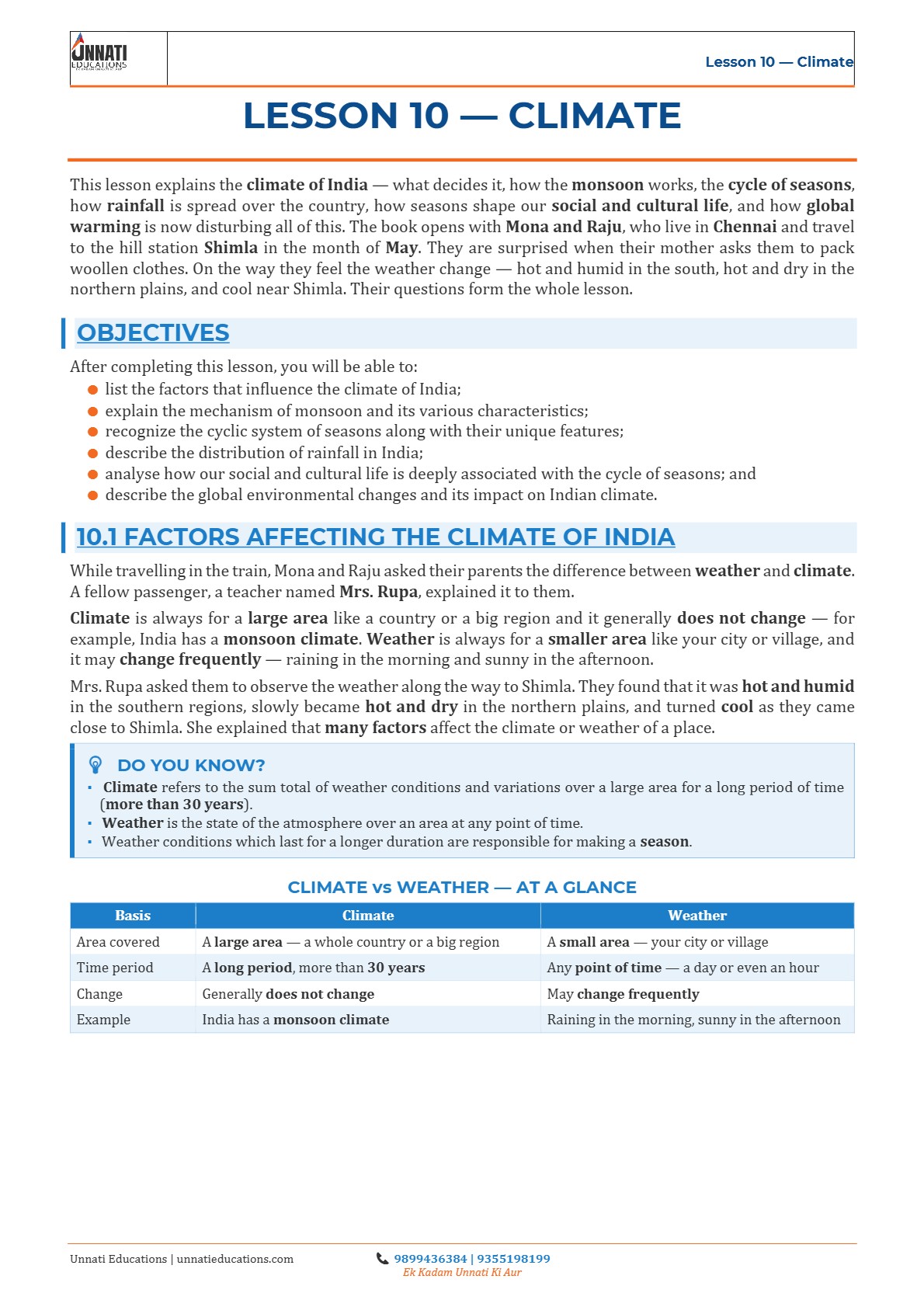
Factors Affecting the Climate of India
India has a varied climate because of several geographical and atmospheric factors. Two of the six major factors are shown here.
Location or latitude: India lies between 8 degrees 4 minutes North and 37 degrees 6 minutes North. Areas near the equator in South India stay hotter than the north, and places near the Tropic of Cancer receive more direct sunlight.
Distance from the sea: coastal cities such as Mumbai and Chennai enjoy a moderate climate from the sea breeze, while interior cities such as Delhi and Lucknow face extreme summers and winters.
This is a shortened preview. The full notes carry all six factors with worked examples and map points.
Liked the sample quality? Get the complete NIOS Social Science 213 Notes for 2026 delivered on WhatsApp today.
About the NIOS Class 10 Social Science 213 Notes
Social Science for NIOS Secondary carries the subject code 213 and blends History, Geography, Political Science and Economics into a single paper. Many learners find the sheer volume heavy, which is exactly why concise and reliable notes matter.
Our notes condense every lesson into clear points, key terms, dates and definitions, so revision becomes fast and far less stressful. The theory paper is scored out of a set weightage, with the remaining marks coming from your TMA work, so steady chapter wise revision truly pays off.
Because the subject rewards direct recall of facts, well organised short notes give you a genuine advantage in the examination hall.
Who Should Use These Social Science 213 Notes
These notes suit any NIOS Secondary learner sitting the Social Science 213 paper, whether in the April or the October to November cycle.
- First attempt learners who want the whole subject in a compact form.
- Working students and adult learners with limited revision time.
- Re-appear candidates who need a fast and focused last mile revision.
- Anyone who finds the full textbook heavy and wants clarity fast.
Why Choose Our Social Science 213 Notes
We did not copy and paste from the textbook. Our team analysed the entire book, marked the high frequency topics, and rewrote them in simple language that a first attempt learner can follow. The result is dependable NIOS Study Material that respects your time.
What makes the Social Science 213 Notes different
- Short and to the point, written for quick revision rather than heavy reading.
- Key terms, definitions, dates and map points highlighted lesson by lesson.
- Prepared after analysing the full NIOS 213 book, not a single sample chapter.
- Updated for the 2026 syllabus and examination pattern.
- Delivered in clean PDF format that opens on any phone or laptop.
How Our Social Science 213 Notes Help You Pass
Social Science rewards direct recall of dates, names, definitions and article numbers. Our notes place those exact facts in front of you in a form you can revise again and again without hunting through long chapters.
Because each lesson is trimmed to its scoring core, you can complete a confident revision of the whole subject in a short window before the examination. Pairing the notes with steady practice, and with the wider material listed under the NIOS Syllabus, builds real exam readiness rather than last minute panic.
How to Get the Complete NIOS Class 10 Social Science 213 Notes
Getting the full set is simple. Send us a message on WhatsApp, tell us you want the NIOS Class 10 Social Science 213 Notes, and our team will share access details and delivery in PDF format.
Send one message and start your focused Social Science 213 revision today.
FAQs on the Social Science 213 Notes
What do the NIOS Social Science 213 Notes include?
The NIOS Social Science 213 Notes include short and clear notes for every lesson across all four modules, covering History, Geography, Political Science and Economics. Each lesson carries key terms, dates, definitions and map points in a compact form. They are built for fast revision so you can cover the whole subject with confidence before your 2026 examination.
Are these Social Science 213 Notes updated for the 2026 exam?
Yes, these Social Science 213 Notes are fully updated for the 2026 syllabus and examination pattern. Our team reviewed the current NIOS textbook for code 213 and refreshed every lesson so the content matches what learners face this session. You revise from material that is current and aligned, not from an outdated older edition of the notes.
How do I get the full Social Science 213 Notes from Unnati Educations?
Getting the full Social Science 213 Notes is quick and direct. Message us on WhatsApp at 9654 279 279 or 9899 436 384, mention the subject and code 213, and our team shares the complete set in PDF format along with access details. The samples on this page let you check the quality first before you request the full material.
Can the Social Science 213 Notes help me revise quickly?
Yes, the Social Science 213 Notes are designed for quick and focused revision. Each lesson is trimmed to its scoring core, so a busy learner can revise the whole subject in a short window before the exam. They work best when paired with steady practice of previous questions, giving you both speed and genuine understanding of the paper.
Are the sample Social Science 213 Notes on this page the complete material?
No, the extracts on this page are only a short preview of the Social Science 213 Notes. They come from three different modules so you can judge our clarity and style. The complete set covers all twenty seven lessons in full detail with every key fact and map point. Contact us on WhatsApp to receive the entire material.
Do the Social Science 213 Notes cover all four modules?
Yes, the Social Science 213 Notes cover all four modules of the course in full. That includes India and the World Through the Ages, Natural Environment and Resources, Democracy at Work, and Contemporary India Issues and Goals. No lesson is skipped, so you can rely on a single organised source for the complete subject rather than juggling scattered material.
Disclaimer
Disclaimer: Unnati Educations is an independent academic support platform. We are not affiliated with, endorsed by, or associated with the National Institute of Open Schooling (NIOS). All subject codes and lesson names belong to their respective owners and are used only for reference.
Sources: Lesson structure verified against the official NIOS Social Science (213) module and lesson listing on nios.ac.in. Sample content is original study material prepared by Unnati Educations.
Contact Unnati Educations - Your Academic Lifeline
If you're eager to begin your journey or need guidance in the NIOS admissions process, we're just a message away.