NIOS Class 12 History 315 Notes 2026 – Lesson Wise Short Notes with Sample Pages
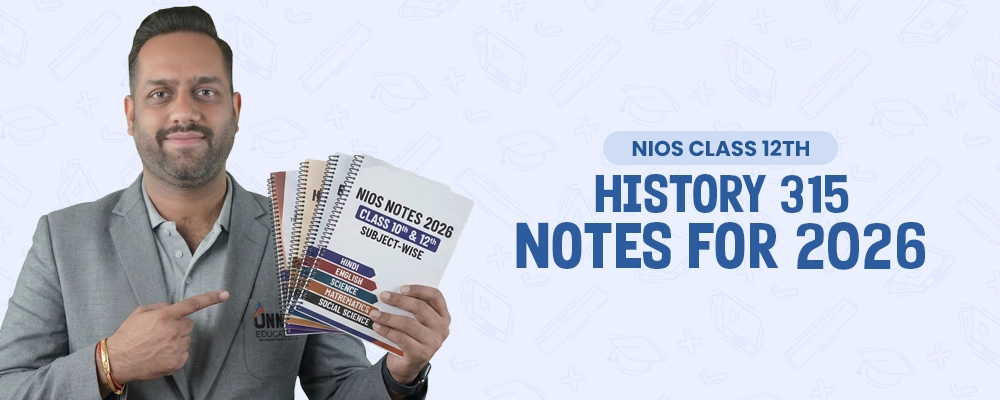
These NIOS Class 12 History 315 Notes 2026 are prepared by studying the complete History (315) textbook and analysing every lesson of the senior secondary course. Each chapter is condensed into clear, easy short notes so you revise faster and hold on to more before the exam.
On this page you can read genuine sample pages from our notes, judge the quality yourself and then request the full set covering the whole syllabus. Everything below reflects the actual notes our team has written and reviewed.
NIOS History 315 Notes at a Glance
| Detail | Information |
|---|---|
| Subject and code | History, code 315 (Senior Secondary) |
| Class | NIOS Class 12 |
| Session | 2026 (April to May and October to November exams) |
| Medium | English and Hindi |
| Format | Concise chapter-wise short notes with tables and key points |
| Coverage | Ancient, medieval, modern and world history lessons of the 315 course |
| Preview | Sample pages shown below at no cost |
What Is NIOS History 315 and Who Needs These Notes
NIOS History 315 is the senior secondary History subject offered by the National Institute of Open Schooling under subject code 315. It is a theory subject with a three hour written paper of 100 marks, and it spans Indian history from the Harappan age to the modern national movement along with key themes in world history.
These notes are made for NIOS Class 12 learners who want a fast, reliable revision resource rather than re-reading the whole textbook. They suit self-study students, working learners short on time, and anyone aiming to clear History 315 comfortably in the 2026 session. You can also browse every subject on our NIOS Class 12 Notes page.
NIOS Class 12 History 315 Notes Full Lesson-Wise Coverage
Our notes follow the official History 315 lesson structure laid out in the NIOS Class 12 Syllabus so nothing important is missed. The coverage below shows the exact chapters and the main topics condensed inside each one.
Ancient India
- Lesson 3 The Harappan Civilization: origin and extent, town planning, structural remains, economic activities, religion, art and the decline.
- Lesson 4 The Vedic Age: early and later Vedic society, polity, economy, religion and the transition towards new kingdoms.
- Lesson 6 Post Mauryan Developments: new dynasties, trade, society and cultural growth after the Mauryas.
- Lesson 7 The Guptas and Their Descendants: polity, administration, economy and the classical cultural flowering.
Medieval India
- Lesson 9 Establishment of the Delhi Sultanate: rise of Turkish rule and the early Sultanate.
- Lesson 10 Establishment of the Mughal Empire: advent of Babur, Humayun and Afghan revival, Akbar to Aurangzeb, and challenges to Mughal rule.
- Lesson 12 Administrative System and Institutions: Sultanate and Mughal administration, the iqta system, Alauddin Khalji market reforms and Maratha institutions.
- Lesson 14 Cultural Developments in Medieval India: Sufism, the Bhakti movement, Sikhism, literature, music, painting and architecture.
Modern India
- Lesson 16 Establishment of British Rule: European trade, Anglo-French struggle, occupation of Bengal and the growth of colonial administration.
- Lesson 18 Social Changes in Modern India: British cultural policy, socio-religious reforms, western education and the growth of the press.
- Lesson 19 Popular Resistance to British Rule: early uprisings and the nature, course and consequences of the Revolt of 1857.
- Lesson 20 Nationalism: culture, economy and religion as sources of Indian nationalism.
- Lesson 21 Indian National Movement: the Congress, Swadeshi and Boycott, Home Rule, the Gandhian mass movements, Civil Disobedience and the road to freedom.
World History and Themes
- Lesson 23 World War I and the Russian Revolution: causes and course of the war and the stages and impact of the revolution.
- Lesson 24 The Inter-War Period and World War II: peace treaties, totalitarian regimes, the Great Depression, appeasement and the world at war.
- Lesson 25 The Cold War Era and Its Aftermath: meaning and causes of the Cold War, its phases, detente and its end.
- Lessons 28 to 32 Cultural and Thematic Studies: cultural change in the modern world, early and medieval states, cultural production and communication, and the colonial state.
Sample Pages from Our NIOS History 315 Notes
Below is a genuine extract from Lesson 3 The Harappan Civilization, shown exactly as it appears in our notes. Read it to check the depth, layout and clarity before you request the complete set. This is a preview of a few pages, and the full notes carry every lesson listed above in the same style.
Sample Page Preview
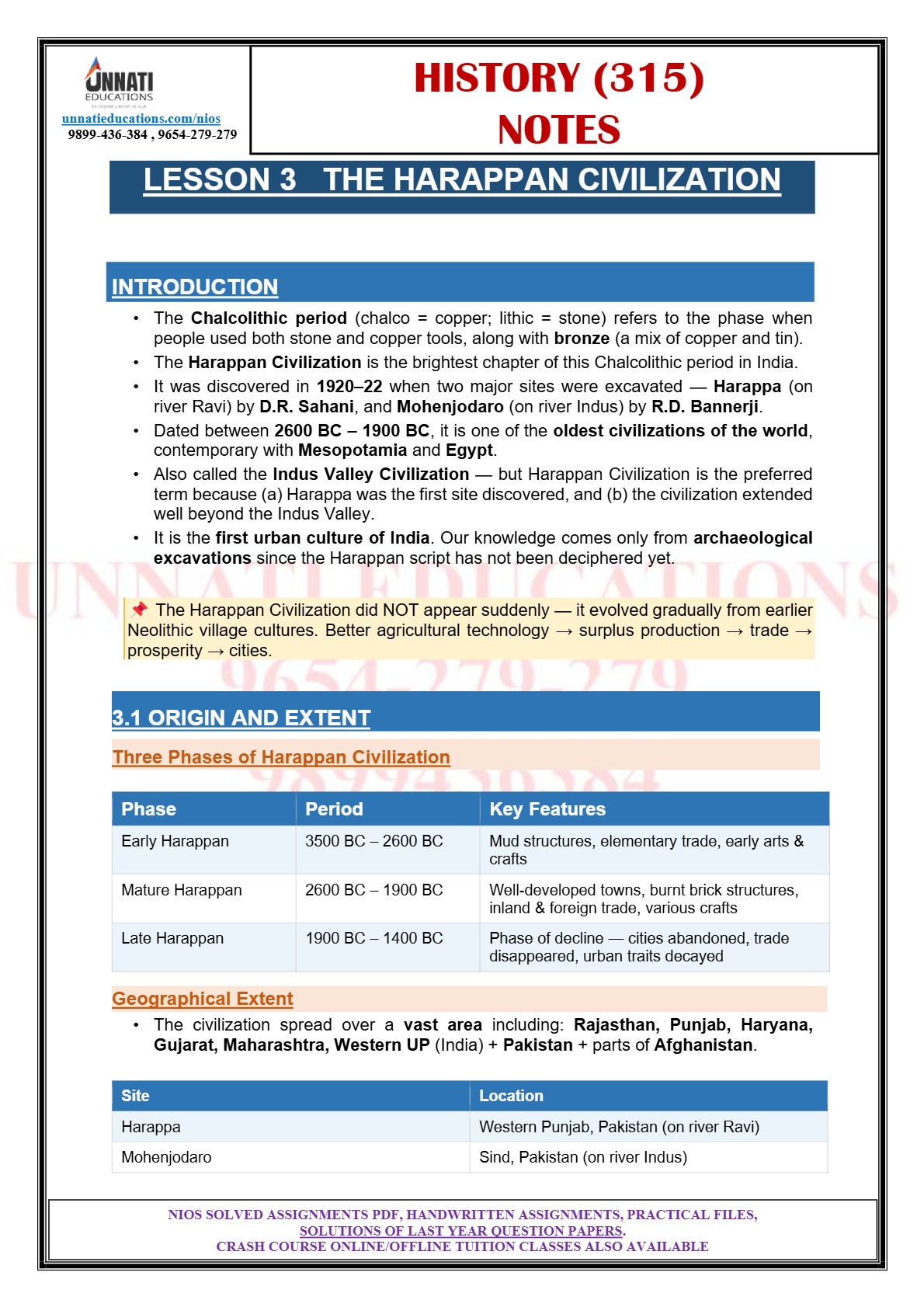
Lesson 3 The Harappan Civilization
Introduction
- The Chalcolithic period (chalco = copper; lithic = stone) refers to the phase when people used both stone and copper tools, along with bronze (a mix of copper and tin).
- The Harappan Civilization is the brightest chapter of this Chalcolithic period in India.
- It was discovered in 1920–22 when two major sites were excavated — Harappa (on river Ravi) by D.R. Sahani, and Mohenjodaro (on river Indus) by R.D. Bannerji.
- Dated between 2600 BC – 1900 BC, it is one of the oldest civilizations of the world, contemporary with Mesopotamia and Egypt.
- Also called the Indus Valley Civilization — but Harappan Civilization is the preferred term because (a) Harappa was the first site discovered, and (b) the civilization extended well beyond the Indus Valley.
- It is the first urban culture of India. Our knowledge comes only from archaeological excavations since the Harappan script has not been deciphered yet.
3.1 Origin and Extent — Three Phases
| Phase | Period | Key Features |
|---|---|---|
| Early Harappan | 3500 BC – 2600 BC | Mud structures, elementary trade, early arts & crafts |
| Mature Harappan | 2600 BC – 1900 BC | Well-developed towns, burnt brick structures, inland & foreign trade, various crafts |
| Late Harappan | 1900 BC – 1400 BC | Phase of decline — cities abandoned, trade disappeared, urban traits decayed |
Major Sites and Locations
| Site | Location |
|---|---|
| Harappa | Western Punjab, Pakistan (on river Ravi) |
| Mohenjodaro | Sind, Pakistan (on river Indus) |
| Kalibangan | Rajasthan, India (on river Ghaggar-Hakra) |
| Lothal | Gujarat, India |
| Dholavira | Gujarat, India |
| Sutkagendor | Makran Coast — WESTERNMOST site |
| Alamgirpur | Western UP — EASTERNMOST site |
3.2 Town Planning
- Town planning is the most interesting urban feature of the Harappan civilization — marked by remarkable uniformity (with some regional variations).
- Almost all major sites (Harappa, Mohenjodaro, Kalibangan) were divided into two parts: the Citadel on a higher mound on the western side for administrative or ritual structures, and the Lower Town on the eastern side for residential buildings.
- Streets ran in a criss-cross (grid) pattern, intersecting at right angles. House doors opened into the lanes, NOT onto the main street.
- Houses were built primarily of burnt bricks; bigger houses had rooms around a square courtyard with private wells, kitchens and bathing platforms.
- The drainage was elaborate and well-planned. Every house had drains connecting to street drains, covered with brick or stone slabs, with manholes at regular intervals for cleaning.
3.3 Major Structural Remains
| Structure | Location | Details |
|---|---|---|
| Great Bath | Mohenjodaro | Large public bath; corridors on all sides; bitumen lining to prevent seepage; used for ritual bathing |
| Granary | Harappa | Rows of circular brick platforms for threshing wheat and barley |
| Dockyard | Lothal | Brick structure for berthing ships and handling cargo, showing Lothal was an important port |
3.4 Economic Activities
- Harappan prosperity rested on three pillars: Agriculture, Arts & Crafts, and Trade.
- Agriculture with pastoralism formed the base; plough marks were found at Kalibangan and a terracotta plough at Banawali.
- Chief crops were wheat and barley, with sesame, mustard, peas, rice (Lothal and Rangpur) and cotton (Mohenjodaro).
- Harappans knew almost all metals EXCEPT iron; famous artefacts include the Bronze Dancing Girl and the stone Bearded Man of Mohenjodaro.
End of sample preview. The full Lesson 3 continues with religion, seals, weights, decline and more, and every other lesson follows in the same format.
Why Our NIOS History 315 Notes Help You Score More
We did not summarise from a guidebook. Our team read the complete History 315 book, analysed each lesson and rewrote it as short, exam-ready notes. That first-hand work is why the notes stay accurate and stay focused on what the paper actually asks.
- Built from the full book: every lesson analysed line by line, then condensed to essentials.
- Easy to revise: key points, dated tables and comparisons instead of long paragraphs.
- Exam-focused: emphasis on high-weight topics and frequently asked areas.
- Both mediums: available in English and Hindi to suit your paper.
- Reviewed: checked by an experienced NIOS counsellor before release.
Use these notes alongside the rest of our NIOS Study Material to build a complete, subject-by-subject revision plan for the year.
NIOS History 315 Exam Pattern and Passing Marks
History 315 is a theory subject with no practical component. The written paper carries 100 marks and runs for three hours, and the Tutor Marked Assignment (TMA) contributes internal assessment weightage worth 20 per cent of the theory marks for this subject group.
To pass, a learner must score at least 33 per cent in the external examination and 33 per cent in aggregate, as stated by NIOS. Public examinations are held twice a year in April to May and October to November, with On Demand Examination also available to registered learners.
| Component | Details |
|---|---|
| Theory paper | 100 marks, three hours, written |
| Practical | None for History 315 |
| TMA weightage | 20 per cent of theory marks (internal assessment) |
| Passing marks | 33 per cent in exam and 33 per cent aggregate |
| Exam sessions | April to May and October to November |
Pattern verified against the official NIOS FAQ. The way TMA marks are displayed on the marksheet was revised from the October 2024 session, so check the current-session display on the official NIOS portal before exams.
How to Study History 315 Using These Short Notes
Start with the lesson map above and read our notes chapter by chapter, since the subject moves in a clear timeline from ancient to modern India. Revise dates and dynasties from the tables first, because those carry easy, guaranteed marks.
After each lesson, write two or three answers in your own words to lock in recall, then use the notes for quick revision in the final week. Give extra time to the national movement and world history lessons, as they carry strong question weight every session. Before you begin, cross-check your chapters against the wider NIOS Syllabus so you cover the right lessons.
How to Get the Complete NIOS Class 12 History 315 Notes 2026
If the sample above matches what you need, you can request the complete notes for the full syllabus. Send us a message on WhatsApp with your subject and medium, and we will share the details and how to receive the full set.
- Tap the WhatsApp button below.
- Tell us your class, subject (History 315) and preferred medium.
- We confirm the complete notes and delivery details.
Request the full NIOS History 315 notes on WhatsApp
Primary 9654279279. Alternate 9899436384.
NIOS History 315 Notes Frequently Asked Questions
Are the NIOS Class 12 History 315 Notes updated for 2026?
Yes, these notes are prepared for the 2026 session and follow the current History 315 lesson structure. Our team reviews the content against the latest NIOS textbook and exam pattern before release, so the chapters, dates and key points stay aligned with what the paper asks. If NIOS revises the syllabus, we update the affected lessons accordingly.
Do these History 315 notes cover the full syllabus?
Yes, the complete notes cover every lesson of the History 315 course, from the Harappan Civilization and the Vedic Age through medieval India, modern India and the world history themes. The sample on this page is only a short preview from Lesson 3, while the full set condenses all chapters into the same clear, exam-ready short-note format.
In which medium are the NIOS History 315 notes available?
The notes are available in both English and Hindi so you can study in whichever medium you sit the paper in. Tell us your preferred medium when you message us, and we will share the matching version. The layout, tables and key points stay the same across both, so the quality you see in the sample carries over.
How are the History 315 notes delivered after I contact you?
After you message us on WhatsApp with your subject and medium, we confirm the complete notes and share how you will receive them. Delivery is handled directly over WhatsApp for convenience, so there is no complicated portal to navigate. We keep the process simple, and you can start revising quickly rather than waiting on long formalities or slow email replies.
What is the passing mark for NIOS History 315?
You must score at least 33 per cent in the external theory examination and 33 per cent in aggregate to pass NIOS History 315, as stated by NIOS. The paper is worth 100 marks over three hours, and the Tutor Marked Assignment adds internal assessment weightage. Focused revision from short notes is a reliable way to cross this mark comfortably.
Disclaimer
Disclaimer: Unnati Educations is an independent academic support platform and is not affiliated with, endorsed by or associated with the National Institute of Open Schooling (NIOS). NIOS names, subject names and codes are used only for identification and reference. Always confirm the current syllabus, exam pattern and dates on the official NIOS website.
Ready to start? Get the full History 315 notes today.
Sources: Official NIOS FAQ, rcdelhi.nios.ac.in. Author Prateek Talwar. Reviewer Jyoti Sharma, Senior NIOS Counsellor.
Contact Unnati Educations - Your Academic Lifeline
If you're eager to begin your journey or need guidance in the NIOS admissions process, we're just a message away.