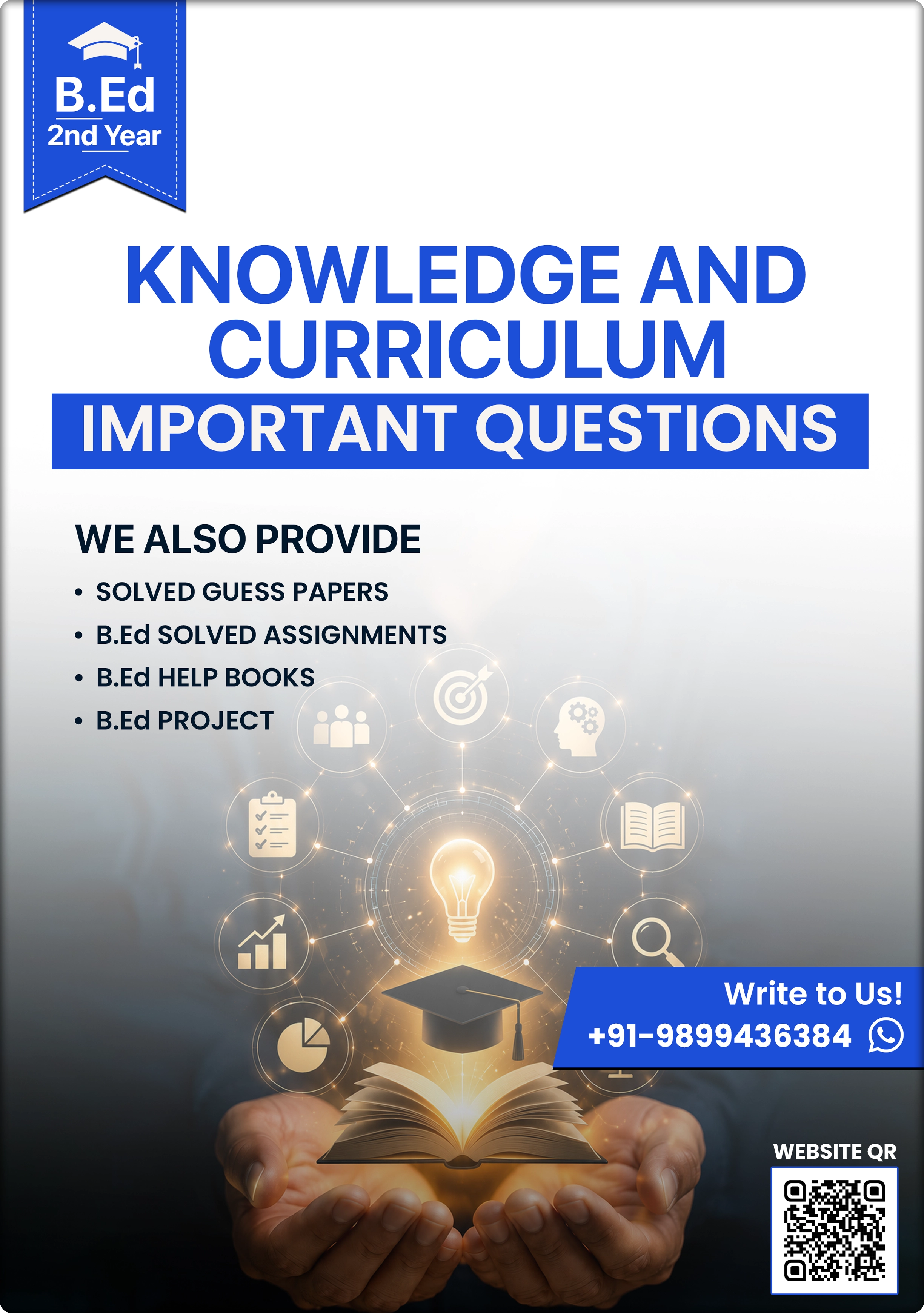
Knowledge and Curriculum Important Questions B.Ed 2nd Year MDU Rohtak 2026
What's Included
Full content delivered instantly
Clean layout, well-structured
Organized for easy revision
Download link delivered immediately
Read anywhere, any device
Course Overview
| Last updated | 26 May 2026 |
|---|---|
| Verified by | Sheetal Kirola, M.Ed., B.Ed Faculty |
| Source | MDU 17121 syllabus and last five years' question papers (2021–2025) |
| Programme | B.Ed 2nd Year |
| Paper Code | 17121 |
| Maximum Marks | 80 written plus 20 internal |
Quick Facts at a Glance
If you are preparing Knowledge and Curriculum Important Questions for B.Ed 2nd Year, here are the verified details compiled from the MDU 17121 syllabus and last five years' question papers (2021–2025).
| Field | Detail |
|---|---|
| Paper Name | Knowledge and Curriculum |
| Paper Code | 17121 |
| Paper Number | I |
| Programme | B.Ed (2nd Year, annual scheme) |
| Target Exam | MDU 2026 Annual Examination |
| Written Marks | 80 |
| Internal Assessment | 20 |
| Duration | Three Hours |
| Questions Set / To Attempt | 9 set / attempt 5 (Q1 compulsory plus 1 from each Unit) |
| Q1 | Compulsory short notes (4 × 4 = 16) |
| Marks per Long Question | 16 |
| Medium | English and Hindi (bilingual) |
| Pattern Applies To | MDU Rohtak (primary); also relevant to CRSU Jind and KUK Kurukshetra |
Knowledge and Curriculum Important Questions 2026 — Paper Overview
Knowledge and Curriculum is the B.Ed (Bachelor of Education) 2nd Year theory paper that studies what knowledge is, how it is constructed, the philosophies that shape education, and how a curriculum is built and designed. As a Year-2 paper it carries 80 written marks plus 20 internal, a 100-mark paper at programme level. This set of b.ed Knowledge and Curriculum 2nd year Important Questions covers all four units, from theories of knowledge to curriculum design models.
Knowledge and Curriculum Important Questions (No-Cost Preview)
A no-cost preview of real, recurring questions, each with a one-line opener so you can see how to begin.
- What is knowledge? Critically examine the various methods of acquiring knowledge.
Opener: nine recognised methods, from appeal to authority through to problem solving. - Describe the relative roles of the knower and the known in knowledge transmission and construction.
Opener: constructivism, where the learner actively builds meaning rather than passively receiving it. - What do you understand by Sankhya philosophy? Explain its relationship with education.
Opener: the path of right knowledge that separates Purusha from Prakriti. - Describe in detail the principles of Naturalism and discuss its impact on education.
Opener: 'Back to Nature', child-centred and activity-based education. - Describe curriculum, its nature and its organising components.
Opener: far more than a syllabus, organised through purpose, content, methods and evaluation. - What is a curriculum design model? Classify and explain curriculum design.
Opener: discipline-centred, learner-centred and problem-centred designs compared.
Q1 short notes is compulsory every year, so prioritise it first.
Knowledge and Curriculum Important Questions in This Analysis
These are the most important Knowledge and Curriculum topics identified from the MDU 17121 syllabus and last five years' question papers.
- Meaning and methods of acquiring knowledge
- Kinds and sources of knowledge
- Belief versus truth
- Knower and known and knowledge construction
- Sankhya philosophy
- Idealism
- Naturalism
- Pragmatism and educational implications
- Curriculum meaning, nature and components
- Principles of curriculum construction
- Traditional versus learner-driven approach
- Curriculum design models
- Discipline-centred versus problem-centred design
- Curriculum change and its factors
- Curriculum development phases
Knowledge and Curriculum Important Questions — Unit-wise Topics
These are the high-yield areas, as reflected in MDU's last five years' papers from 2021 to 2025. Treat them as priorities, not promises.
| Unit | High-weight Topics |
|---|---|
| Unit I — Knowledge | Meaning and methods of acquiring knowledge; kinds and sources of knowledge; belief versus truth; knower and known and knowledge construction; the teacher's role in assimilation and dissemination. |
| Unit II — Philosophy and Education | Sankhya philosophy; idealism; naturalism; pragmatism and their educational implications. |
| Unit III — Curriculum | Curriculum meaning, nature and components; principles of curriculum construction; traditional versus learner-driven approach. |
| Unit IV — Development and Design | Components and phases of curriculum development; curriculum design models; discipline-centred versus problem-centred design; curriculum change and its factors. |
The consistently HIGH-frequency themes are the methods of acquiring knowledge, curriculum design models, and curriculum meaning and components. You can safely skip-list the low-yield material: existentialism, heavy historical biographies, and the Tyler, Wheeler and Kerr models in full 16-mark depth.
What You Get
Buyers receive full solved long answers and short notes across all four units, the complete 12-question 2026 guess paper, and the last-five-years frequency analysis, all re-aligned to the current session. Each answer is structured the way examiners expect, with a definition plus theorist, five to eight points, a classroom link and a short conclusion. This is where b.ed Knowledge and Curriculum Important Questions become exam-ready rather than just listed. Delivery is via WhatsApp from Unnati Education B.Ed, with a sample preview at no cost.
Marks Structure and Exam Pattern (Code 17121)
Here is the quick reference for the Knowledge and Curriculum paper, set out the way it is actually attempted in the hall.
In plain words, you write five answers in all: the compulsory short notes, then one question from each of the four units, with every long question worth equal marks.
How to Prepare Knowledge and Curriculum
Open every answer with a definition and a theorist, for example according to Dewey or according to Crow and Crow, then link the philosophy or concept to classroom practice through its aim, curriculum, method and role of the teacher. In practice, the heading then definition then five to eight numbered points then a short conclusion is the structure examiners scan for. Bring in NCF 2005 and NEP 2020 where the syllabus supports it. Most B.Ed students under-prepare structure and over-write content, so close every answer with one reflective line. Paper patterns vary slightly across universities, so confirm your own scheme.
About the Solved Set and 2026 Guess Paper
The solved set includes full solved long answers and short notes across all four units, the complete 12-question 2026 guess paper, last-five-years frequency analysis, Hindi and English support, and regularly updated content aligned with current examination trends. A sample preview is available before purchase.
Frequently Asked Questions
Which units are most scoring in Knowledge and Curriculum?
Unit I knowledge methods and Unit IV design models repeat most across recent papers. Building your b.ed Knowledge and Curriculum 2nd year Important Questions around these two units, plus a strong philosophy from Unit II, gives the safest coverage.
How many questions should I prepare for the 80-mark paper?
You attempt five of nine, so prepare the compulsory Q1 short notes plus at least two strong questions per unit. That gives you a reliable choice in every unit even if one topic feels shaky on the day.
What is paper code 17121?
Code 17121 is the MDU Rohtak B.Ed 2nd Year Knowledge and Curriculum paper, listed as Paper I. It is an 80-mark written paper of Three Hours, with 20 internal marks added at programme level.
Is the solved set and guess paper available?
Yes, the full solved set with the 12-question 2026 guess paper is available via WhatsApp from Unnati Education B.Ed. The b.ed Knowledge and Curriculum Important Questions come with a no-cost sample preview so you can judge the depth first.
Is the paper bilingual?
Yes, every question is printed in both English and Hindi. You may answer in either language, so pick one medium and stay consistent through the whole paper.
Get the Solved Questions and 2026 Guess Paper on WhatsApp
Ready for the full answers? The pack includes every important question solved across all four units, the complete 12-question 2026 guess paper, and a sample preview sent first so you can check the quality. Message Unnati Education B.Ed on WhatsApp at 9899436384 or 9355198199 for the solved 2nd-year set.
Sources, Disclaimer & Author
The important questions and frequency analysis here are prepared by the Unnati Education B.Ed team from the MDU 17121 prescribed syllabus and the last five years' MDU question papers from 2021 to 2025, and the solved answers are model answers prepared by the team. Unnati Education B.Ed is an independent academic publisher and is not affiliated with Maharshi Dayanand University (MDU), Rohtak, Chaudhary Ranbir Singh University (CRSU), Jind or Kurukshetra University Kurukshetra (KUK). Material is shared for educational and revision purposes, and the guess paper indicates high-probability questions and does not guarantee exact repetition. Verified by Sheetal Kirola, M.Ed., B.Ed Faculty. Last verified: 26 May 2026.
What's Included
Course Overview
| Last updated | 26 May 2026 |
|---|---|
| Verified by | Sheetal Kirola, M.Ed., B.Ed Faculty |
| Source | MDU 17121 syllabus and last five years' question papers (2021–2025) |
| Programme | B.Ed 2nd Year |
| Paper Code | 17121 |
| Maximum Marks | 80 written plus 20 internal |
Quick Facts at a Glance
If you are preparing Knowledge and Curriculum Important Questions for B.Ed 2nd Year, here are the verified details compiled from the MDU 17121 syllabus and last five years' question papers (2021–2025).
| Field | Detail |
|---|---|
| Paper Name | Knowledge and Curriculum |
| Paper Code | 17121 |
| Paper Number | I |
| Programme | B.Ed (2nd Year, annual scheme) |
| Target Exam | MDU 2026 Annual Examination |
| Written Marks | 80 |
| Internal Assessment | 20 |
| Duration | Three Hours |
| Questions Set / To Attempt | 9 set / attempt 5 (Q1 compulsory plus 1 from each Unit) |
| Q1 | Compulsory short notes (4 × 4 = 16) |
| Marks per Long Question | 16 |
| Medium | English and Hindi (bilingual) |
| Pattern Applies To | MDU Rohtak (primary); also relevant to CRSU Jind and KUK Kurukshetra |
Knowledge and Curriculum Important Questions 2026 — Paper Overview
Knowledge and Curriculum is the B.Ed (Bachelor of Education) 2nd Year theory paper that studies what knowledge is, how it is constructed, the philosophies that shape education, and how a curriculum is built and designed. As a Year-2 paper it carries 80 written marks plus 20 internal, a 100-mark paper at programme level. This set of b.ed Knowledge and Curriculum 2nd year Important Questions covers all four units, from theories of knowledge to curriculum design models.
Knowledge and Curriculum Important Questions (No-Cost Preview)
A no-cost preview of real, recurring questions, each with a one-line opener so you can see how to begin.
- What is knowledge? Critically examine the various methods of acquiring knowledge.
Opener: nine recognised methods, from appeal to authority through to problem solving. - Describe the relative roles of the knower and the known in knowledge transmission and construction.
Opener: constructivism, where the learner actively builds meaning rather than passively receiving it. - What do you understand by Sankhya philosophy? Explain its relationship with education.
Opener: the path of right knowledge that separates Purusha from Prakriti. - Describe in detail the principles of Naturalism and discuss its impact on education.
Opener: 'Back to Nature', child-centred and activity-based education. - Describe curriculum, its nature and its organising components.
Opener: far more than a syllabus, organised through purpose, content, methods and evaluation. - What is a curriculum design model? Classify and explain curriculum design.
Opener: discipline-centred, learner-centred and problem-centred designs compared.
Q1 short notes is compulsory every year, so prioritise it first.
Knowledge and Curriculum Important Questions in This Analysis
These are the most important Knowledge and Curriculum topics identified from the MDU 17121 syllabus and last five years' question papers.
- Meaning and methods of acquiring knowledge
- Kinds and sources of knowledge
- Belief versus truth
- Knower and known and knowledge construction
- Sankhya philosophy
- Idealism
- Naturalism
- Pragmatism and educational implications
- Curriculum meaning, nature and components
- Principles of curriculum construction
- Traditional versus learner-driven approach
- Curriculum design models
- Discipline-centred versus problem-centred design
- Curriculum change and its factors
- Curriculum development phases
Knowledge and Curriculum Important Questions — Unit-wise Topics
These are the high-yield areas, as reflected in MDU's last five years' papers from 2021 to 2025. Treat them as priorities, not promises.
| Unit | High-weight Topics |
|---|---|
| Unit I — Knowledge | Meaning and methods of acquiring knowledge; kinds and sources of knowledge; belief versus truth; knower and known and knowledge construction; the teacher's role in assimilation and dissemination. |
| Unit II — Philosophy and Education | Sankhya philosophy; idealism; naturalism; pragmatism and their educational implications. |
| Unit III — Curriculum | Curriculum meaning, nature and components; principles of curriculum construction; traditional versus learner-driven approach. |
| Unit IV — Development and Design | Components and phases of curriculum development; curriculum design models; discipline-centred versus problem-centred design; curriculum change and its factors. |
The consistently HIGH-frequency themes are the methods of acquiring knowledge, curriculum design models, and curriculum meaning and components. You can safely skip-list the low-yield material: existentialism, heavy historical biographies, and the Tyler, Wheeler and Kerr models in full 16-mark depth.
What You Get
Buyers receive full solved long answers and short notes across all four units, the complete 12-question 2026 guess paper, and the last-five-years frequency analysis, all re-aligned to the current session. Each answer is structured the way examiners expect, with a definition plus theorist, five to eight points, a classroom link and a short conclusion. This is where b.ed Knowledge and Curriculum Important Questions become exam-ready rather than just listed. Delivery is via WhatsApp from Unnati Education B.Ed, with a sample preview at no cost.
Marks Structure and Exam Pattern (Code 17121)
Here is the quick reference for the Knowledge and Curriculum paper, set out the way it is actually attempted in the hall.
In plain words, you write five answers in all: the compulsory short notes, then one question from each of the four units, with every long question worth equal marks.
How to Prepare Knowledge and Curriculum
Open every answer with a definition and a theorist, for example according to Dewey or according to Crow and Crow, then link the philosophy or concept to classroom practice through its aim, curriculum, method and role of the teacher. In practice, the heading then definition then five to eight numbered points then a short conclusion is the structure examiners scan for. Bring in NCF 2005 and NEP 2020 where the syllabus supports it. Most B.Ed students under-prepare structure and over-write content, so close every answer with one reflective line. Paper patterns vary slightly across universities, so confirm your own scheme.
About the Solved Set and 2026 Guess Paper
The solved set includes full solved long answers and short notes across all four units, the complete 12-question 2026 guess paper, last-five-years frequency analysis, Hindi and English support, and regularly updated content aligned with current examination trends. A sample preview is available before purchase.
Frequently Asked Questions
Which units are most scoring in Knowledge and Curriculum?
Unit I knowledge methods and Unit IV design models repeat most across recent papers. Building your b.ed Knowledge and Curriculum 2nd year Important Questions around these two units, plus a strong philosophy from Unit II, gives the safest coverage.
How many questions should I prepare for the 80-mark paper?
You attempt five of nine, so prepare the compulsory Q1 short notes plus at least two strong questions per unit. That gives you a reliable choice in every unit even if one topic feels shaky on the day.
What is paper code 17121?
Code 17121 is the MDU Rohtak B.Ed 2nd Year Knowledge and Curriculum paper, listed as Paper I. It is an 80-mark written paper of Three Hours, with 20 internal marks added at programme level.
Is the solved set and guess paper available?
Yes, the full solved set with the 12-question 2026 guess paper is available via WhatsApp from Unnati Education B.Ed. The b.ed Knowledge and Curriculum Important Questions come with a no-cost sample preview so you can judge the depth first.
Is the paper bilingual?
Yes, every question is printed in both English and Hindi. You may answer in either language, so pick one medium and stay consistent through the whole paper.
Get the Solved Questions and 2026 Guess Paper on WhatsApp
Ready for the full answers? The pack includes every important question solved across all four units, the complete 12-question 2026 guess paper, and a sample preview sent first so you can check the quality. Message Unnati Education B.Ed on WhatsApp at 9899436384 or 9355198199 for the solved 2nd-year set.
Sources, Disclaimer & Author
The important questions and frequency analysis here are prepared by the Unnati Education B.Ed team from the MDU 17121 prescribed syllabus and the last five years' MDU question papers from 2021 to 2025, and the solved answers are model answers prepared by the team. Unnati Education B.Ed is an independent academic publisher and is not affiliated with Maharshi Dayanand University (MDU), Rohtak, Chaudhary Ranbir Singh University (CRSU), Jind or Kurukshetra University Kurukshetra (KUK). Material is shared for educational and revision purposes, and the guess paper indicates high-probability questions and does not guarantee exact repetition. Verified by Sheetal Kirola, M.Ed., B.Ed Faculty. Last verified: 26 May 2026.