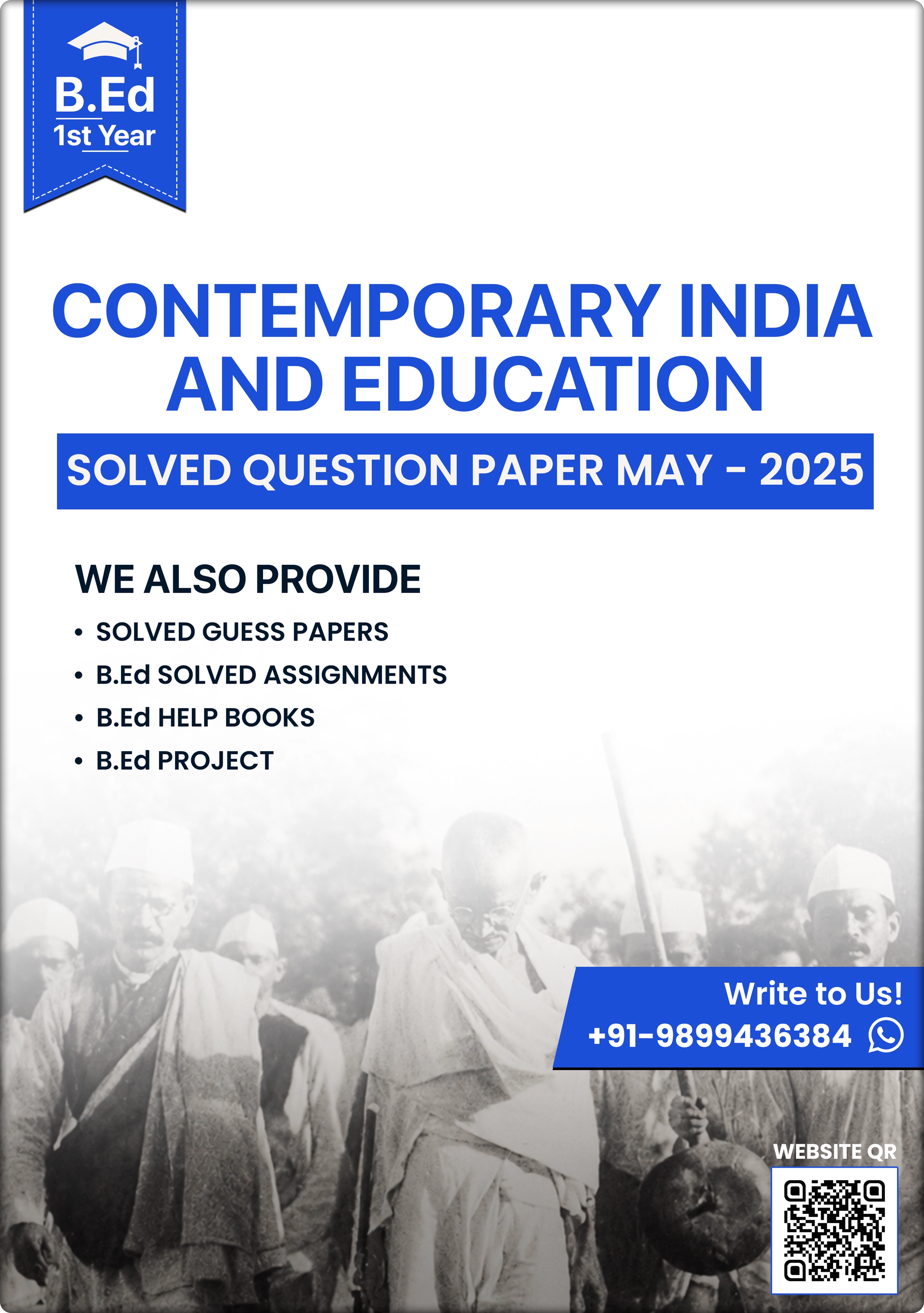
Contemporary India And Education B.Ed Question Paper May 2025 MDU Paper-II
What's Included
Full content delivered instantly
Clean layout, well-structured
Organized for easy revision
Download link delivered immediately
Read anywhere, any device
Course Overview
Contemporary India And Education B.Ed Question Paper May 2025 is the paper where policy turns into marks. This MDU Paper-II expects you to explain the Right to Education Act 2009, weigh the National Policy of Education 1986 and tie Articles 14 and 15 to a real classroom. Treat it as your map of what the examiner keeps asking.
Quick Snapshot of the MDU B.Ed Paper-II Question Paper
- Contemporary India And Education B.Ed Question Paper May 2025 is the official MDU Paper-II in English and Hindi.
- Eighty marks in three hours, five answers to write, with every question carrying equal weight.
- Question one bundles four short notes at four marks each, so easy openers are built in.
- RTE 2009, NPE 1986 and the Secondary Education Commission anchor the descriptive units.
- Schemes like Mid-Day Meal and Sarva Shiksha Abhiyan turn up as eight-mark notes here.
- Unit wise topic list comes straight from this sitting, keeping revision tightly focused.
What is the MDU Contemporary India And Education Paper-II
The Contemporary India And Education B.Ed Question Paper May 2025 is the official MDU Term End paper for B.Ed 1st Year Paper-II, set in English and Hindi, worth 80 marks across three hours with five answers required.
You answer one compulsory short notes question plus one question from each of the four units. The content moves from constitutional provisions to the National Curriculum Framework 2005, then on to commissions, policies, schemes and distance education, mapping the whole Contemporary India And Education syllabus at a glance.
About MDU B.Ed Contemporary India And Education Paper-II
This paper starts with the Constitution, Articles 14 and 15 and the concurrent status of education that places it on both central and state lists, then turns to the National Curriculum Framework 2005 and the Common School System. Democracy and education runs underneath all of it.
Unit by unit it moves through the Right to Education Act 2009, the Secondary Education Commission of 1952-53 and the National Policy of Education 1986, before reaching the Mid-Day Meal Scheme, Sarva Shiksha Abhiyan, open and distance education, the link between culture and education, and universal education with the teacher's role in it.
Set beside the other sittings on the B.Ed 1st year question paper hub, you can see how often the Constitution and the major policies come back.
This page was written by Prateek Talwar and reviewed by Sheetal Kirola, M.Ed., B.Ed Faculty, with the Unnati Educations B.Ed academic team. It draws on the Maharshi Dayanand University (MDU) Examination, May 2025, and covers MDU B.Ed 1st Year, Contemporary India And Education Paper-II. Last updated June 2026.
Contemporary India And Education B.Ed Question Paper May 2025 Marks and Exam Pattern
| Aspect | Detail |
|---|---|
| Medium and language | Bilingual, English and Hindi |
| Duration | 3 hours |
| Total marks | 80 |
| Questions printed | 9 |
| Questions to attempt | Five in all, Question No. 1 compulsory plus one from each of the four units |
| Marks per question | 16 marks each, all questions equal; Question 1 is four notes of 4 marks (4x4=16) and Question 6 is two notes of 8 marks (8x2=16) |
| Type of questions | One compulsory short notes question plus long descriptive answer type questions |
| Language of answers | English or Hindi |
Complete Question Paper Reproduced Below
17102
B.Ed. 1st Year (Two Years) Examination, May-2025
Contemporary India & Education
Paper-II
Time Allowed : 3 hours] [Maximum Marks : 80
Note : Attempt five questions in all, selecting one question from each unit. Question No. 1 is compulsory. All questions carry equal marks.
नोट : प्रत्येक इकाई से एक प्रश्न का चयन करते हुये कुल पाँच प्रश्नों के उत्तर दीजिए। प्रश्न संख्या 1 अनिवार्य है। सभी प्रश्नों के अंक समान हैं।
1. Write short notes on the following : 4×4=16
निम्नलिखित पर संक्षिप्त टिप्पणियाँ लिखिए :
(a) Articles 14 and 15 of the Constitution
संविधान की धारा 14 व 15
(b) Objectives of National Curriculum Framework, 2005
राष्ट्रीय पाठ्यक्रम रूपरेखा, 2005 के उद्देश्य
(c) Common School System
सामान्य विद्यालय प्रणाली
(d) Democracy and Education
प्रजातंत्र एवं शिक्षा
Unit-I / इकाई-I
2. Discuss concurrent status of education in Indian Constitution. 16
भारतीय संविधान में शिक्षा के समवर्ती स्तर पर चर्चा कीजिए।
Or/अथवा
3. Describe the provisions of Right to Education Act, 2009. 16
शिक्षा का अधिकार अधिनियम, 2009 के प्रावधानों का वर्णन कीजिए।
Unit-II / इकाई-II
4. Discuss the recommendations of Secondary Education Commission (1952-53). 16
माध्यमिक शिक्षा आयोग (1952-53) की सिफारिशों पर चर्चा कीजिए।
Or/अथवा
5. Describe various aspects of National Policy of Education, 1986. 16
राष्ट्रीय शिक्षा नीति, 1986 के विभिन्न पहलुओं का वर्णन कीजिए।
Unit-III / इकाई-III
6. Write notes on the following : 8×2=16
निम्नलिखित पर टिप्पणियाँ लिखिए :
(a) Mid-day Meal Scheme
मध्याह्न भोजन योजना
(b) Sarva Shiksha Abhiyan
सर्व शिक्षा अभियान
Or/अथवा
7. What do you mean by Open Learning and Distance Education? What are the objectives of Distance Education? Discuss the merits and limitations of distance education. 16
खुली शिक्षा और दूरस्थ शिक्षा से आपका क्या अभिप्राय है? दूरस्थ शिक्षा के क्या उद्देश्य हैं? दूरस्थ शिक्षा के लाभ और सीमाओं पर चर्चा कीजिए।
Unit-IV / इकाई-IV
8. What do you understand by Culture? Describe the relationship between Culture and Education. 16
संस्कृति से आप क्या समझते हैं? संस्कृति और शिक्षा के बीच सम्बन्ध का वर्णन कीजिए।
Or/अथवा
9. Explain the concept of Universal Education. Discuss the role of teacher in the context of Universal Education. 16
सार्वभौमिक शिक्षा की अवधारणा की व्याख्या कीजिए। सार्वभौमिक शिक्षा के संदर्भ में अध्यापक की भूमिका की चर्चा कीजिए।
Unit Wise Topics in the Contemporary India And Education Paper
Compulsory short notes
- Articles 14 and 15 of the Constitution
- Objectives of the National Curriculum Framework 2005
- The Common School System
- Democracy and education
Unit I
- Concurrent status of education in the Indian Constitution
- Provisions of the Right to Education Act 2009
Unit II
- Recommendations of the Secondary Education Commission 1952-53
- Various aspects of the National Policy of Education 1986
Unit III
- Mid-Day Meal Scheme and Sarva Shiksha Abhiyan
- Open and distance education with its objectives, merits and limitations
Unit IV
- Meaning of culture and the relationship between culture and education
- The concept of universal education and the teacher's role
Smart Ways to Practise This Paper for 2026
Sit one full three-hour mock so writing five answers stops feeling like a sprint at the end. Clear the compulsory short notes first, four quick notes such as Articles 14 and 15 or the Common School System, then give your four best descriptive answers, one from each unit.
For a policy or commission answer, say the Right to Education Act 2009 or the Secondary Education Commission 1952-53, define it, list its key provisions, then add a short line of evaluation. Constitutional provisions, the major education policies and government schemes recur across sittings, so a scan of the MDU question paper hub shows which themes to revise first. The MDU May 2025 examination is your benchmark for 2026.
How to Frame a 16 Mark Answer
Take the provisions of the Right to Education Act 2009. Open with one line of context, the Act that made elementary education a fundamental right for children aged six to fourteen.
Then cover four or five provisions: compulsory schooling at no cost, the 25 percent quota for weaker sections in private schools, norms for infrastructure and pupil teacher ratio, the bar on detention and screening, and the duties of government and local bodies. Add one example, a neighbourhood school admitting children under that quota. Close on what the Act still struggles to deliver. Context, provisions, example, critical close, that is the shape that scores.
Frequently Asked Questions about the Contemporary India And Education B.Ed Question Paper May 2025
Is this the authentic MDU Contemporary India And Education paper?
Yes, this is the real paper Maharshi Dayanand University set for B.Ed 1st Year Contemporary India And Education Paper-II, code 17102, in May 2025. Every question is reproduced word for word in English and Hindi, with the unit structure, the compulsory short notes question, all mark values and each Or option kept exactly as printed, so you revise from the genuine paper.
Will the MDU Contemporary India And Education paper help for the 2026 exam?
A great deal. MDU leans on the same themes year after year, so this sitting is a reliable guide to your 2026 attempt. The Right to Education Act 2009, the National Policy of Education 1986, the Secondary Education Commission 1952-53 and major schemes keep returning, so practising on this B.Ed Contemporary India And Education question paper points you straight at the high yield topics.
Is a solved version of MDU Contemporary India And Education available?
Yes, a solved set of model answers comes with the question paper, built in the context then points then example structure that earns marks. The solved version takes descriptive questions such as the concurrent status of education and the relationship between culture and education and shows how a full 16 mark answer is shaped, so you are not inventing structure under exam pressure.
Does MDU Contemporary India And Education help with notes and important questions too?
It does. The unit wise topic list works as a ready revision checklist, and the recurring themes flag the important questions for Paper-II. You can pair it with the wider B.Ed question paper archive to compare sittings, then build tight notes on the Constitution, NCF 2005, the major policies and the schemes the examiner returns to most.
How fast is delivery for MDU Contemporary India And Education material?
Delivery is quick. After you message us, the Contemporary India And Education B.Ed question paper pdf and any matching material reach you over WhatsApp with no long wait. Since everything is digital there is no posting delay, so you can start practising the same day and fit the paper into your revision plan for the next attempt without losing time.
What support is available?
You can message the Unnati Educations B.Ed team on WhatsApp with any query about the paper, the solved version or the matching notes. The team helps you pick the right material for MDU B.Ed 1st Year, points you to related sittings and answers syllabus questions, so you are not working through Paper-II and its policies and schemes on your own.
Get the Paper and Solved Version on WhatsApp
To get this paper or its solved version, message us on WhatsApp at 9355198199 and 9899436384.
Sources, Disclaimer & Author
Unnati Educations B.Ed is an independent B.Ed study resource platform focused on MDU and other state and central universities.
Unnati Educations is an independent academic support service and is not affiliated with, endorsed by or associated with Maharshi Dayanand University (MDU). The original question paper is the property of MDU and is provided here only as a reference for student practice.
Once Paper-II feels solid, carry the same routine into the B.Ed 2nd year question paper hub and keep your preparation moving.
What's Included
Course Overview
Contemporary India And Education B.Ed Question Paper May 2025 is the paper where policy turns into marks. This MDU Paper-II expects you to explain the Right to Education Act 2009, weigh the National Policy of Education 1986 and tie Articles 14 and 15 to a real classroom. Treat it as your map of what the examiner keeps asking.
Quick Snapshot of the MDU B.Ed Paper-II Question Paper
- Contemporary India And Education B.Ed Question Paper May 2025 is the official MDU Paper-II in English and Hindi.
- Eighty marks in three hours, five answers to write, with every question carrying equal weight.
- Question one bundles four short notes at four marks each, so easy openers are built in.
- RTE 2009, NPE 1986 and the Secondary Education Commission anchor the descriptive units.
- Schemes like Mid-Day Meal and Sarva Shiksha Abhiyan turn up as eight-mark notes here.
- Unit wise topic list comes straight from this sitting, keeping revision tightly focused.
What is the MDU Contemporary India And Education Paper-II
The Contemporary India And Education B.Ed Question Paper May 2025 is the official MDU Term End paper for B.Ed 1st Year Paper-II, set in English and Hindi, worth 80 marks across three hours with five answers required.
You answer one compulsory short notes question plus one question from each of the four units. The content moves from constitutional provisions to the National Curriculum Framework 2005, then on to commissions, policies, schemes and distance education, mapping the whole Contemporary India And Education syllabus at a glance.
About MDU B.Ed Contemporary India And Education Paper-II
This paper starts with the Constitution, Articles 14 and 15 and the concurrent status of education that places it on both central and state lists, then turns to the National Curriculum Framework 2005 and the Common School System. Democracy and education runs underneath all of it.
Unit by unit it moves through the Right to Education Act 2009, the Secondary Education Commission of 1952-53 and the National Policy of Education 1986, before reaching the Mid-Day Meal Scheme, Sarva Shiksha Abhiyan, open and distance education, the link between culture and education, and universal education with the teacher's role in it.
Set beside the other sittings on the B.Ed 1st year question paper hub, you can see how often the Constitution and the major policies come back.
This page was written by Prateek Talwar and reviewed by Sheetal Kirola, M.Ed., B.Ed Faculty, with the Unnati Educations B.Ed academic team. It draws on the Maharshi Dayanand University (MDU) Examination, May 2025, and covers MDU B.Ed 1st Year, Contemporary India And Education Paper-II. Last updated June 2026.
Contemporary India And Education B.Ed Question Paper May 2025 Marks and Exam Pattern
| Aspect | Detail |
|---|---|
| Medium and language | Bilingual, English and Hindi |
| Duration | 3 hours |
| Total marks | 80 |
| Questions printed | 9 |
| Questions to attempt | Five in all, Question No. 1 compulsory plus one from each of the four units |
| Marks per question | 16 marks each, all questions equal; Question 1 is four notes of 4 marks (4x4=16) and Question 6 is two notes of 8 marks (8x2=16) |
| Type of questions | One compulsory short notes question plus long descriptive answer type questions |
| Language of answers | English or Hindi |
Complete Question Paper Reproduced Below
17102
B.Ed. 1st Year (Two Years) Examination, May-2025
Contemporary India & Education
Paper-II
Time Allowed : 3 hours] [Maximum Marks : 80
Note : Attempt five questions in all, selecting one question from each unit. Question No. 1 is compulsory. All questions carry equal marks.
नोट : प्रत्येक इकाई से एक प्रश्न का चयन करते हुये कुल पाँच प्रश्नों के उत्तर दीजिए। प्रश्न संख्या 1 अनिवार्य है। सभी प्रश्नों के अंक समान हैं।
1. Write short notes on the following : 4×4=16
निम्नलिखित पर संक्षिप्त टिप्पणियाँ लिखिए :
(a) Articles 14 and 15 of the Constitution
संविधान की धारा 14 व 15
(b) Objectives of National Curriculum Framework, 2005
राष्ट्रीय पाठ्यक्रम रूपरेखा, 2005 के उद्देश्य
(c) Common School System
सामान्य विद्यालय प्रणाली
(d) Democracy and Education
प्रजातंत्र एवं शिक्षा
Unit-I / इकाई-I
2. Discuss concurrent status of education in Indian Constitution. 16
भारतीय संविधान में शिक्षा के समवर्ती स्तर पर चर्चा कीजिए।
Or/अथवा
3. Describe the provisions of Right to Education Act, 2009. 16
शिक्षा का अधिकार अधिनियम, 2009 के प्रावधानों का वर्णन कीजिए।
Unit-II / इकाई-II
4. Discuss the recommendations of Secondary Education Commission (1952-53). 16
माध्यमिक शिक्षा आयोग (1952-53) की सिफारिशों पर चर्चा कीजिए।
Or/अथवा
5. Describe various aspects of National Policy of Education, 1986. 16
राष्ट्रीय शिक्षा नीति, 1986 के विभिन्न पहलुओं का वर्णन कीजिए।
Unit-III / इकाई-III
6. Write notes on the following : 8×2=16
निम्नलिखित पर टिप्पणियाँ लिखिए :
(a) Mid-day Meal Scheme
मध्याह्न भोजन योजना
(b) Sarva Shiksha Abhiyan
सर्व शिक्षा अभियान
Or/अथवा
7. What do you mean by Open Learning and Distance Education? What are the objectives of Distance Education? Discuss the merits and limitations of distance education. 16
खुली शिक्षा और दूरस्थ शिक्षा से आपका क्या अभिप्राय है? दूरस्थ शिक्षा के क्या उद्देश्य हैं? दूरस्थ शिक्षा के लाभ और सीमाओं पर चर्चा कीजिए।
Unit-IV / इकाई-IV
8. What do you understand by Culture? Describe the relationship between Culture and Education. 16
संस्कृति से आप क्या समझते हैं? संस्कृति और शिक्षा के बीच सम्बन्ध का वर्णन कीजिए।
Or/अथवा
9. Explain the concept of Universal Education. Discuss the role of teacher in the context of Universal Education. 16
सार्वभौमिक शिक्षा की अवधारणा की व्याख्या कीजिए। सार्वभौमिक शिक्षा के संदर्भ में अध्यापक की भूमिका की चर्चा कीजिए।
Unit Wise Topics in the Contemporary India And Education Paper
Compulsory short notes
- Articles 14 and 15 of the Constitution
- Objectives of the National Curriculum Framework 2005
- The Common School System
- Democracy and education
Unit I
- Concurrent status of education in the Indian Constitution
- Provisions of the Right to Education Act 2009
Unit II
- Recommendations of the Secondary Education Commission 1952-53
- Various aspects of the National Policy of Education 1986
Unit III
- Mid-Day Meal Scheme and Sarva Shiksha Abhiyan
- Open and distance education with its objectives, merits and limitations
Unit IV
- Meaning of culture and the relationship between culture and education
- The concept of universal education and the teacher's role
Smart Ways to Practise This Paper for 2026
Sit one full three-hour mock so writing five answers stops feeling like a sprint at the end. Clear the compulsory short notes first, four quick notes such as Articles 14 and 15 or the Common School System, then give your four best descriptive answers, one from each unit.
For a policy or commission answer, say the Right to Education Act 2009 or the Secondary Education Commission 1952-53, define it, list its key provisions, then add a short line of evaluation. Constitutional provisions, the major education policies and government schemes recur across sittings, so a scan of the MDU question paper hub shows which themes to revise first. The MDU May 2025 examination is your benchmark for 2026.
How to Frame a 16 Mark Answer
Take the provisions of the Right to Education Act 2009. Open with one line of context, the Act that made elementary education a fundamental right for children aged six to fourteen.
Then cover four or five provisions: compulsory schooling at no cost, the 25 percent quota for weaker sections in private schools, norms for infrastructure and pupil teacher ratio, the bar on detention and screening, and the duties of government and local bodies. Add one example, a neighbourhood school admitting children under that quota. Close on what the Act still struggles to deliver. Context, provisions, example, critical close, that is the shape that scores.
Frequently Asked Questions about the Contemporary India And Education B.Ed Question Paper May 2025
Is this the authentic MDU Contemporary India And Education paper?
Yes, this is the real paper Maharshi Dayanand University set for B.Ed 1st Year Contemporary India And Education Paper-II, code 17102, in May 2025. Every question is reproduced word for word in English and Hindi, with the unit structure, the compulsory short notes question, all mark values and each Or option kept exactly as printed, so you revise from the genuine paper.
Will the MDU Contemporary India And Education paper help for the 2026 exam?
A great deal. MDU leans on the same themes year after year, so this sitting is a reliable guide to your 2026 attempt. The Right to Education Act 2009, the National Policy of Education 1986, the Secondary Education Commission 1952-53 and major schemes keep returning, so practising on this B.Ed Contemporary India And Education question paper points you straight at the high yield topics.
Is a solved version of MDU Contemporary India And Education available?
Yes, a solved set of model answers comes with the question paper, built in the context then points then example structure that earns marks. The solved version takes descriptive questions such as the concurrent status of education and the relationship between culture and education and shows how a full 16 mark answer is shaped, so you are not inventing structure under exam pressure.
Does MDU Contemporary India And Education help with notes and important questions too?
It does. The unit wise topic list works as a ready revision checklist, and the recurring themes flag the important questions for Paper-II. You can pair it with the wider B.Ed question paper archive to compare sittings, then build tight notes on the Constitution, NCF 2005, the major policies and the schemes the examiner returns to most.
How fast is delivery for MDU Contemporary India And Education material?
Delivery is quick. After you message us, the Contemporary India And Education B.Ed question paper pdf and any matching material reach you over WhatsApp with no long wait. Since everything is digital there is no posting delay, so you can start practising the same day and fit the paper into your revision plan for the next attempt without losing time.
What support is available?
You can message the Unnati Educations B.Ed team on WhatsApp with any query about the paper, the solved version or the matching notes. The team helps you pick the right material for MDU B.Ed 1st Year, points you to related sittings and answers syllabus questions, so you are not working through Paper-II and its policies and schemes on your own.
Get the Paper and Solved Version on WhatsApp
To get this paper or its solved version, message us on WhatsApp at 9355198199 and 9899436384.
Sources, Disclaimer & Author
Unnati Educations B.Ed is an independent B.Ed study resource platform focused on MDU and other state and central universities.
Unnati Educations is an independent academic support service and is not affiliated with, endorsed by or associated with Maharshi Dayanand University (MDU). The original question paper is the property of MDU and is provided here only as a reference for student practice.
Once Paper-II feels solid, carry the same routine into the B.Ed 2nd year question paper hub and keep your preparation moving.