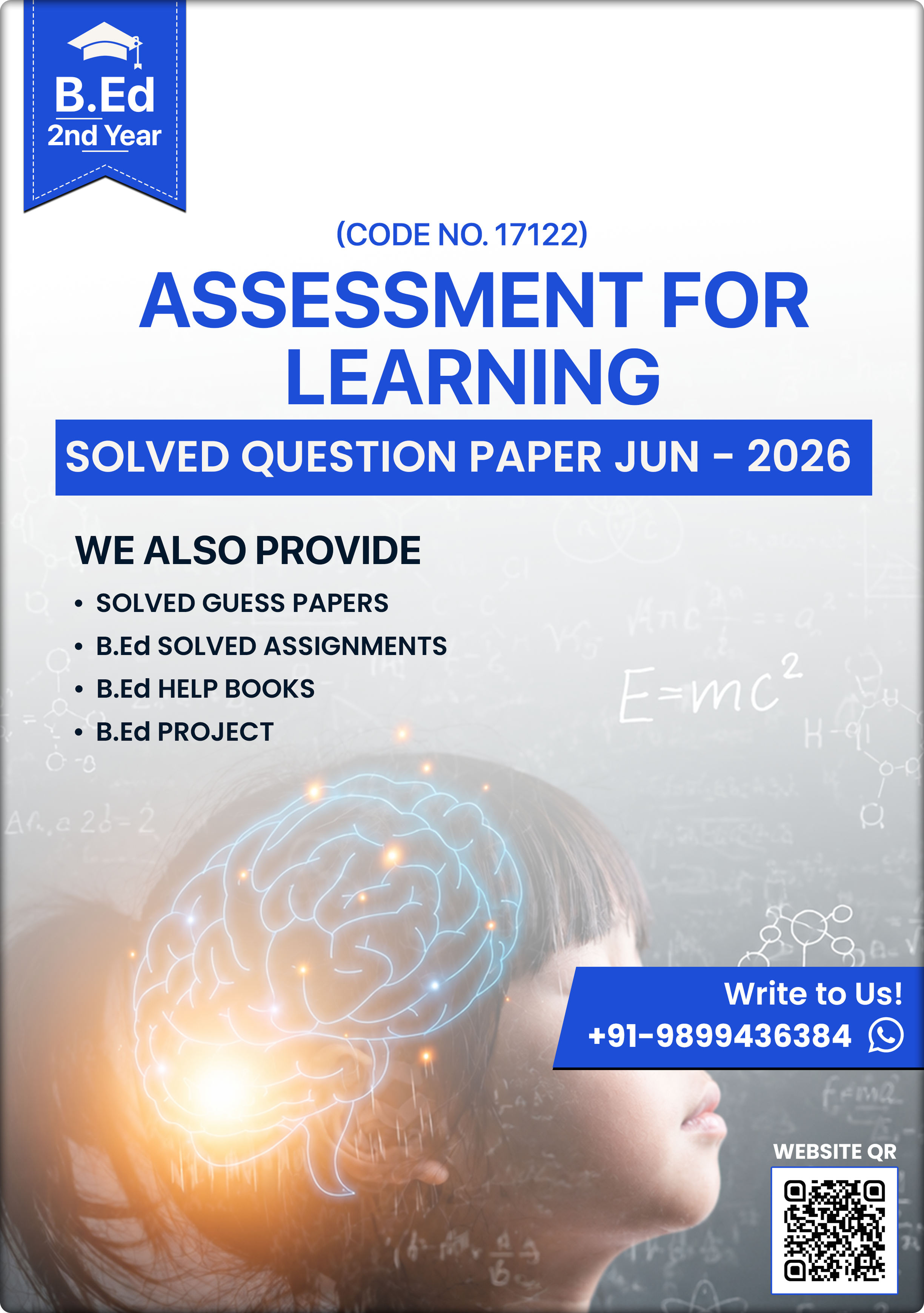
MDU B.Ed 2nd Year Assessment for Learning (17122) Solved Question Paper June 2026
What's Included
Full content delivered instantly
Clean layout, well-structured
Organized for easy revision
Download link delivered immediately
Read anywhere, any device
Course Overview
Product Highlights
- MDU B.Ed Assessment for Learning Question Paper 2026 (code 17122, Paper II) with all 9 questions exactly as printed.
- Q4 on formative vs summative assessment is fully solved here with a comparison table and a Class 8 Indian classroom example.
- 1 answer is shown on this page and the other 8 answers, including the four Q1 short notes, are in the full solved file.
- Compulsory Q1 asks four short notes: diagnostic assessment, observation, self and peer assessment, and feedback.
- Unit I asks about the importance and principles of assessment, or the Revised Bloom's Taxonomy for instructional objectives.
- Unit II pairs formative vs summative assessment with achievement test planning, a blueprint and objective vs subjective tests.
- Unit III offers diagnostic and remedial teaching or assessment issues at different stages and in design and conduct.
- Unit IV offers four scales of measurement or a numerical on the mean and median of 11 psychology exam marks out of 100.
| University | Maharshi Dayanand University (MDU), Rohtak |
|---|---|
| Programme | B.Ed (Two Years) |
| Year | 2nd Year |
| Paper code | 17122 |
| Paper number | II |
| Subject | Assessment for Learning (printed on the cover as "ASSESSMENT FQR LEARNING") |
| Exam session | June 2026 (cover prints "Examination, 2026") |
| Time | Three Hours |
| Maximum marks (theory paper) | 80 |
| Total marks | 100: theory 80, internal 20 (task or assignment 10, test 5, attendance 5) |
| Credits | 4 |
| Total questions | 9 |
| Attempt rule | Attempt Five questions in all, selecting one question from each Unit. Q. No. 1 is compulsory. All questions carry equal marks. |
| Unit structure | Q1 compulsory (four short notes), then Units I to IV with two questions each |
| Marks per question | 16 each; Q1 is four short answers of 4 marks each (as per the MDU B.Ed scheme) |
| Solved on this page | 1 (Q4) |
| In full solved file | 8 |
| Paper language | Bilingual, English and Hindi |
Assessment for Learning (17122) June 2026 Paper: Key Facts at a Glance
MDU B.Ed Assessment for Learning Question Paper 2026 is the June 2026 theory paper for Assessment for Learning (code 17122, Paper II), the MDU B.Ed 2nd-year subject on how teachers plan, collect and use evidence of what students have learnt.
This page covers the MDU B.Ed 2nd year Assessment for Learning paper June 2026 in full: all nine questions as printed, Q4 solved completely, and a clear route to the rest. Students often search for it as "B.Ed Assessment for Learning question paper solved kaise milega", and each section below answers part of that directly.
This is the most practical theory paper of the second year. The tests, checklists and report-card thinking it covers are what you use during internship and in your first job. For earlier sessions of every subject, our B.Ed Question Paper archive keeps them in one place.
MDU B.Ed Assessment for Learning Question Paper 2026: All 9 Questions
The June 2026 Assessment for Learning paper has 9 questions: one compulsory question with four short notes, then two questions in each of Units I to IV, and you attempt five.
The 17122 question paper is reproduced below exactly as printed in English. The Hindi version under each question is not repeated here, but for Hindi-medium readers this is the complete अधिगम के लिए आकलन प्रश्न पत्र for June 2026. The paper prints no "Or" between questions. The choice comes from the rule of one question per unit.
Compulsory Question in 17122 (Q1)
1. Write short notes on the following :
(a) Diagnostic assessment
(b) Observation as an assessment tool
(c) Self-assessment and peer-assessment
(d) Importance of Feedback in learning.
Unit I of 17122: Assessment, Measurement, Evaluation and Revised Taxonomy (Q2, Q3)
2. Discuss the importance and principles of assessment in the teaching-learning process.
3. Explain the Revised Bloom's Taxonomy (2000) and its use in instructional objectives.
Unit II of 17122: Tools and Techniques (Q4, Q5)
4. Differentiate between formative and summative assessment with examples. Why it is important to use both in the teaching-learning process ?
5. Explain the process of planning and preparing an achievement test, including a blueprint. Differentiate between objective and subjective type tests.
Unit III of 17122: New Trends and Issues in Assessment (Q6, Q7)
6. What is diagnostic and remedial teaching ? How does it support qualitative assessment ?
7. Discuss the following issues in assessment :
(a) Assessment at different stages
(b) Design and conduct of assessment.
Unit IV of 17122: Statistical Methods and Interpretation of Scores (Q8, Q9)
8. Differentiate between nominal, ordinal, interval, and ratio scales of measurement. How are they used in educational assessment ?
9. 11 college students appeared in a psychology exam. Their marks out of 100 are :
72, 65, 78, 80, 68, 70, 75, 82, 60, 77, 74
Find the mean and the median of these marks.
MDU B.Ed Assessment for Learning Question Paper 2026 Solved: Q4 with Full Answer
Q4 is solved in full below because formative versus summative assessment is the idea the rest of this Assessment for Learning paper builds on.
Read it as a sample of the Assessment for Learning solved question paper: the same structure, depth and checking run through all nine answers in the full file.
Q4. Differentiate between formative and summative assessment with examples. Why it is important to use both in the teaching-learning process ?
Introduction
Assessment is the planned collection of evidence about what learners know and can do, and the use of that evidence to make decisions. "Formative" and "summative" name two purposes of assessment, not two kinds of test paper.
Michael Scriven introduced the terms in 1967 while writing about curriculum evaluation. Benjamin Bloom, J. Thomas Hastings and George Madaus applied them to classroom learning in their 1971 handbook on evaluating student learning.
Formative assessment
Formative assessment happens during teaching, while learning is still in progress. It aims to find out what students have understood, spot gaps early and adjust teaching before the unit ends. It is assessment for learning: informal, frequent and low-stakes, and its value lies in the feedback that follows.
Paul Black and Dylan Wiliam's 1998 review, Inside the Black Box, concluded that well-used formative assessment raises achievement. Examples include oral questioning in class, a two-minute exit slip, observing group work with a checklist, written comments on homework and a short quiz after a sub-topic.
Summative assessment
Summative assessment happens at the end of a unit, term or course. It aims to judge and record how much has been learnt, usually as marks or grades for a report card or certificate. It is assessment of learning: formal, less frequent and higher-stakes.
Examples include half-yearly and annual school examinations, CBSE Class 10 and 12 board examinations, MDU's own B.Ed annual theory papers and a graded end-of-term project. Robert Stake's well-known comparison fits: when the cook tastes the soup it is formative, and when the guests taste it, it is summative.
| Basis | Formative assessment | Summative assessment |
|---|---|---|
| Purpose | Improve learning while it happens | Judge and certify learning at the end |
| Timing | During teaching, continuously | End of unit, term or course |
| Nature | Informal and flexible | Formal and standardised |
| Frequency | Daily or weekly | Once or twice a term |
| Stakes | Low; marks often not recorded | High; marks decide result or promotion |
| Use of results | Immediate feedback and reteaching | Grading, reporting and certification |
| Focus | Process of learning and specific gaps | Product of learning and overall achievement |
| Typical tools | Questioning, observation, quizzes, exit slips | Term exams, board exams, final projects |
| Classroom example | Exit slip after a lesson on fractions | Annual mathematics examination |
Indian classroom example
A Class 8 science teacher in a Haryana government school is teaching the laws of reflection. After the first lesson, all 40 students draw a ray diagram. She finds that 12 of them measure the angle of incidence from the mirror instead of from the normal. Next day she reteaches with a protractor activity and rechecks those 12. That is formative assessment.
At the end of term, a question on the laws of reflection in the half-yearly examination is marked and entered in the report card. That is summative assessment. The topic is the same; the purpose and the use of the result differ.
Diagram to draw
Draw a cycle: Teach → Formative check → Feedback and reteaching → Teach the next part, repeating through the unit, then an arrow out to Summative test → Grade and report → Results guide next year's planning. Label the loop "assessment for learning" and the end point "assessment of learning".
Why both are important in the teaching-learning process
1. Different jobs. Formative assessment improves learning while there is still time. Summative assessment tells students, parents and institutions what has been achieved. Neither can do the other's work.
2. Better final results. Gaps closed in the second week do not turn into lost marks in March, so summative results become fairer and less of a surprise.
3. A complete picture of the learner. Formative evidence shows how a child learns; summative evidence shows what the child finally learnt. Seeing only one shows half the learner.
4. Policy expects both. Section 29(2)(h) of the RTE Act, 2009 requires comprehensive and continuous evaluation. CBSE's earlier CCE scheme gave formative assessments 40 per cent and summative assessments 60 per cent of the weight. NEP 2020 asks for regular, competency-based formative assessment alongside reformed board exams.
5. Guidance for the teacher. Formative results change tomorrow's lesson. Summative results show whether the whole unit, textbook or method worked.
6. Balanced pressure. Frequent low-stakes checks reduce exam fear, while a final summative goal keeps students serious about the course.
7. Summative data used formatively. When a teacher studies half-yearly scripts to plan remedial classes, one test serves both purposes.
Conclusion
Formative and summative assessment are two ends of one process. The first keeps learning on track and the second confirms where it arrived. A teacher who plans both in every unit teaches better and reports results more honestly, which is exactly what the Assessment for Learning course sets out to build.
How Is the Assessment for Learning Paper Structured? Question Types and Choice Rule
The Assessment for Learning paper asks you to attempt 5 of its 9 questions: compulsory Q1 plus one question from each of the four units, each worth 16 marks.
| Section | Questions available | How many to attempt | Marks | Expected answer length |
|---|---|---|---|---|
| Compulsory | Q1, parts (a) to (d) | All four parts | 16 (four parts of 4 marks each, per MDU scheme) | About 150 to 200 words per part |
| Unit I | Q2, Q3 | 1 | 16 | About 700 to 900 words |
| Unit II | Q4, Q5 | 1 | 16 | About 700 to 900 words |
| Unit III | Q6, Q7 (parts a and b) | 1 | 16 | About 700 to 900 words |
| Unit IV | Q8, Q9 (numerical) | 1 | 16 | 700 to 900 words for Q8; full working for Q9 |
| Total | 9 | 5 | 80 | Three hours |
The internal choice sits inside each unit: two questions, pick one. Skipping a unit is not allowed, even if you answer both questions of another unit.
The paper itself prints no split for Q1, but the MDU B.Ed scheme fixes it as four short answers of 4 marks each. Unit questions carry no printed split such as 8,8 or 4,12 either. Where a question has two demands, give each a clear heading and a fair share of the 16 marks. A printed 8,8 would mean two equal halves of about 400 words each, and that is a sensible default here too.
Assessment for Learning June 2026 Paper Analysis: Difficulty and Unit-wise Coverage
The June 2026 Assessment for Learning paper is of moderate difficulty: the questions are mostly direct theory, but all eight unit questions carry two demands and one is a numerical.
| Unit | Syllabus topics (2 to 3) | Questions from this paper | Question type |
|---|---|---|---|
| Compulsory | Four 4-mark short answers set from the entire syllabus | Q1 (a) to (d): parts (b), (c) and (d) from Unit II topics, part (a) from Unit III | Direct, four short notes |
| Unit I: Assessment, Measurement, Evaluation and Revised Taxonomy | Importance and principles of assessment; NCF 2005 vision of assessment for learning; Revised Bloom's Taxonomy (2000) for instructional objectives | Q2, Q3 | Direct, two-part |
| Unit II: Tools and Techniques | Formative and summative approaches; tools of evaluation such as observation and rating scales; achievement test planning including blueprint | Q4, Q5 | Comparison with justification; process plus comparison |
| Unit III: New Trends and Issues in Assessment | New trends such as grading, question bank and open book system; diagnostic and remedial teaching for qualitative assessment; issues in assessment | Q6, Q7 | Concept plus link; two printed sub-parts |
| Unit IV: Statistical Methods and Interpretation of Scores | Scales of measurement; mean, median and mode; variability, normal curve and correlation | Q8, Q9 | Comparison plus application; numerical application |
Q1: easy to moderate. All four notes are standard terms, and diagnostic assessment reappears in Unit III.
Unit I: moderate. Both questions are direct theory, but half-remembered category names cost marks.
Unit II: moderate to demanding. Q4 is a familiar comparison, while Q5 combines a full process with a comparison, the heaviest answer in the paper.
Unit III: moderate. Both questions reward understanding over memorised definitions.
Unit IV: the most scoring unit for students comfortable with basic arithmetic, since Q9 is a straight numerical.
These unit topics come from the official MDU B.Ed (Two Years) scheme and syllabus, which also fixes theory at 80 marks and internal assessment at 20. The June 2026 paper follows its unit order exactly.
Assessment for Learning Topics Asked in June 2026 and Why They Matter
Every topic in the June 2026 Assessment for Learning paper links to real work a B.Ed trainee does in school, from unit tests to report cards.
| Topic asked | Where it appears | Why it matters for a trainee teacher |
|---|---|---|
| Diagnostic assessment and remedial teaching | Q1(a), Q6 | Asked twice in this paper and also an internal assignment option |
| Observation, self and peer assessment | Q1(b), Q1(c) | Used in internship lessons when there is no written test |
| Feedback in learning | Q1(d) | Connects each class check to the next lesson |
| Importance and principles of assessment | Q2 | The ground rules behind every test you set |
| Revised Bloom's Taxonomy | Q3 | Used to frame objectives in every lesson plan |
| Formative and summative assessment | Q4 | Decides how class tests and term exams are mixed |
| Achievement test and blueprint | Q5 | Also an internal assignment option: an achievement test and its analysis |
| Assessment at different stages; design and conduct | Q7 | Covers fairness from primary to senior secondary |
| Scales of measurement | Q8 | Comes up whenever marks become grades or ranks |
| Mean and median | Q9 | The first calculation on any set of class marks |
Use this table as your B.Ed Assessment for Learning important questions checklist: if you can write confidently on each row, no question in this paper will catch you off guard.
How to Write Short and Long Answers in Assessment for Learning
In Assessment for Learning, short notes need about 150 to 200 words each and 16-mark answers about 700 to 900 words, built on a definition, a table or diagram and a classroom example.
For each Q1 note, define the term in the first line, give two or three features and add one classroom example. Stop there. Each note carries 4 marks under the MDU scheme, so one long note and three thin ones lose more than they gain.
For long answers, open with a definition, then use headed points. Any "differentiate" question in this subject is best answered with a table, and any process reads well as a labelled flow or cycle diagram. Examiners in this paper look for structure before length.
Named thinkers earn credit only where they belong: Scriven for formative and summative, Bloom for objectives, Black and Wiliam for feedback. Policy anchors such as the RTE Act, 2009, NCF 2005 and NEP 2020 help when linked to the point you are making, not dropped in a list.
An Indian classroom example, with a class, a subject and a real number of students, is the quickest way to show understanding. For the Unit IV numerical, write every step of working clearly. For more topic-wise practice, see our B.Ed Important Questions for MDU.
Assessment for Learning Complete Solved Paper: What's Inside and How to Get It
The complete Assessment for Learning solved paper contains answers to all 9 questions: Q4 is shown on this page and the other 8 are in the full file.
The full MDU B.Ed Assessment for Learning Question Paper 2026 solution follows the same standard as the Q4 answer above, question for question.
| Q no. | Topic | Marks | Status |
|---|---|---|---|
| 1 | Short notes: diagnostic assessment, observation, self and peer assessment, feedback | 16 | In full file |
| 2 | Importance and principles of assessment | 16 | In full file |
| 3 | Revised Bloom's Taxonomy and instructional objectives | 16 | In full file |
| 4 | Formative vs summative assessment and why both are needed | 16 | Shown |
| 5 | Achievement test planning with blueprint; objective vs subjective tests | 16 | In full file |
| 6 | Diagnostic and remedial teaching and qualitative assessment | 16 | In full file |
| 7 | Assessment at different stages; design and conduct of assessment | 16 | In full file |
| 8 | Nominal, ordinal, interval and ratio scales | 16 | In full file |
| 9 | Mean and median of 11 psychology exam marks | 16 | In full file |
| Total: 9 questions | 1 shown + 8 in full file | ||
Getting it takes three steps. Tap the button below, which opens WhatsApp with a ready message, or write to 9899436384 yourself. Confirm the subject and code 17122 so the right file comes to you. Our team then replies on the same chat with the file details and how to receive the PDF.
Get the complete solved paper on WhatsApp
More MDU B.Ed 2nd Year Papers Like Assessment for Learning: PYQs and Important Questions
Assessment for Learning connects closely with the other second-year theory papers, so revising them together saves time.
Knowledge and Curriculum shares the planning of objectives and content. Creating an Inclusive School uses diagnostic tools and remedial support for varied learners. Language Across the Curriculum links through classroom questioning and feedback. Sessions of all three sit in our B.Ed 2nd year Question Paper collection.
If you still have a first-year paper to clear, the B.Ed 1st year Question Paper set covers the psychology papers where ideas like learner differences first appear.
Assessment for Learning June 2026 Paper FAQs
These answers cover what students ask most about the 17122 Assessment for Learning paper.
What is the exam pattern of the MDU B.Ed Assessment for Learning (17122) June 2026 paper?
The 17122 paper has nine questions, of which you attempt five for 80 marks in three hours. Q1 is compulsory and has four short notes. Questions 2 to 9 sit in four units, two per unit, and you choose one from each unit. All five attempted questions carry equal marks, so each is worth 16. The paper does not print an Or between unit questions; the unit rule creates the choice.
Which unit of the Assessment for Learning 17122 paper offers the most choice?
Every unit of the Assessment for Learning paper offers the same choice in print: two questions, attempt one. The real difference is in type. Unit IV gives the widest contrast, a theory question on scales of measurement or a numerical on mean and median. Units II and III lean on two-part questions, so pick the one where you can handle both demands fully.
How long should answers be in the MDU B.Ed Assessment for Learning exam?
Aim for about 150 to 200 words for each of the four Q1 short notes in Assessment for Learning, and about 700 to 900 words for each 16-mark unit question. With five answers in three hours, that leaves roughly 35 minutes per question. For the numerical in Unit IV, length matters less than clear, step-by-step working set out neatly.
Is the Assessment for Learning 17122 question paper bilingual?
Yes. The June 2026 Assessment for Learning paper prints every question in English followed by its Hindi version, and the cover instructions appear in both languages too. Write in the medium you normally use and keep to one language within an answer. Hindi-medium students should still learn English terms such as formative, summative and nominal scale, because examiners recognise them at once.
Which Assessment for Learning question is solved on this page?
Q4 from Unit II is solved in full: the difference between formative and summative assessment with examples, and why both are needed in the teaching-learning process. The Assessment for Learning answer includes a comparison table, a Class 8 science example from an Indian school, references to Scriven and Bloom, and the RTE Act 2009 and NEP 2020 angle that examiners reward.
How do I get the full Assessment for Learning 17122 solved paper?
Send a message on WhatsApp to 9899436384 asking for the MDU B.Ed Assessment for Learning solved paper, June 2026. The full file contains answers to all 9 questions: the Q4 answer shown here plus the 8 remaining answers, including all four Q1 short notes and the Unit IV numerical with complete working. Our team replies with the file details and how to receive it.
Is there a numerical question in the Assessment for Learning 17122 paper?
Yes. Q9 in Unit IV of the Assessment for Learning paper gives the marks of 11 college students in a psychology exam, out of 100, and asks for the mean and the median. It is the only numerical in the June 2026 paper. Students who pick it should set out every step clearly, because examiners mark the method as well as the final figures.
Does the 17122 Assessment for Learning paper print marks for each Q1 part?
No, the June 2026 Assessment for Learning paper only says that all questions carry equal marks. The split comes from the MDU B.Ed scheme, which sets Q1 as four short-answer questions of 4 marks each, 16 in total. Give each note a similar share of time, about eight to nine minutes, rather than writing one long note and three thin ones.
Unnati Educations is an independent study-material provider and is not affiliated with Maharshi Dayanand University.
What's Included
Course Overview
Product Highlights
- MDU B.Ed Assessment for Learning Question Paper 2026 (code 17122, Paper II) with all 9 questions exactly as printed.
- Q4 on formative vs summative assessment is fully solved here with a comparison table and a Class 8 Indian classroom example.
- 1 answer is shown on this page and the other 8 answers, including the four Q1 short notes, are in the full solved file.
- Compulsory Q1 asks four short notes: diagnostic assessment, observation, self and peer assessment, and feedback.
- Unit I asks about the importance and principles of assessment, or the Revised Bloom's Taxonomy for instructional objectives.
- Unit II pairs formative vs summative assessment with achievement test planning, a blueprint and objective vs subjective tests.
- Unit III offers diagnostic and remedial teaching or assessment issues at different stages and in design and conduct.
- Unit IV offers four scales of measurement or a numerical on the mean and median of 11 psychology exam marks out of 100.
| University | Maharshi Dayanand University (MDU), Rohtak |
|---|---|
| Programme | B.Ed (Two Years) |
| Year | 2nd Year |
| Paper code | 17122 |
| Paper number | II |
| Subject | Assessment for Learning (printed on the cover as "ASSESSMENT FQR LEARNING") |
| Exam session | June 2026 (cover prints "Examination, 2026") |
| Time | Three Hours |
| Maximum marks (theory paper) | 80 |
| Total marks | 100: theory 80, internal 20 (task or assignment 10, test 5, attendance 5) |
| Credits | 4 |
| Total questions | 9 |
| Attempt rule | Attempt Five questions in all, selecting one question from each Unit. Q. No. 1 is compulsory. All questions carry equal marks. |
| Unit structure | Q1 compulsory (four short notes), then Units I to IV with two questions each |
| Marks per question | 16 each; Q1 is four short answers of 4 marks each (as per the MDU B.Ed scheme) |
| Solved on this page | 1 (Q4) |
| In full solved file | 8 |
| Paper language | Bilingual, English and Hindi |
Assessment for Learning (17122) June 2026 Paper: Key Facts at a Glance
MDU B.Ed Assessment for Learning Question Paper 2026 is the June 2026 theory paper for Assessment for Learning (code 17122, Paper II), the MDU B.Ed 2nd-year subject on how teachers plan, collect and use evidence of what students have learnt.
This page covers the MDU B.Ed 2nd year Assessment for Learning paper June 2026 in full: all nine questions as printed, Q4 solved completely, and a clear route to the rest. Students often search for it as "B.Ed Assessment for Learning question paper solved kaise milega", and each section below answers part of that directly.
This is the most practical theory paper of the second year. The tests, checklists and report-card thinking it covers are what you use during internship and in your first job. For earlier sessions of every subject, our B.Ed Question Paper archive keeps them in one place.
MDU B.Ed Assessment for Learning Question Paper 2026: All 9 Questions
The June 2026 Assessment for Learning paper has 9 questions: one compulsory question with four short notes, then two questions in each of Units I to IV, and you attempt five.
The 17122 question paper is reproduced below exactly as printed in English. The Hindi version under each question is not repeated here, but for Hindi-medium readers this is the complete अधिगम के लिए आकलन प्रश्न पत्र for June 2026. The paper prints no "Or" between questions. The choice comes from the rule of one question per unit.
Compulsory Question in 17122 (Q1)
1. Write short notes on the following :
(a) Diagnostic assessment
(b) Observation as an assessment tool
(c) Self-assessment and peer-assessment
(d) Importance of Feedback in learning.
Unit I of 17122: Assessment, Measurement, Evaluation and Revised Taxonomy (Q2, Q3)
2. Discuss the importance and principles of assessment in the teaching-learning process.
3. Explain the Revised Bloom's Taxonomy (2000) and its use in instructional objectives.
Unit II of 17122: Tools and Techniques (Q4, Q5)
4. Differentiate between formative and summative assessment with examples. Why it is important to use both in the teaching-learning process ?
5. Explain the process of planning and preparing an achievement test, including a blueprint. Differentiate between objective and subjective type tests.
Unit III of 17122: New Trends and Issues in Assessment (Q6, Q7)
6. What is diagnostic and remedial teaching ? How does it support qualitative assessment ?
7. Discuss the following issues in assessment :
(a) Assessment at different stages
(b) Design and conduct of assessment.
Unit IV of 17122: Statistical Methods and Interpretation of Scores (Q8, Q9)
8. Differentiate between nominal, ordinal, interval, and ratio scales of measurement. How are they used in educational assessment ?
9. 11 college students appeared in a psychology exam. Their marks out of 100 are :
72, 65, 78, 80, 68, 70, 75, 82, 60, 77, 74
Find the mean and the median of these marks.
MDU B.Ed Assessment for Learning Question Paper 2026 Solved: Q4 with Full Answer
Q4 is solved in full below because formative versus summative assessment is the idea the rest of this Assessment for Learning paper builds on.
Read it as a sample of the Assessment for Learning solved question paper: the same structure, depth and checking run through all nine answers in the full file.
Q4. Differentiate between formative and summative assessment with examples. Why it is important to use both in the teaching-learning process ?
Introduction
Assessment is the planned collection of evidence about what learners know and can do, and the use of that evidence to make decisions. "Formative" and "summative" name two purposes of assessment, not two kinds of test paper.
Michael Scriven introduced the terms in 1967 while writing about curriculum evaluation. Benjamin Bloom, J. Thomas Hastings and George Madaus applied them to classroom learning in their 1971 handbook on evaluating student learning.
Formative assessment
Formative assessment happens during teaching, while learning is still in progress. It aims to find out what students have understood, spot gaps early and adjust teaching before the unit ends. It is assessment for learning: informal, frequent and low-stakes, and its value lies in the feedback that follows.
Paul Black and Dylan Wiliam's 1998 review, Inside the Black Box, concluded that well-used formative assessment raises achievement. Examples include oral questioning in class, a two-minute exit slip, observing group work with a checklist, written comments on homework and a short quiz after a sub-topic.
Summative assessment
Summative assessment happens at the end of a unit, term or course. It aims to judge and record how much has been learnt, usually as marks or grades for a report card or certificate. It is assessment of learning: formal, less frequent and higher-stakes.
Examples include half-yearly and annual school examinations, CBSE Class 10 and 12 board examinations, MDU's own B.Ed annual theory papers and a graded end-of-term project. Robert Stake's well-known comparison fits: when the cook tastes the soup it is formative, and when the guests taste it, it is summative.
| Basis | Formative assessment | Summative assessment |
|---|---|---|
| Purpose | Improve learning while it happens | Judge and certify learning at the end |
| Timing | During teaching, continuously | End of unit, term or course |
| Nature | Informal and flexible | Formal and standardised |
| Frequency | Daily or weekly | Once or twice a term |
| Stakes | Low; marks often not recorded | High; marks decide result or promotion |
| Use of results | Immediate feedback and reteaching | Grading, reporting and certification |
| Focus | Process of learning and specific gaps | Product of learning and overall achievement |
| Typical tools | Questioning, observation, quizzes, exit slips | Term exams, board exams, final projects |
| Classroom example | Exit slip after a lesson on fractions | Annual mathematics examination |
Indian classroom example
A Class 8 science teacher in a Haryana government school is teaching the laws of reflection. After the first lesson, all 40 students draw a ray diagram. She finds that 12 of them measure the angle of incidence from the mirror instead of from the normal. Next day she reteaches with a protractor activity and rechecks those 12. That is formative assessment.
At the end of term, a question on the laws of reflection in the half-yearly examination is marked and entered in the report card. That is summative assessment. The topic is the same; the purpose and the use of the result differ.
Diagram to draw
Draw a cycle: Teach → Formative check → Feedback and reteaching → Teach the next part, repeating through the unit, then an arrow out to Summative test → Grade and report → Results guide next year's planning. Label the loop "assessment for learning" and the end point "assessment of learning".
Why both are important in the teaching-learning process
1. Different jobs. Formative assessment improves learning while there is still time. Summative assessment tells students, parents and institutions what has been achieved. Neither can do the other's work.
2. Better final results. Gaps closed in the second week do not turn into lost marks in March, so summative results become fairer and less of a surprise.
3. A complete picture of the learner. Formative evidence shows how a child learns; summative evidence shows what the child finally learnt. Seeing only one shows half the learner.
4. Policy expects both. Section 29(2)(h) of the RTE Act, 2009 requires comprehensive and continuous evaluation. CBSE's earlier CCE scheme gave formative assessments 40 per cent and summative assessments 60 per cent of the weight. NEP 2020 asks for regular, competency-based formative assessment alongside reformed board exams.
5. Guidance for the teacher. Formative results change tomorrow's lesson. Summative results show whether the whole unit, textbook or method worked.
6. Balanced pressure. Frequent low-stakes checks reduce exam fear, while a final summative goal keeps students serious about the course.
7. Summative data used formatively. When a teacher studies half-yearly scripts to plan remedial classes, one test serves both purposes.
Conclusion
Formative and summative assessment are two ends of one process. The first keeps learning on track and the second confirms where it arrived. A teacher who plans both in every unit teaches better and reports results more honestly, which is exactly what the Assessment for Learning course sets out to build.
How Is the Assessment for Learning Paper Structured? Question Types and Choice Rule
The Assessment for Learning paper asks you to attempt 5 of its 9 questions: compulsory Q1 plus one question from each of the four units, each worth 16 marks.
| Section | Questions available | How many to attempt | Marks | Expected answer length |
|---|---|---|---|---|
| Compulsory | Q1, parts (a) to (d) | All four parts | 16 (four parts of 4 marks each, per MDU scheme) | About 150 to 200 words per part |
| Unit I | Q2, Q3 | 1 | 16 | About 700 to 900 words |
| Unit II | Q4, Q5 | 1 | 16 | About 700 to 900 words |
| Unit III | Q6, Q7 (parts a and b) | 1 | 16 | About 700 to 900 words |
| Unit IV | Q8, Q9 (numerical) | 1 | 16 | 700 to 900 words for Q8; full working for Q9 |
| Total | 9 | 5 | 80 | Three hours |
The internal choice sits inside each unit: two questions, pick one. Skipping a unit is not allowed, even if you answer both questions of another unit.
The paper itself prints no split for Q1, but the MDU B.Ed scheme fixes it as four short answers of 4 marks each. Unit questions carry no printed split such as 8,8 or 4,12 either. Where a question has two demands, give each a clear heading and a fair share of the 16 marks. A printed 8,8 would mean two equal halves of about 400 words each, and that is a sensible default here too.
Assessment for Learning June 2026 Paper Analysis: Difficulty and Unit-wise Coverage
The June 2026 Assessment for Learning paper is of moderate difficulty: the questions are mostly direct theory, but all eight unit questions carry two demands and one is a numerical.
| Unit | Syllabus topics (2 to 3) | Questions from this paper | Question type |
|---|---|---|---|
| Compulsory | Four 4-mark short answers set from the entire syllabus | Q1 (a) to (d): parts (b), (c) and (d) from Unit II topics, part (a) from Unit III | Direct, four short notes |
| Unit I: Assessment, Measurement, Evaluation and Revised Taxonomy | Importance and principles of assessment; NCF 2005 vision of assessment for learning; Revised Bloom's Taxonomy (2000) for instructional objectives | Q2, Q3 | Direct, two-part |
| Unit II: Tools and Techniques | Formative and summative approaches; tools of evaluation such as observation and rating scales; achievement test planning including blueprint | Q4, Q5 | Comparison with justification; process plus comparison |
| Unit III: New Trends and Issues in Assessment | New trends such as grading, question bank and open book system; diagnostic and remedial teaching for qualitative assessment; issues in assessment | Q6, Q7 | Concept plus link; two printed sub-parts |
| Unit IV: Statistical Methods and Interpretation of Scores | Scales of measurement; mean, median and mode; variability, normal curve and correlation | Q8, Q9 | Comparison plus application; numerical application |
Q1: easy to moderate. All four notes are standard terms, and diagnostic assessment reappears in Unit III.
Unit I: moderate. Both questions are direct theory, but half-remembered category names cost marks.
Unit II: moderate to demanding. Q4 is a familiar comparison, while Q5 combines a full process with a comparison, the heaviest answer in the paper.
Unit III: moderate. Both questions reward understanding over memorised definitions.
Unit IV: the most scoring unit for students comfortable with basic arithmetic, since Q9 is a straight numerical.
These unit topics come from the official MDU B.Ed (Two Years) scheme and syllabus, which also fixes theory at 80 marks and internal assessment at 20. The June 2026 paper follows its unit order exactly.
Assessment for Learning Topics Asked in June 2026 and Why They Matter
Every topic in the June 2026 Assessment for Learning paper links to real work a B.Ed trainee does in school, from unit tests to report cards.
| Topic asked | Where it appears | Why it matters for a trainee teacher |
|---|---|---|
| Diagnostic assessment and remedial teaching | Q1(a), Q6 | Asked twice in this paper and also an internal assignment option |
| Observation, self and peer assessment | Q1(b), Q1(c) | Used in internship lessons when there is no written test |
| Feedback in learning | Q1(d) | Connects each class check to the next lesson |
| Importance and principles of assessment | Q2 | The ground rules behind every test you set |
| Revised Bloom's Taxonomy | Q3 | Used to frame objectives in every lesson plan |
| Formative and summative assessment | Q4 | Decides how class tests and term exams are mixed |
| Achievement test and blueprint | Q5 | Also an internal assignment option: an achievement test and its analysis |
| Assessment at different stages; design and conduct | Q7 | Covers fairness from primary to senior secondary |
| Scales of measurement | Q8 | Comes up whenever marks become grades or ranks |
| Mean and median | Q9 | The first calculation on any set of class marks |
Use this table as your B.Ed Assessment for Learning important questions checklist: if you can write confidently on each row, no question in this paper will catch you off guard.
How to Write Short and Long Answers in Assessment for Learning
In Assessment for Learning, short notes need about 150 to 200 words each and 16-mark answers about 700 to 900 words, built on a definition, a table or diagram and a classroom example.
For each Q1 note, define the term in the first line, give two or three features and add one classroom example. Stop there. Each note carries 4 marks under the MDU scheme, so one long note and three thin ones lose more than they gain.
For long answers, open with a definition, then use headed points. Any "differentiate" question in this subject is best answered with a table, and any process reads well as a labelled flow or cycle diagram. Examiners in this paper look for structure before length.
Named thinkers earn credit only where they belong: Scriven for formative and summative, Bloom for objectives, Black and Wiliam for feedback. Policy anchors such as the RTE Act, 2009, NCF 2005 and NEP 2020 help when linked to the point you are making, not dropped in a list.
An Indian classroom example, with a class, a subject and a real number of students, is the quickest way to show understanding. For the Unit IV numerical, write every step of working clearly. For more topic-wise practice, see our B.Ed Important Questions for MDU.
Assessment for Learning Complete Solved Paper: What's Inside and How to Get It
The complete Assessment for Learning solved paper contains answers to all 9 questions: Q4 is shown on this page and the other 8 are in the full file.
The full MDU B.Ed Assessment for Learning Question Paper 2026 solution follows the same standard as the Q4 answer above, question for question.
| Q no. | Topic | Marks | Status |
|---|---|---|---|
| 1 | Short notes: diagnostic assessment, observation, self and peer assessment, feedback | 16 | In full file |
| 2 | Importance and principles of assessment | 16 | In full file |
| 3 | Revised Bloom's Taxonomy and instructional objectives | 16 | In full file |
| 4 | Formative vs summative assessment and why both are needed | 16 | Shown |
| 5 | Achievement test planning with blueprint; objective vs subjective tests | 16 | In full file |
| 6 | Diagnostic and remedial teaching and qualitative assessment | 16 | In full file |
| 7 | Assessment at different stages; design and conduct of assessment | 16 | In full file |
| 8 | Nominal, ordinal, interval and ratio scales | 16 | In full file |
| 9 | Mean and median of 11 psychology exam marks | 16 | In full file |
| Total: 9 questions | 1 shown + 8 in full file | ||
Getting it takes three steps. Tap the button below, which opens WhatsApp with a ready message, or write to 9899436384 yourself. Confirm the subject and code 17122 so the right file comes to you. Our team then replies on the same chat with the file details and how to receive the PDF.
Get the complete solved paper on WhatsApp
More MDU B.Ed 2nd Year Papers Like Assessment for Learning: PYQs and Important Questions
Assessment for Learning connects closely with the other second-year theory papers, so revising them together saves time.
Knowledge and Curriculum shares the planning of objectives and content. Creating an Inclusive School uses diagnostic tools and remedial support for varied learners. Language Across the Curriculum links through classroom questioning and feedback. Sessions of all three sit in our B.Ed 2nd year Question Paper collection.
If you still have a first-year paper to clear, the B.Ed 1st year Question Paper set covers the psychology papers where ideas like learner differences first appear.
Assessment for Learning June 2026 Paper FAQs
These answers cover what students ask most about the 17122 Assessment for Learning paper.
What is the exam pattern of the MDU B.Ed Assessment for Learning (17122) June 2026 paper?
The 17122 paper has nine questions, of which you attempt five for 80 marks in three hours. Q1 is compulsory and has four short notes. Questions 2 to 9 sit in four units, two per unit, and you choose one from each unit. All five attempted questions carry equal marks, so each is worth 16. The paper does not print an Or between unit questions; the unit rule creates the choice.
Which unit of the Assessment for Learning 17122 paper offers the most choice?
Every unit of the Assessment for Learning paper offers the same choice in print: two questions, attempt one. The real difference is in type. Unit IV gives the widest contrast, a theory question on scales of measurement or a numerical on mean and median. Units II and III lean on two-part questions, so pick the one where you can handle both demands fully.
How long should answers be in the MDU B.Ed Assessment for Learning exam?
Aim for about 150 to 200 words for each of the four Q1 short notes in Assessment for Learning, and about 700 to 900 words for each 16-mark unit question. With five answers in three hours, that leaves roughly 35 minutes per question. For the numerical in Unit IV, length matters less than clear, step-by-step working set out neatly.
Is the Assessment for Learning 17122 question paper bilingual?
Yes. The June 2026 Assessment for Learning paper prints every question in English followed by its Hindi version, and the cover instructions appear in both languages too. Write in the medium you normally use and keep to one language within an answer. Hindi-medium students should still learn English terms such as formative, summative and nominal scale, because examiners recognise them at once.
Which Assessment for Learning question is solved on this page?
Q4 from Unit II is solved in full: the difference between formative and summative assessment with examples, and why both are needed in the teaching-learning process. The Assessment for Learning answer includes a comparison table, a Class 8 science example from an Indian school, references to Scriven and Bloom, and the RTE Act 2009 and NEP 2020 angle that examiners reward.
How do I get the full Assessment for Learning 17122 solved paper?
Send a message on WhatsApp to 9899436384 asking for the MDU B.Ed Assessment for Learning solved paper, June 2026. The full file contains answers to all 9 questions: the Q4 answer shown here plus the 8 remaining answers, including all four Q1 short notes and the Unit IV numerical with complete working. Our team replies with the file details and how to receive it.
Is there a numerical question in the Assessment for Learning 17122 paper?
Yes. Q9 in Unit IV of the Assessment for Learning paper gives the marks of 11 college students in a psychology exam, out of 100, and asks for the mean and the median. It is the only numerical in the June 2026 paper. Students who pick it should set out every step clearly, because examiners mark the method as well as the final figures.
Does the 17122 Assessment for Learning paper print marks for each Q1 part?
No, the June 2026 Assessment for Learning paper only says that all questions carry equal marks. The split comes from the MDU B.Ed scheme, which sets Q1 as four short-answer questions of 4 marks each, 16 in total. Give each note a similar share of time, about eight to nine minutes, rather than writing one long note and three thin ones.
Unnati Educations is an independent study-material provider and is not affiliated with Maharshi Dayanand University.