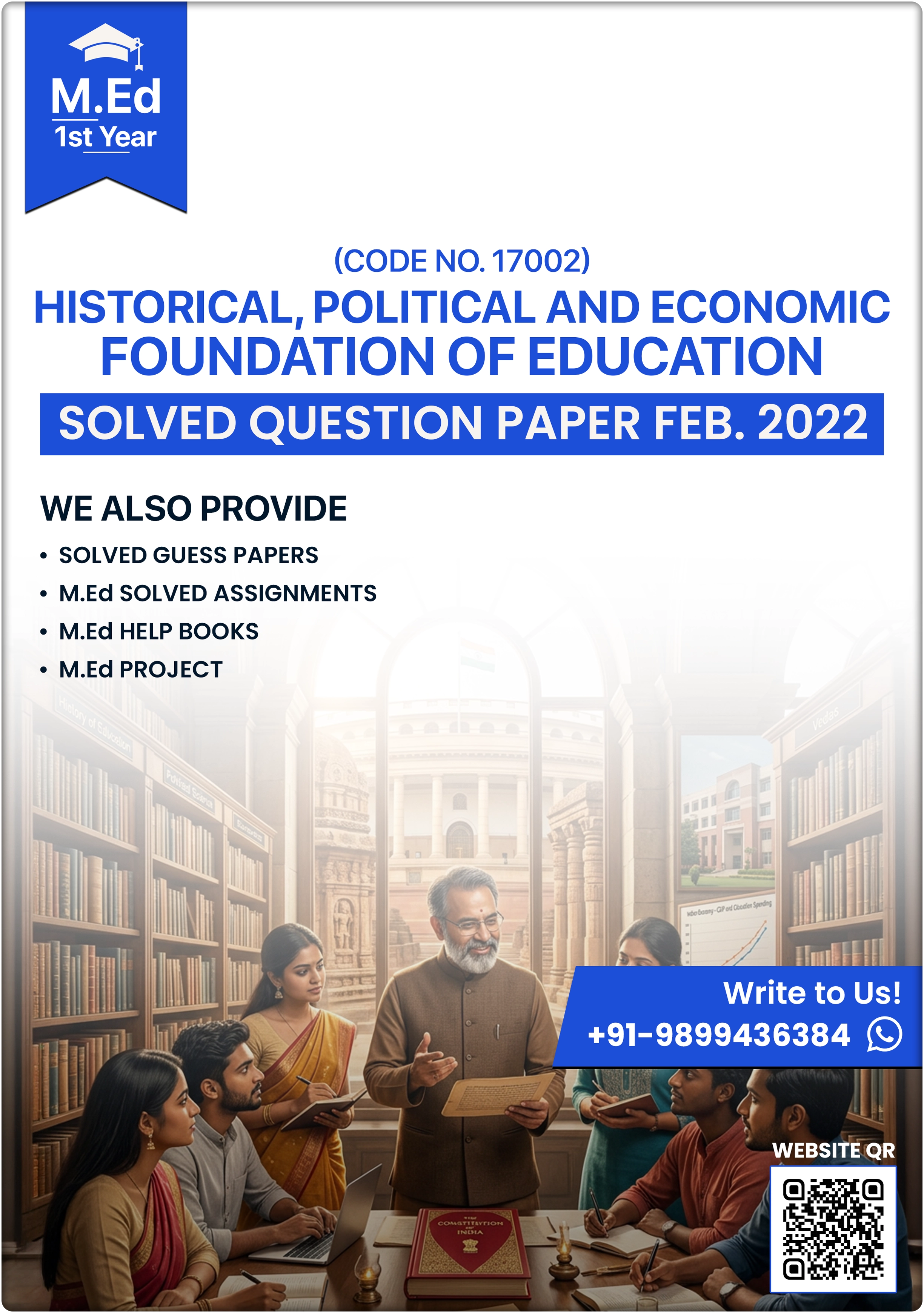
Historical, Political and Economic Foundation of Education — M.Ed 1st Sem Question Paper, February 2022 (Code 17002, with Solutions)
What's Included
Full content delivered instantly
Clean layout, well-structured
Organized for easy revision
Download link delivered immediately
Read anywhere, any device
Course Overview
| Last updated | 26 May 2026 |
|---|---|
| Verified by | Sheetal Kirola, M.Ed., B.Ed Faculty |
| Source | scanned February 2022 examination paper (Code 17002, Paper II, series RR-423) |
| Programme | M.Ed 1st Semester (CBCS) |
| Maximum Marks | 80 |
Quick Facts at a Glance
If you are revising Foundation of Education M.Ed 1st Sem, here are the verified facts from the scanned paper, set out for quick reference before your exam.
| Field | Detail |
|---|---|
| Paper Name | Historical, Political and Economic Foundation of Education |
| Paper Code | 17002 (print series: RR-423) |
| Paper Number | II |
| Programme | M.Ed 1st Semester (Two Years Course), CBCS |
| Exam Session | February 2022 |
| Maximum Marks | 80 |
| Duration | Three Hours |
| Total Questions / To Attempt | 9 set / attempt 5 (Q1 compulsory + one of two per Unit, Or/अथवा choice) |
| Marks per Question | 16 (Q7 and Q8 are 8 × 2; Q4 is a two-part note) |
| Medium | English & Hindi (bilingual) |
| Pattern Applies To | MDU Rohtak CBCS scheme (primary); also relevant to other CBCS-scheme M.Ed programmes |
Historical, Political and Economic Foundation of Education Feb 2022 — Paper Preview
Below is the complete scanned paper exactly as it appeared in the examination hall, followed by a clean, crawlable transcription so you can confirm every question before you trust the page.
Roll No. ........................
Total No. of Questions : 9 ] [ Total No. of Pages : 4
17002
M.Ed. 1st Semester (Two Years Course)
Examination, February-2022
(CBCS)
HISTORICAL, POLITICAL AND ECONOMIC FOUNDATION OF EDUCATION
Paper – II
Time : Three Hours ] [ Maximum Marks : 80
Before answering the questions, candidates should ensure that they have been supplied the correct and complete question paper. No complaint in this regard will be entertained after examination.
Note :– Attempt FIVE questions in all, selecting ONE question from each Unit. Q. No. 1 is COMPULSORY. All questions carry equal marks.
Series : RR-423
1. Write short notes on the following: 4 × 4 = 16
- (a) Concept of economical perspective in Education
- (b) Women education in Vedic Period
- (c) Knowledge of Industries and Occupations
- (d) Write a note on Kothari Commission
Unit – I
2. Explain the concept and need of historical and political economy courses in education. Write its scope.
Or (अथवा)
3. Discuss the concept and need of the historical perspective in education. Write its scope.
Unit – II
4. Write notes on the following:
- (a) Explain the difference between Vedic and Buddhist period of women education
- (b) Teacher-pupil Relationship
Or (अथवा)
5. Explain the education system in India during the Medieval Period.
Unit – III
6. Write a detailed note on Constitutional Provisions for education.
Or (अथवा)
7. Write notes on the following: 8 × 2 = 16
- (a) Education in Communist Countries
- (b) Explain National Policy on Education (1986) and N.C.F. (2005)
Unit – IV
8. Write notes on the following: 8 × 2 = 16
- (a) How is education related to the economy of a particular country?
- (b) Youth Unemployment
Or (अथवा)
9. Explain Educational Financing in India at Senior Secondary School Level.
Important Questions in This Foundation of Education Paper
These are the high-weight items worth prioritising in your revision, pulled directly from the verified February 2022 set.
- Difference between women's education in the Vedic and Buddhist periods; teacher-pupil relationship (Q4, Unit II)
- Education system in India during the medieval period (Q5, Unit II)
- Constitutional provisions for education, in detail (Q6, Unit III)
- Education in communist countries; National Policy on Education (1986) and NCF 2005 (Q7, Unit III)
- Education and the economy of a country; youth unemployment (Q8, Unit IV)
- Educational financing in India at senior secondary school level (Q9, Unit IV)
- Question 1 (short notes — economic perspective in education, women's education in the Vedic period, knowledge of industries and occupations, the Kothari Commission) is compulsory, so prioritise it first.
The strongest session-specific differentiators against the April 2021 sitting are the Kothari Commission, the National Policy on Education 1986, the Vedic-versus-Buddhist women's-education comparison, and senior-secondary educational financing.
Historical, Political and Economic Foundation of Education M.Ed Question Paper PDF — Download & Solved Pack
The full scanned paper is previewable above at no cost, and a 2–3 page sample of the step-by-step solved pack is available as a no-cost preview. The complete solved pack — every one of the 9 questions worked out — is delivered via WhatsApp.
Question-by-Question Breakdown (with Topic Tags)
| Q. No. | Question (summary) | Unit | Marks | Topic Tag |
|---|---|---|---|---|
| Q1 | Short notes: economic perspective in education; women's education in the Vedic period; knowledge of industries and occupations; Kothari Commission | Compulsory | 16 | Foundations & commissions |
| Q2 | Concept, need and scope of historical and political-economy courses in education | Unit I | 16 | Historical & political-economy courses |
| Q3 | Concept, need and scope of the historical perspective in education | Unit I | 16 | Historical perspective in education |
| Q4 | (a) Vedic vs Buddhist women's education; (b) teacher-pupil relationship | Unit II | 16 | Vedic vs Buddhist women's education; teacher-pupil relationship |
| Q5 | Education system in India during the medieval period | Unit II | 16 | Medieval-period education in India |
| Q6 | Constitutional provisions for education, in detail | Unit III | 16 | Constitutional provisions for education |
| Q7 | (a) Education in communist countries; (b) National Policy on Education (1986) and NCF 2005 | Unit III | 16 | Communist-country education; NPE 1986 & NCF 2005 |
| Q8 | (a) How education relates to a country's economy; (b) youth unemployment | Unit IV | 16 | Education & economy; youth unemployment |
| Q9 | Educational financing in India at senior secondary school level | Unit IV | 16 | Educational financing at senior secondary level |
Syllabus Mapping — Units & Learning Outcomes
| Unit | Themes (as reflected in this paper) |
|---|---|
| Unit I | Historical and political-economy perspective and courses in education (concept, need, scope) |
| Unit II | Women's education (Vedic and Buddhist periods); teacher-pupil relationship; medieval-period education in India |
| Unit III | Constitutional provisions for education; comparative education (communist countries); education policy (NPE 1986, NCF 2005) |
| Unit IV | Education and the economy; youth unemployment; educational financing at senior secondary level |
In practice, this paper rewards naming the right document or period precisely — the Kothari Commission, NPE 1986, NCF 2005, the Vedic versus Buddhist contrast — and then building the discussion around it.
About the Solved Pack
Buyers get step-by-step, exam-ready model answers to all 9 questions, structured the way examiners expect them — definition, then key points, then examples. The compulsory short notes in Q1 are covered, and the longer Unit essays are developed in full, including the constitutional provisions for education, the National Policy on Education 1986 and NCF 2005, the link between education and a country's economy, and educational financing at senior secondary level.
This M.Ed Solved question paper is delivered via WhatsApp, with a sample preview first so you can check the depth before you commit. Hindi and English support is provided where relevant, and the pack is refreshed each session.
Frequently Asked Questions
Is the February 2022 Historical, Political and Economic Foundation of Education paper available in PDF?
Yes. The complete M.Ed Historical, Political and Economic Foundation of Education Feb 2022 question paper is previewable on this page at no cost, with all four pages scanned and a clean transcription. A step-by-step solved version is available separately via WhatsApp.
What is the paper code?
The paper code is 17002, listed as Paper II, with the print series RR-423. The same code 17002 is reused for this subject across sittings, so the session date is what distinguishes this February 2022 paper.
How many marks is the paper?
The paper carries 80 marks in total. Each question is worth 16 marks — with Q7 and Q8 split as 8 × 2 across two sub-parts — you attempt five questions, and the duration is Three Hours.
How many questions must I attempt?
You attempt five questions in all. Question 1 is compulsory, and you then attempt one question from each of the four Units, choosing between the two options printed in each Unit.
Does the paper have internal choice?
Yes. Each Unit prints two questions joined by an explicit Or/अथवा, and you answer just one of them. Question 1 stands outside the Units and is compulsory, with no alternative.
Which course and semester is it?
It is Foundation of Education M.Ed 1st Sem, set under the CBCS scheme for the two-year Master of Education programme. The paper is the first-semester foundations paper, listed as Paper II, aligned to the MDU Rohtak pattern.
Is this paper from February 2022 or March 2022?
The printed header reads February 2022, so that is the correct session. Some copies circulate under a "March 2022" label, but the date on the scanned examination paper itself is February 2022.
Is this the same as M.Ed 1st year?
Many students search for it as "1st year", and it is the same stage of the course. The official designation, however, is 1st Semester under the CBCS scheme, which is the term printed on the paper itself.
Are solutions or a solved paper available?
Yes. A complete M.Ed Solved question paper with step-by-step model answers to all 9 questions is available via WhatsApp, with a free sample preview so you can judge the quality first.
Related M.Ed 1st Semester Papers
| Paper | Description |
|---|---|
| Historical, Political and Economic Foundation of Education | April 2021 sitting of the same subject |
| Psychology of Learning and Development | February 2022 sitting (series RR-422) |
| Education Studies | February 2022 sitting (series RR-424) |
| Introduction to Educational Research | February 2022 sitting (series RR-425) |
Sources, Disclaimer & Author
The paper reproduced here is a scanned copy of the M.Ed 1st Semester (CBCS) February 2022 Historical, Political and Economic Foundation of Education examination (Code 17002, Paper II, series RR-423), transcribed faithfully by the Unnati Education B.Ed team from the legible examination images.
Unnati Education B.Ed is an independent academic publisher and is not affiliated with Maharshi Dayanand University (MDU), Rohtak, or any other university or college. Question papers are shared for educational and revision purposes; solutions are model answers prepared by the team. Verified by Sheetal Kirola, M.Ed., B.Ed Faculty. Last verified: 26 May 2026.
Get the Full Solved Pack on WhatsApp
Ready to revise with answers in hand? The WhatsApp pack includes all 9 questions solved in exam-ready form — the constitutional-provisions essay, the NPE 1986 and NCF 2005 answer, and the education-and-economy and senior-secondary-financing questions developed in full, with the compulsory short notes covered — and a sample preview is sent first so you know exactly what you are getting.
What's Included
Course Overview
| Last updated | 26 May 2026 |
|---|---|
| Verified by | Sheetal Kirola, M.Ed., B.Ed Faculty |
| Source | scanned February 2022 examination paper (Code 17002, Paper II, series RR-423) |
| Programme | M.Ed 1st Semester (CBCS) |
| Maximum Marks | 80 |
Quick Facts at a Glance
If you are revising Foundation of Education M.Ed 1st Sem, here are the verified facts from the scanned paper, set out for quick reference before your exam.
| Field | Detail |
|---|---|
| Paper Name | Historical, Political and Economic Foundation of Education |
| Paper Code | 17002 (print series: RR-423) |
| Paper Number | II |
| Programme | M.Ed 1st Semester (Two Years Course), CBCS |
| Exam Session | February 2022 |
| Maximum Marks | 80 |
| Duration | Three Hours |
| Total Questions / To Attempt | 9 set / attempt 5 (Q1 compulsory + one of two per Unit, Or/अथवा choice) |
| Marks per Question | 16 (Q7 and Q8 are 8 × 2; Q4 is a two-part note) |
| Medium | English & Hindi (bilingual) |
| Pattern Applies To | MDU Rohtak CBCS scheme (primary); also relevant to other CBCS-scheme M.Ed programmes |
Historical, Political and Economic Foundation of Education Feb 2022 — Paper Preview
Below is the complete scanned paper exactly as it appeared in the examination hall, followed by a clean, crawlable transcription so you can confirm every question before you trust the page.
Roll No. ........................
Total No. of Questions : 9 ] [ Total No. of Pages : 4
17002
M.Ed. 1st Semester (Two Years Course)
Examination, February-2022
(CBCS)
HISTORICAL, POLITICAL AND ECONOMIC FOUNDATION OF EDUCATION
Paper – II
Time : Three Hours ] [ Maximum Marks : 80
Before answering the questions, candidates should ensure that they have been supplied the correct and complete question paper. No complaint in this regard will be entertained after examination.
Note :– Attempt FIVE questions in all, selecting ONE question from each Unit. Q. No. 1 is COMPULSORY. All questions carry equal marks.
Series : RR-423
1. Write short notes on the following: 4 × 4 = 16
- (a) Concept of economical perspective in Education
- (b) Women education in Vedic Period
- (c) Knowledge of Industries and Occupations
- (d) Write a note on Kothari Commission
Unit – I
2. Explain the concept and need of historical and political economy courses in education. Write its scope.
Or (अथवा)
3. Discuss the concept and need of the historical perspective in education. Write its scope.
Unit – II
4. Write notes on the following:
- (a) Explain the difference between Vedic and Buddhist period of women education
- (b) Teacher-pupil Relationship
Or (अथवा)
5. Explain the education system in India during the Medieval Period.
Unit – III
6. Write a detailed note on Constitutional Provisions for education.
Or (अथवा)
7. Write notes on the following: 8 × 2 = 16
- (a) Education in Communist Countries
- (b) Explain National Policy on Education (1986) and N.C.F. (2005)
Unit – IV
8. Write notes on the following: 8 × 2 = 16
- (a) How is education related to the economy of a particular country?
- (b) Youth Unemployment
Or (अथवा)
9. Explain Educational Financing in India at Senior Secondary School Level.
Important Questions in This Foundation of Education Paper
These are the high-weight items worth prioritising in your revision, pulled directly from the verified February 2022 set.
- Difference between women's education in the Vedic and Buddhist periods; teacher-pupil relationship (Q4, Unit II)
- Education system in India during the medieval period (Q5, Unit II)
- Constitutional provisions for education, in detail (Q6, Unit III)
- Education in communist countries; National Policy on Education (1986) and NCF 2005 (Q7, Unit III)
- Education and the economy of a country; youth unemployment (Q8, Unit IV)
- Educational financing in India at senior secondary school level (Q9, Unit IV)
- Question 1 (short notes — economic perspective in education, women's education in the Vedic period, knowledge of industries and occupations, the Kothari Commission) is compulsory, so prioritise it first.
The strongest session-specific differentiators against the April 2021 sitting are the Kothari Commission, the National Policy on Education 1986, the Vedic-versus-Buddhist women's-education comparison, and senior-secondary educational financing.
Historical, Political and Economic Foundation of Education M.Ed Question Paper PDF — Download & Solved Pack
The full scanned paper is previewable above at no cost, and a 2–3 page sample of the step-by-step solved pack is available as a no-cost preview. The complete solved pack — every one of the 9 questions worked out — is delivered via WhatsApp.
Question-by-Question Breakdown (with Topic Tags)
| Q. No. | Question (summary) | Unit | Marks | Topic Tag |
|---|---|---|---|---|
| Q1 | Short notes: economic perspective in education; women's education in the Vedic period; knowledge of industries and occupations; Kothari Commission | Compulsory | 16 | Foundations & commissions |
| Q2 | Concept, need and scope of historical and political-economy courses in education | Unit I | 16 | Historical & political-economy courses |
| Q3 | Concept, need and scope of the historical perspective in education | Unit I | 16 | Historical perspective in education |
| Q4 | (a) Vedic vs Buddhist women's education; (b) teacher-pupil relationship | Unit II | 16 | Vedic vs Buddhist women's education; teacher-pupil relationship |
| Q5 | Education system in India during the medieval period | Unit II | 16 | Medieval-period education in India |
| Q6 | Constitutional provisions for education, in detail | Unit III | 16 | Constitutional provisions for education |
| Q7 | (a) Education in communist countries; (b) National Policy on Education (1986) and NCF 2005 | Unit III | 16 | Communist-country education; NPE 1986 & NCF 2005 |
| Q8 | (a) How education relates to a country's economy; (b) youth unemployment | Unit IV | 16 | Education & economy; youth unemployment |
| Q9 | Educational financing in India at senior secondary school level | Unit IV | 16 | Educational financing at senior secondary level |
Syllabus Mapping — Units & Learning Outcomes
| Unit | Themes (as reflected in this paper) |
|---|---|
| Unit I | Historical and political-economy perspective and courses in education (concept, need, scope) |
| Unit II | Women's education (Vedic and Buddhist periods); teacher-pupil relationship; medieval-period education in India |
| Unit III | Constitutional provisions for education; comparative education (communist countries); education policy (NPE 1986, NCF 2005) |
| Unit IV | Education and the economy; youth unemployment; educational financing at senior secondary level |
In practice, this paper rewards naming the right document or period precisely — the Kothari Commission, NPE 1986, NCF 2005, the Vedic versus Buddhist contrast — and then building the discussion around it.
About the Solved Pack
Buyers get step-by-step, exam-ready model answers to all 9 questions, structured the way examiners expect them — definition, then key points, then examples. The compulsory short notes in Q1 are covered, and the longer Unit essays are developed in full, including the constitutional provisions for education, the National Policy on Education 1986 and NCF 2005, the link between education and a country's economy, and educational financing at senior secondary level.
This M.Ed Solved question paper is delivered via WhatsApp, with a sample preview first so you can check the depth before you commit. Hindi and English support is provided where relevant, and the pack is refreshed each session.
Frequently Asked Questions
Is the February 2022 Historical, Political and Economic Foundation of Education paper available in PDF?
Yes. The complete M.Ed Historical, Political and Economic Foundation of Education Feb 2022 question paper is previewable on this page at no cost, with all four pages scanned and a clean transcription. A step-by-step solved version is available separately via WhatsApp.
What is the paper code?
The paper code is 17002, listed as Paper II, with the print series RR-423. The same code 17002 is reused for this subject across sittings, so the session date is what distinguishes this February 2022 paper.
How many marks is the paper?
The paper carries 80 marks in total. Each question is worth 16 marks — with Q7 and Q8 split as 8 × 2 across two sub-parts — you attempt five questions, and the duration is Three Hours.
How many questions must I attempt?
You attempt five questions in all. Question 1 is compulsory, and you then attempt one question from each of the four Units, choosing between the two options printed in each Unit.
Does the paper have internal choice?
Yes. Each Unit prints two questions joined by an explicit Or/अथवा, and you answer just one of them. Question 1 stands outside the Units and is compulsory, with no alternative.
Which course and semester is it?
It is Foundation of Education M.Ed 1st Sem, set under the CBCS scheme for the two-year Master of Education programme. The paper is the first-semester foundations paper, listed as Paper II, aligned to the MDU Rohtak pattern.
Is this paper from February 2022 or March 2022?
The printed header reads February 2022, so that is the correct session. Some copies circulate under a "March 2022" label, but the date on the scanned examination paper itself is February 2022.
Is this the same as M.Ed 1st year?
Many students search for it as "1st year", and it is the same stage of the course. The official designation, however, is 1st Semester under the CBCS scheme, which is the term printed on the paper itself.
Are solutions or a solved paper available?
Yes. A complete M.Ed Solved question paper with step-by-step model answers to all 9 questions is available via WhatsApp, with a free sample preview so you can judge the quality first.
Related M.Ed 1st Semester Papers
| Paper | Description |
|---|---|
| Historical, Political and Economic Foundation of Education | April 2021 sitting of the same subject |
| Psychology of Learning and Development | February 2022 sitting (series RR-422) |
| Education Studies | February 2022 sitting (series RR-424) |
| Introduction to Educational Research | February 2022 sitting (series RR-425) |
Sources, Disclaimer & Author
The paper reproduced here is a scanned copy of the M.Ed 1st Semester (CBCS) February 2022 Historical, Political and Economic Foundation of Education examination (Code 17002, Paper II, series RR-423), transcribed faithfully by the Unnati Education B.Ed team from the legible examination images.
Unnati Education B.Ed is an independent academic publisher and is not affiliated with Maharshi Dayanand University (MDU), Rohtak, or any other university or college. Question papers are shared for educational and revision purposes; solutions are model answers prepared by the team. Verified by Sheetal Kirola, M.Ed., B.Ed Faculty. Last verified: 26 May 2026.
Get the Full Solved Pack on WhatsApp
Ready to revise with answers in hand? The WhatsApp pack includes all 9 questions solved in exam-ready form — the constitutional-provisions essay, the NPE 1986 and NCF 2005 answer, and the education-and-economy and senior-secondary-financing questions developed in full, with the compulsory short notes covered — and a sample preview is sent first so you know exactly what you are getting.