NIOS Class 12 Home Science 321 Solved Practical Files (Lab Manual) for 2026
NIOS Class 12 Home Science 321 Practical Files are the part of the course that most students leave for the last week, and that delay quietly costs them easy marks. Home Science carries a separate 20-mark practical alongside the theory paper, and a neat, correctly formatted file is often the difference between an average score and a comfortable one. On this page you can see precisely what our file holds, look at real pages from it, and judge the quality yourself before you decide anything.
NIOS Class 12 Home Science 321 Practical Files for 2026
Written by Prateek Talwar · Reviewed by Jyoti Sharma, Senior NIOS Counsellor · Updated for the 2026 session
NIOS Class 12 Home Science 321 Practical Files are the part of the course that most students leave for the last week, and that delay quietly costs them easy marks. Home Science carries a separate 20-mark practical alongside the theory paper, and a neat, correctly formatted file is often the difference between an average score and a comfortable one. On this page you can see precisely what our file holds, look at real pages from it, and judge the quality yourself before you decide anything.
We prepare these files by hand for the October 2026 board session. Every experiment in the subject is solved, written out in clean handwriting, and supported with the diagrams, pasted images and observation tables that examiners expect. The idea is simple: give you a file that is ready to submit and easy to learn from, so the practical stops being a source of stress.
Home Science 321 Practical File at a Glance
| Subject and code | Home Science (321), NIOS Senior Secondary |
|---|---|
| Class | Class 12 (Senior Secondary) |
| Practical activities | 10 practicals, fully solved |
| Practical marks | 20 marks (theory: 80 marks) |
| Format | Handwritten record with diagrams, pasted photos and observation tables |
| Session | Prepared for the 2026 practical exam |
| Medium | English (Hindi medium on request) |
| Delivery | Ready file shared after you message us on WhatsApp |
Sample Pages From the Home Science 321 Practical File
Rather than ask you to trust a description, we show you fifteen sample pages pulled straight from the completed file. Look at the handwriting, the labelled diagrams and the filled tables, and decide the quality for yourself before you request the full copy.
 Page 01
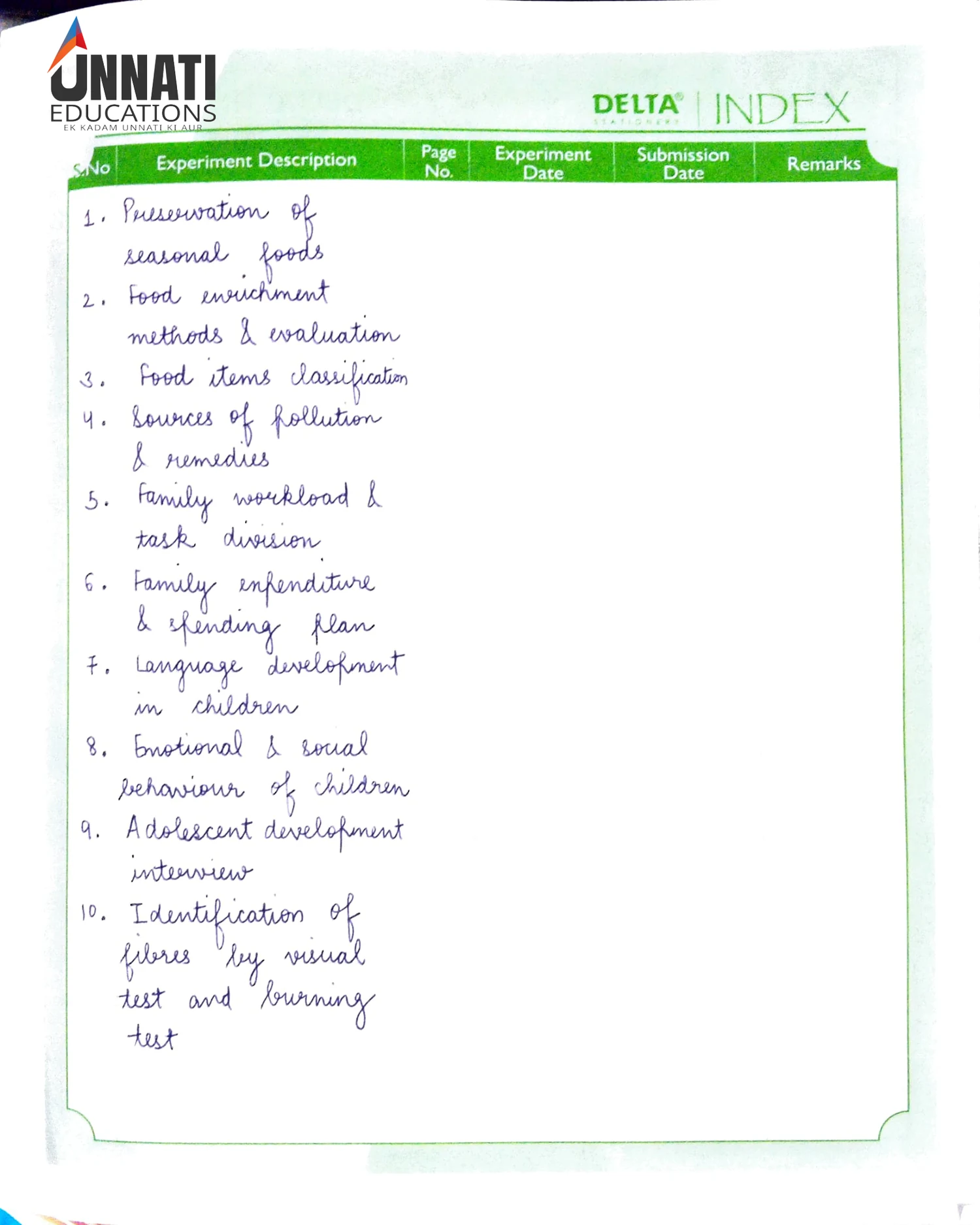
Experiment Index
The experiment index at the front of the file, all ten practicals numbered with page ranges.
View Full Page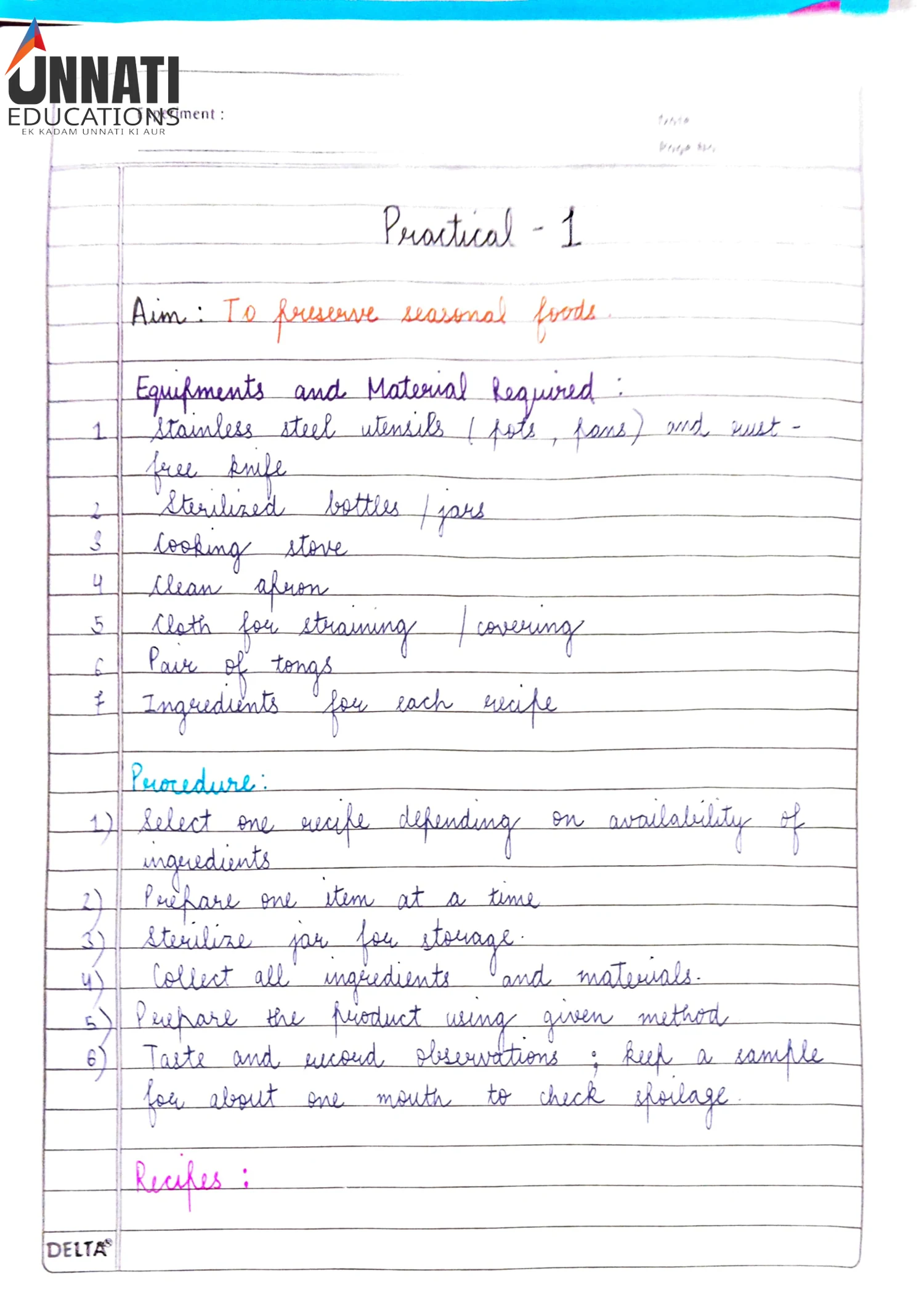 Page 02
Food Preservation – Aim and Materials
Experiment 1, food preservation — the aim, materials and sterilisation method for jars.
View Full Page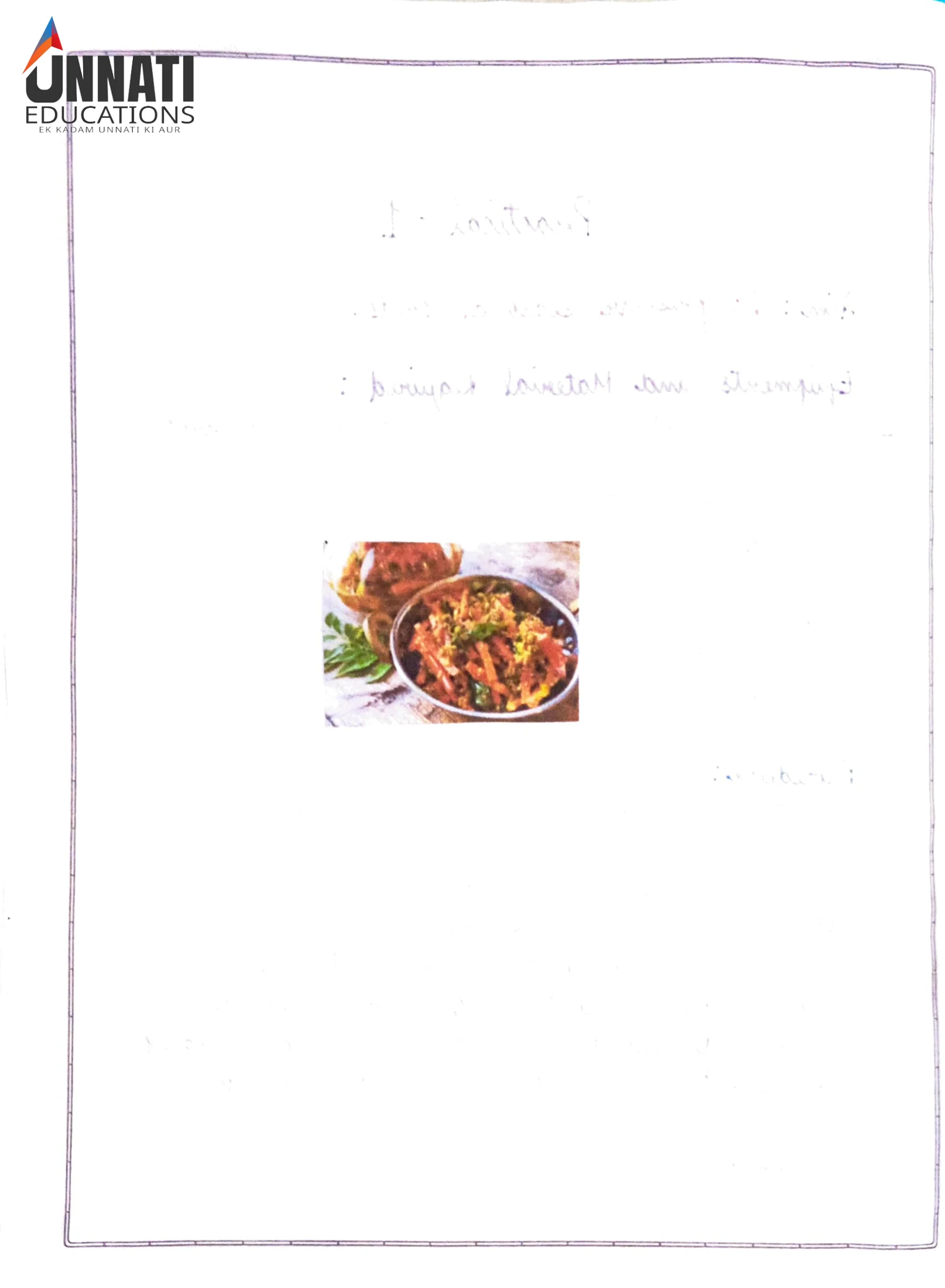 Page 03
Preservation Recipe Table
The full recipe table for pickle, chutney, jam, squash and ketchup with ingredient quantities.
View Full Page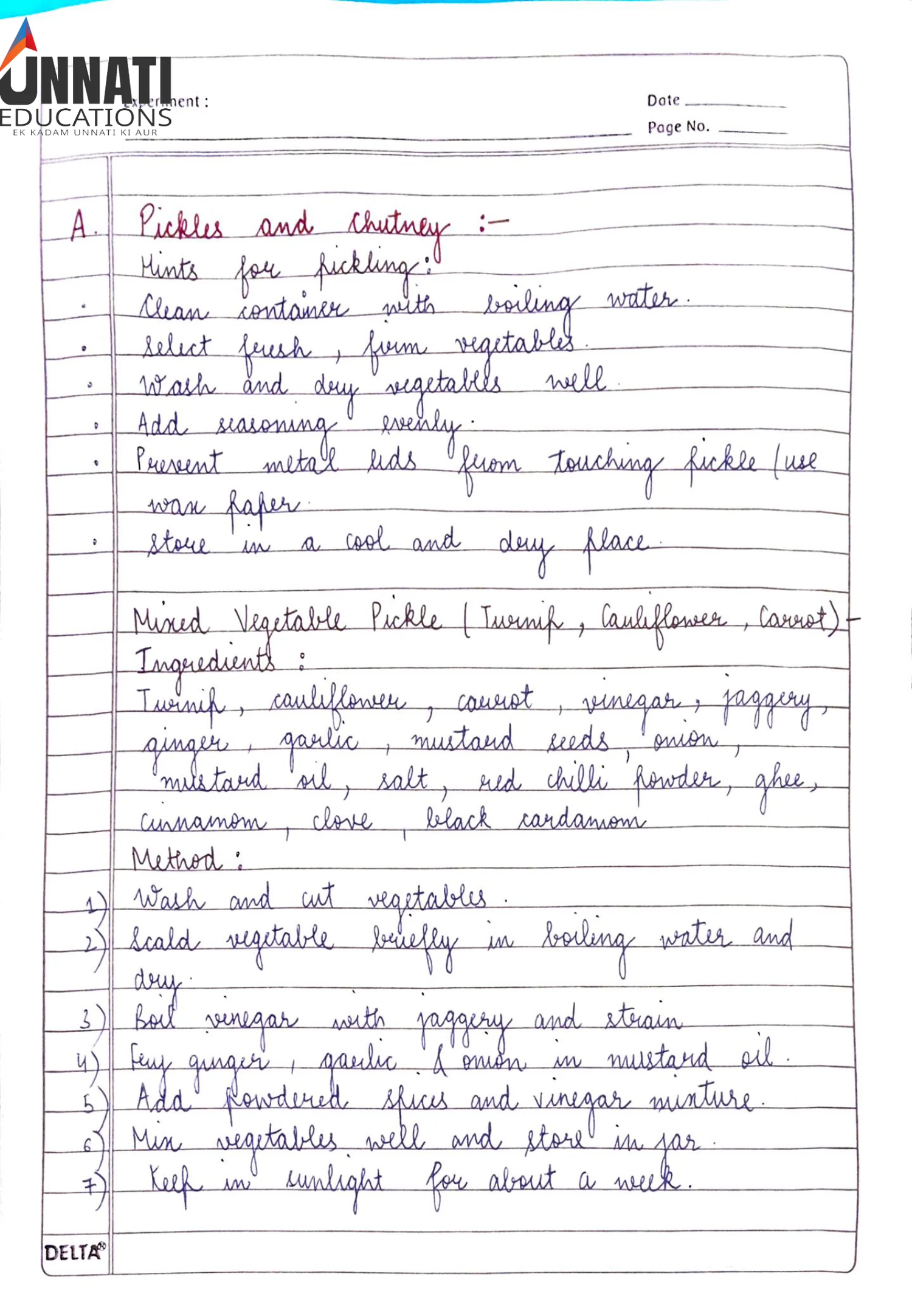 Page 04
Preservation Observation Table
Observation table for food preservation showing colour, texture and shelf-life for each item.
View Full Page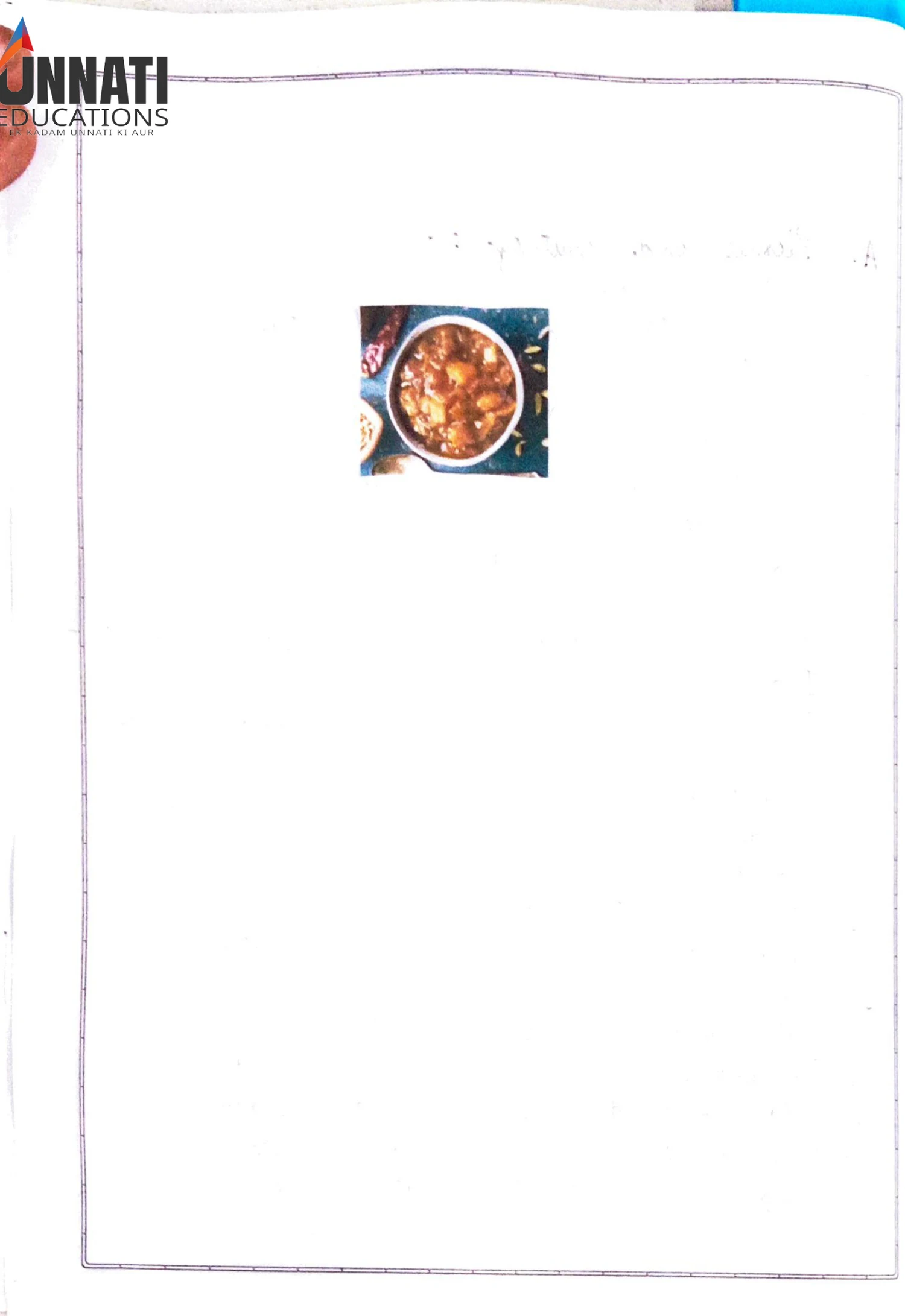 Page 05
Food Enrichment – Bajra Ladoo
Experiment 2, food enrichment — the combination recipe for bajra ladoo with procedure steps.
View Full Page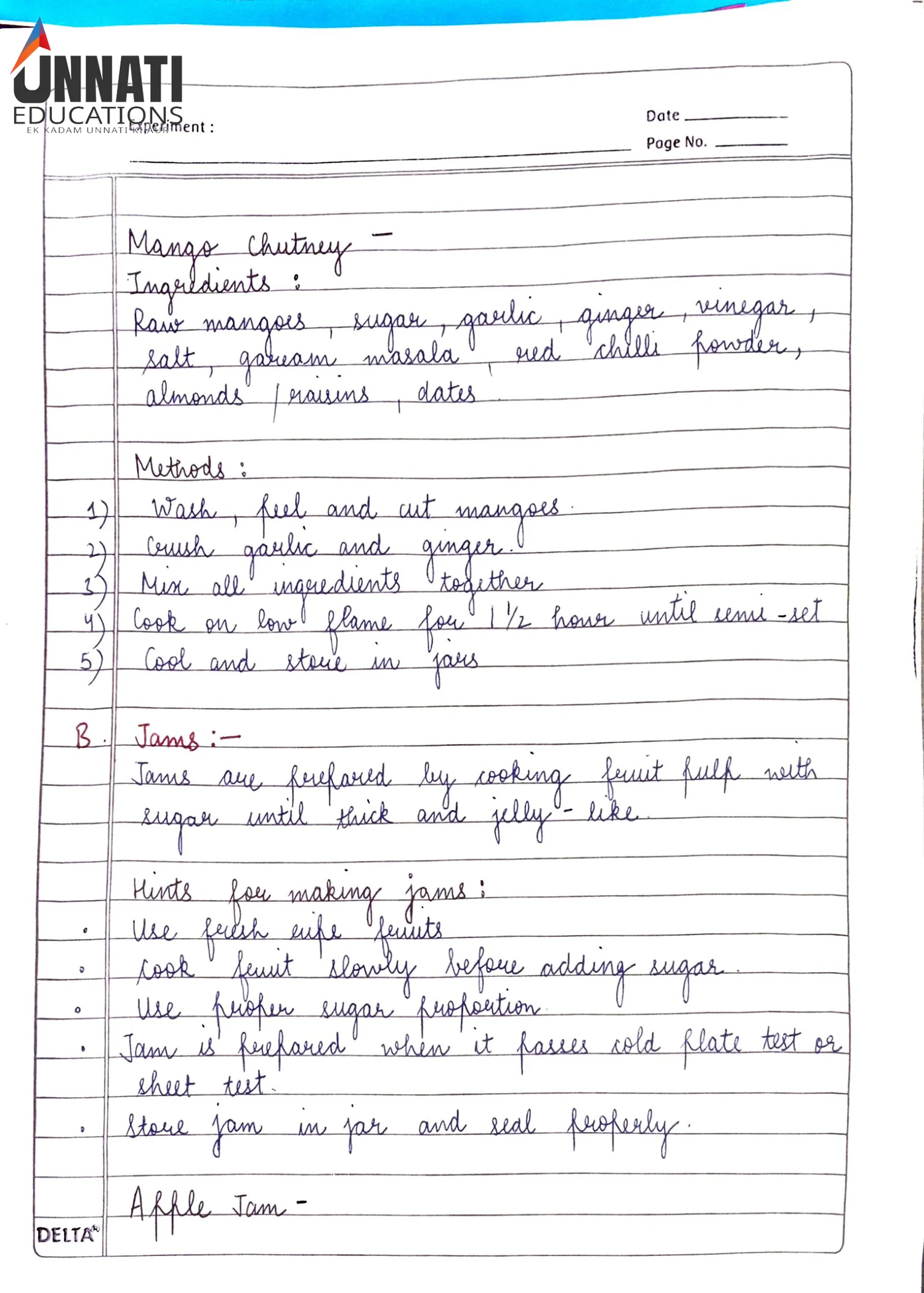 Page 06
Fermentation and Germination
Fermentation and germination setups with observation notes for idli and sprouted raita.
View Full Page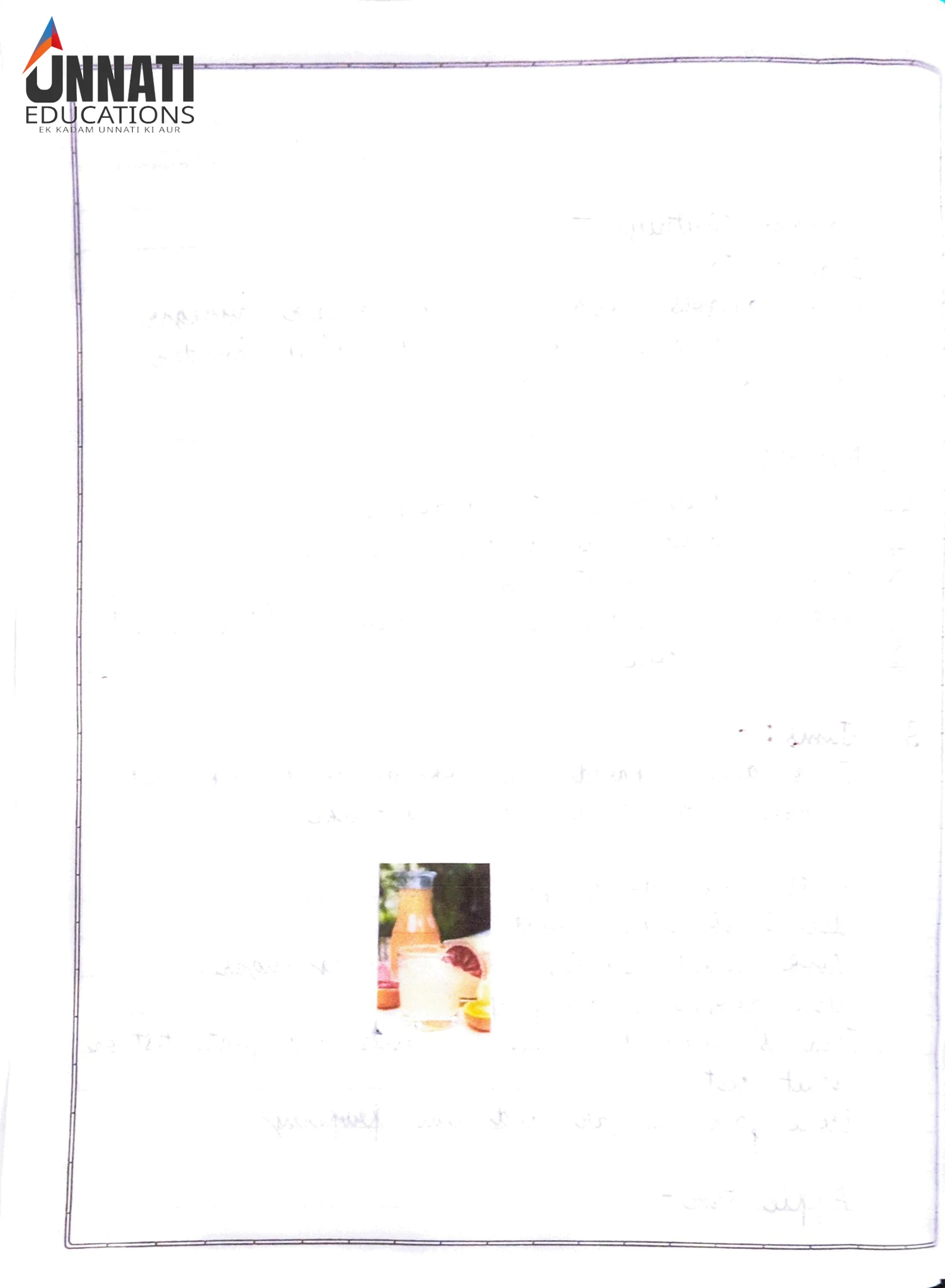 Page 07
Food Group Classification Table
Experiment 3, food group classification — the fifteen-item table sorted by major nutrient.
View Full Page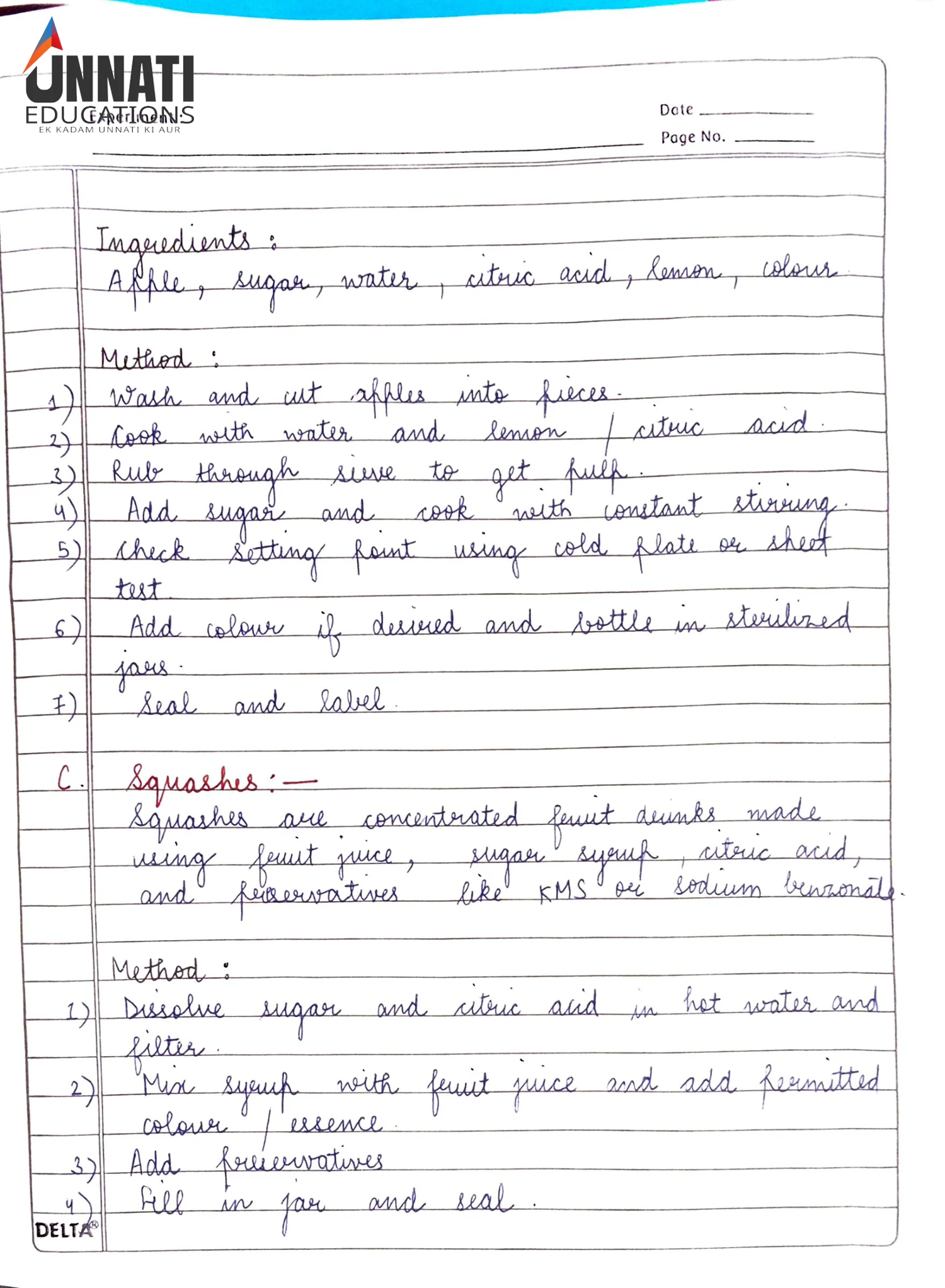 Page 08
Food Pyramid Chart
The hand-drawn food pyramid chart alongside the classification table.
View Full Page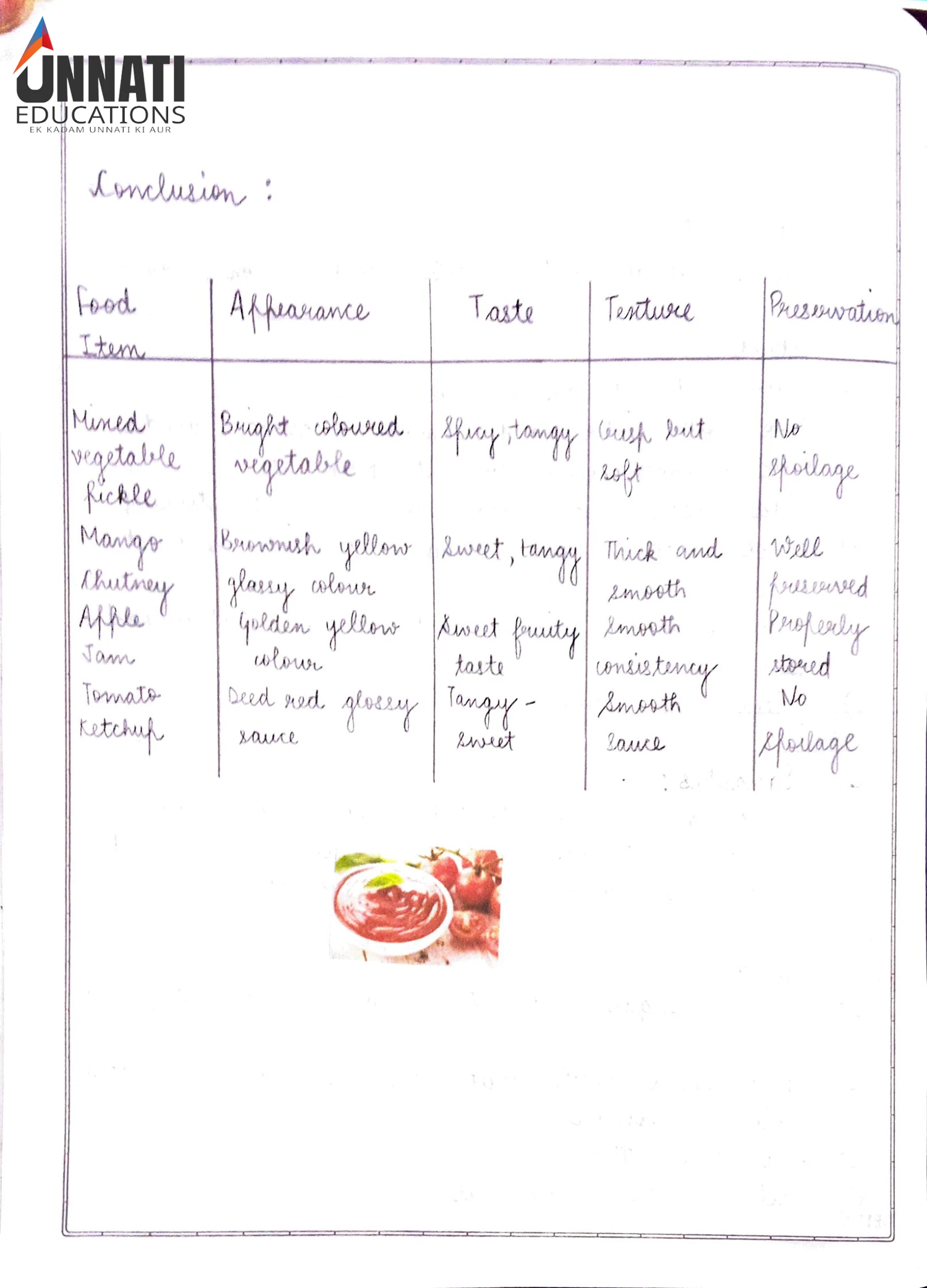 Page 09
Pollution Survey and Locality Map
Experiment 4, pollution survey — the locality map with sources marked and causes listed.
View Full Page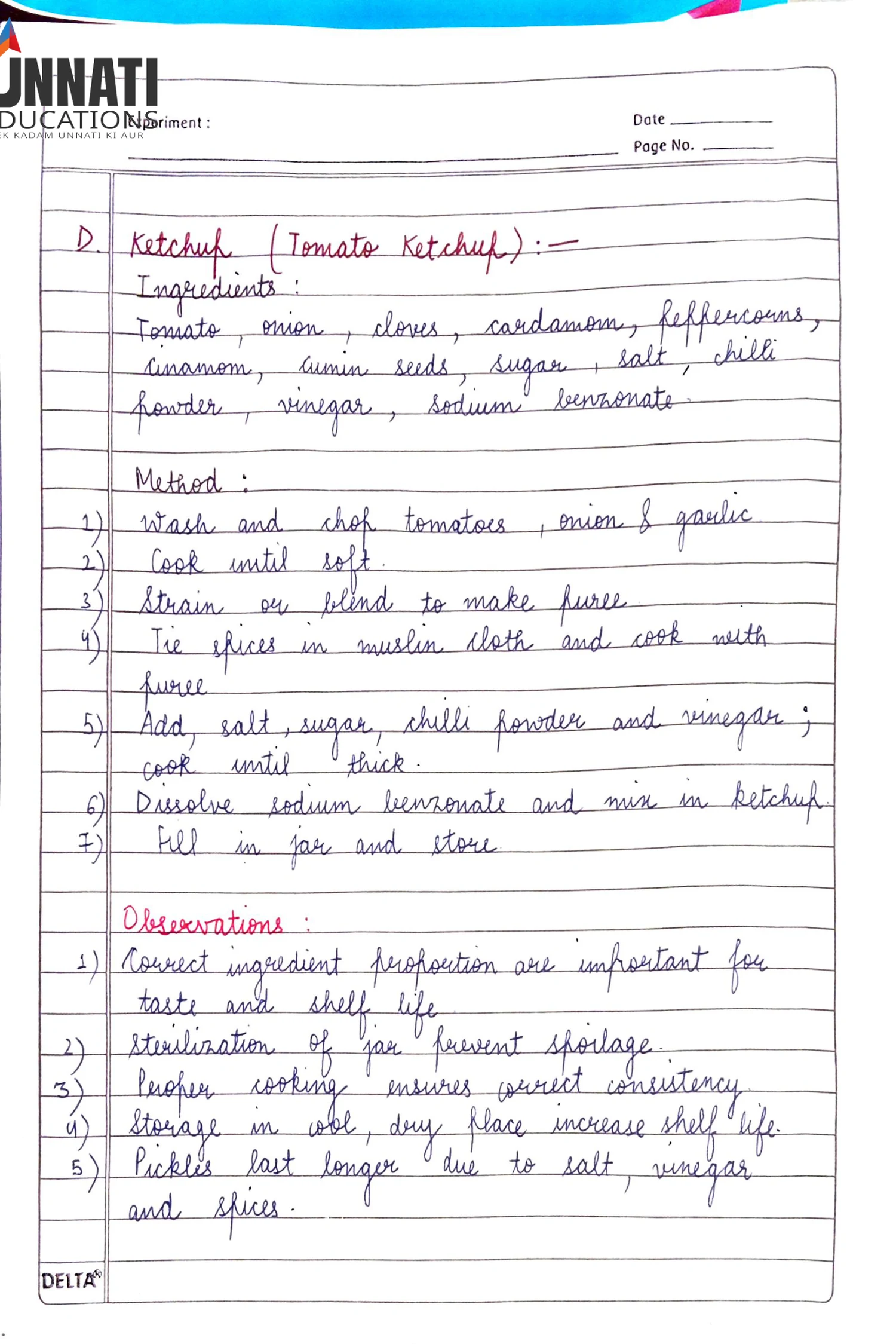 Page 10
Remedial Measures Table
Remedial measures table for air, water, soil and noise pollution.
View Full Page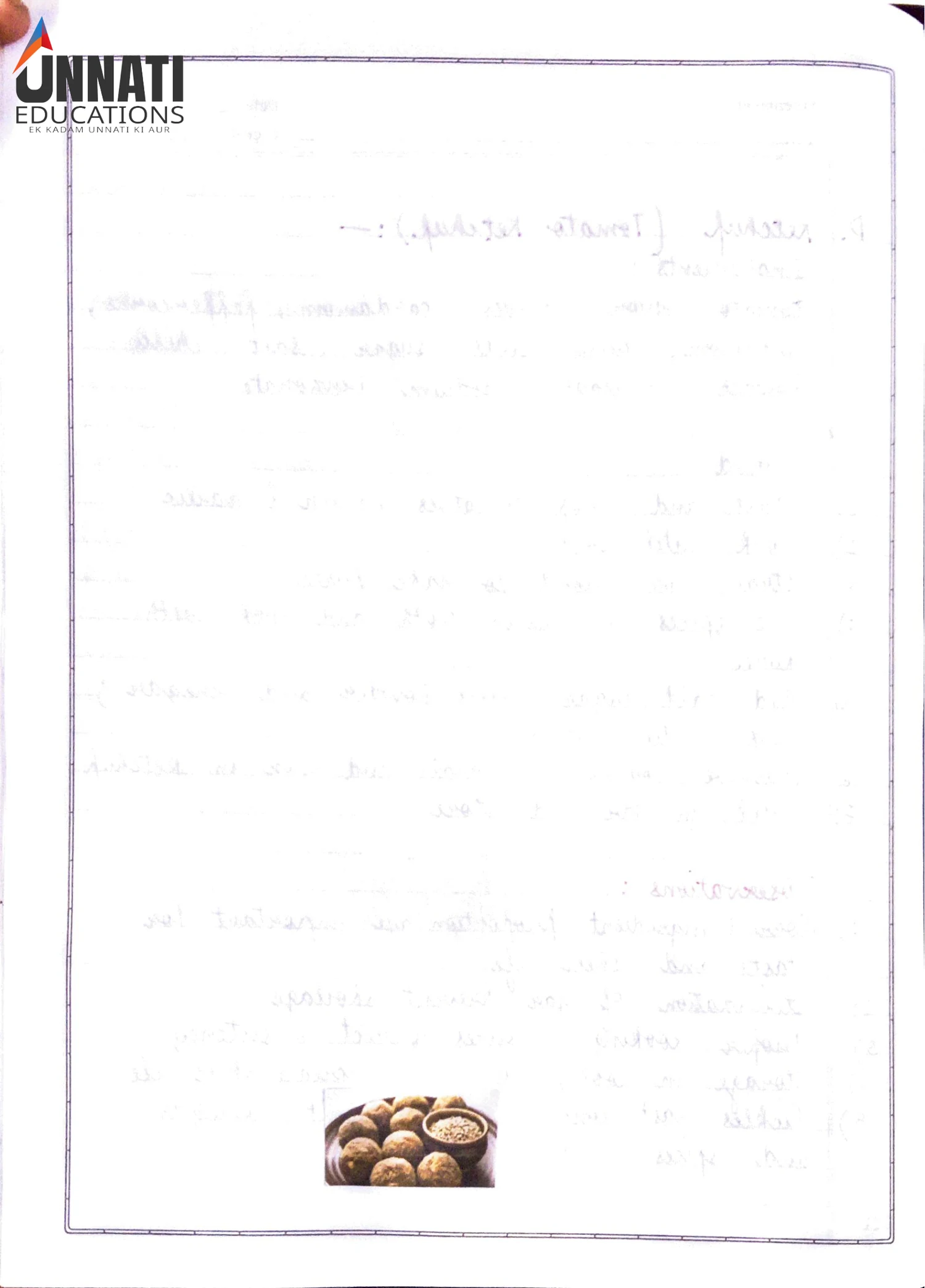 Page 11
Fibre Identification – Visual Comparison
Experiment 10, fibre identification — the visual comparison table for cotton, wool, silk and polyester.
View Full Page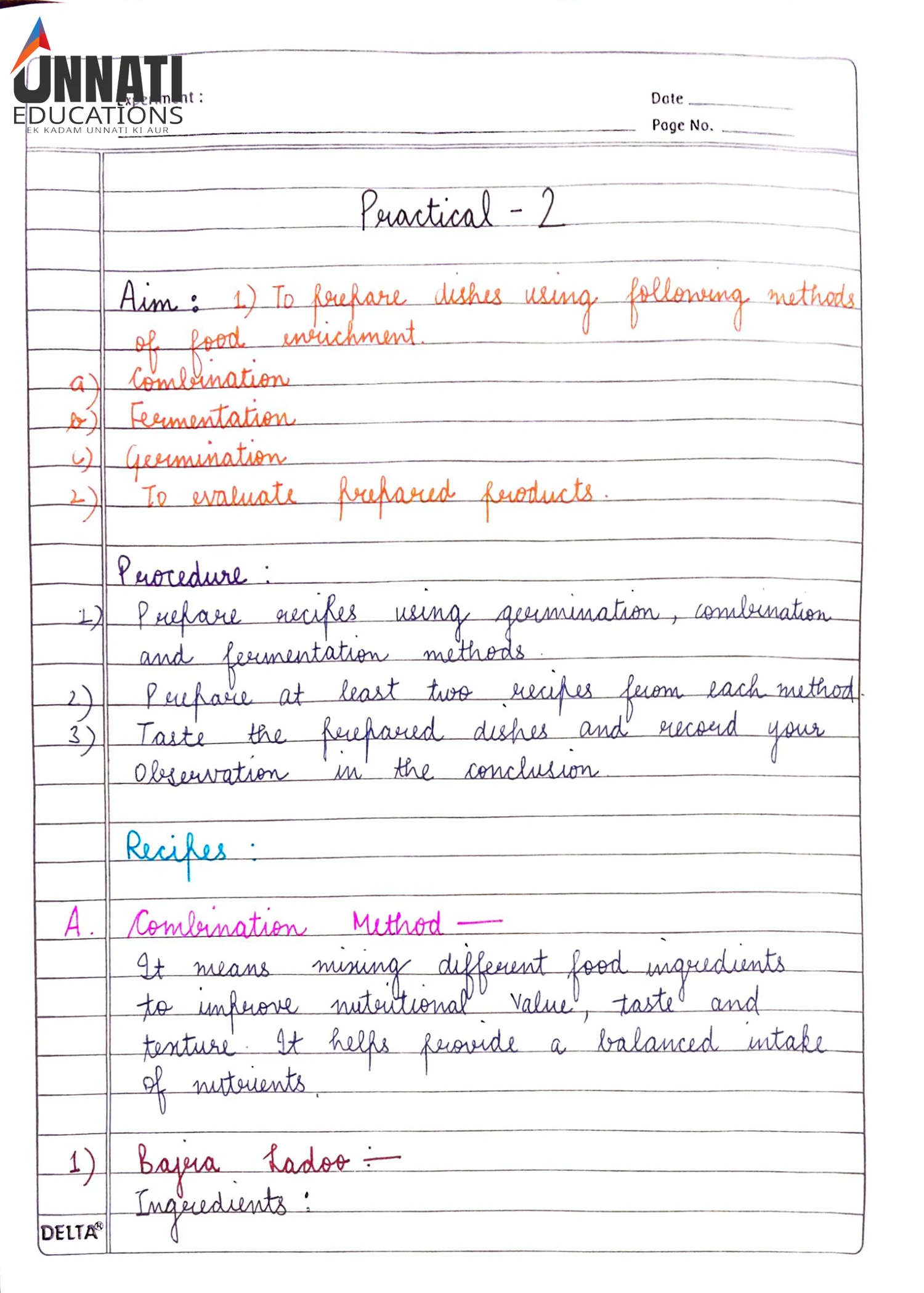 Page 12
Fibre Burning Test Results
The burning test results with flame behaviour, odour and residue for each fibre.
View Full Page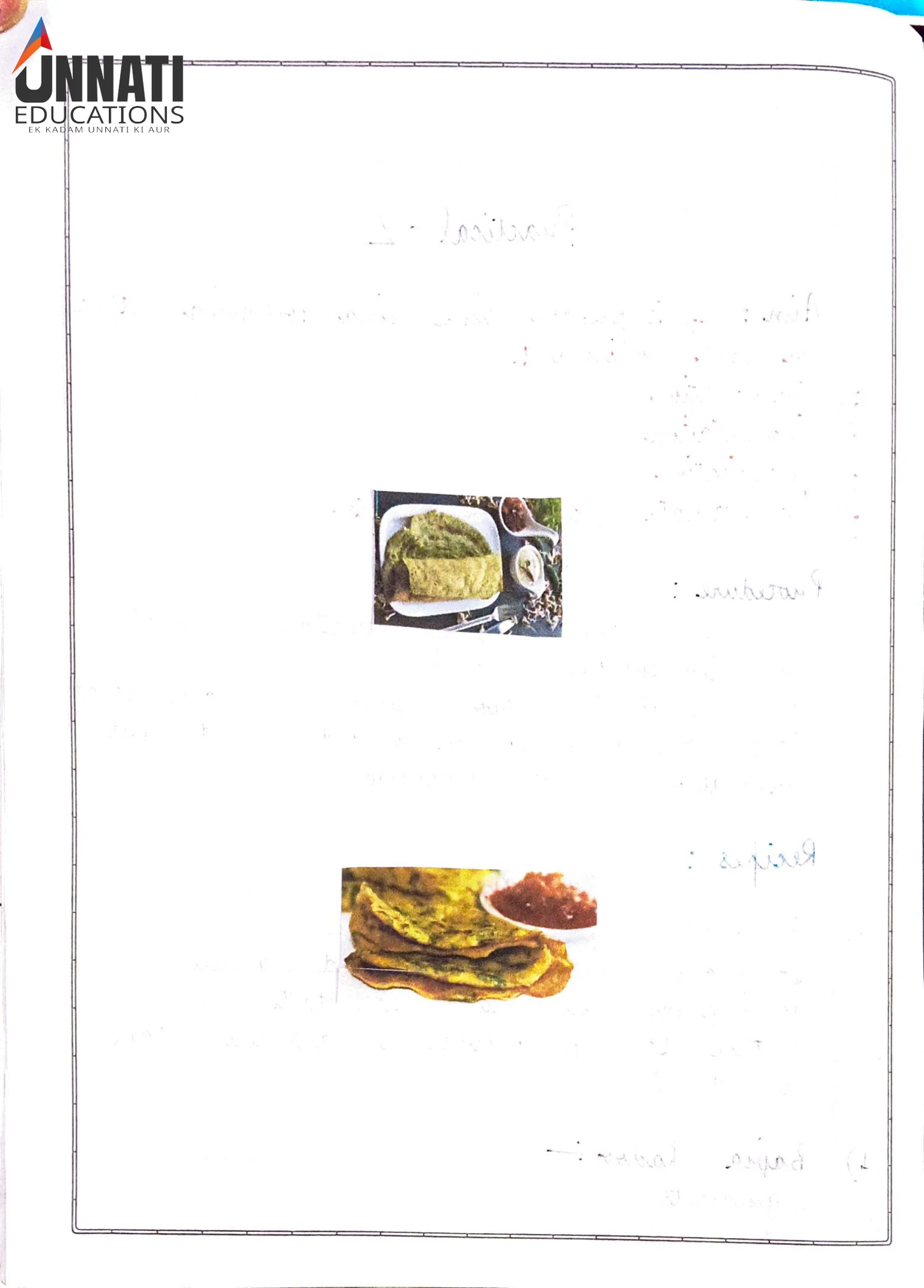 Page 13
Child Language Observation Table
Experiment 7, child language observation — the comparison table for 18-month and 3-year-old children.
View Full Page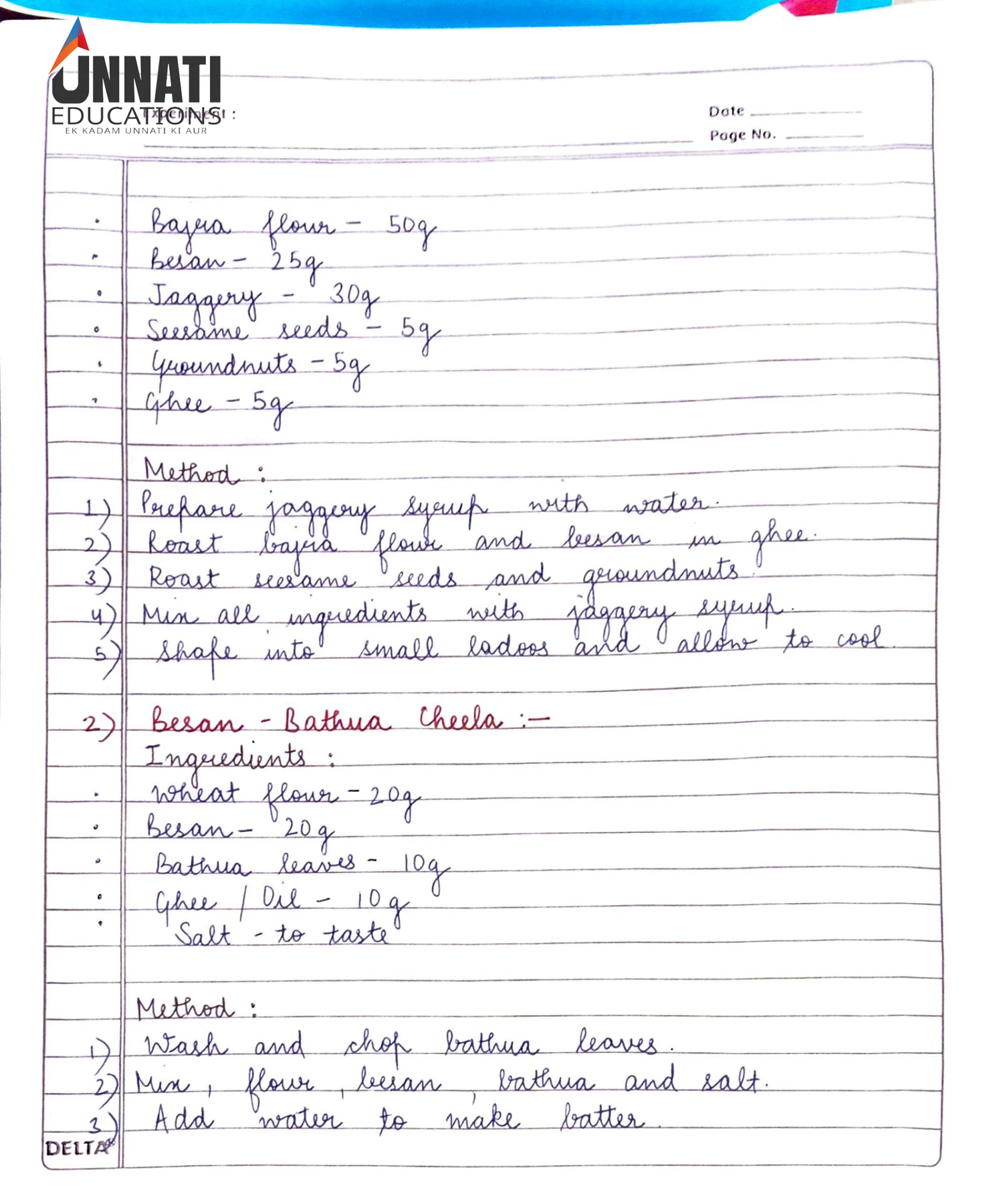 Page 14
Emotional Behaviour and Social Adjustment
Experiment 8, emotional behaviour observation notes and social adjustment rating scale.
View Full Page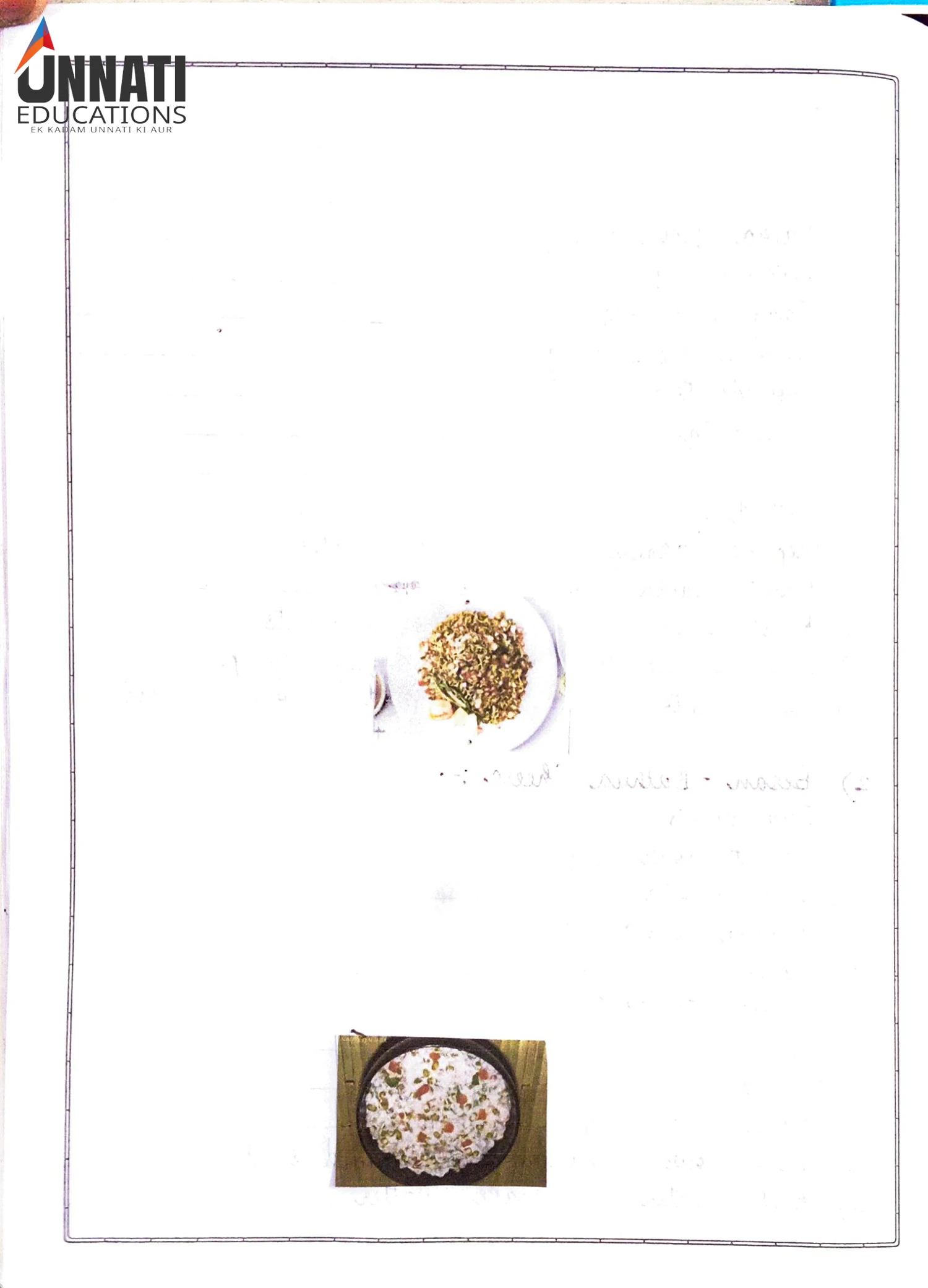 Page 15
Adolescent Development Interview
Experiment 9, adolescent interview — the structured questionnaire and key response summary.
View Full PageFifteen pages is enough to see the pattern hold across food, textiles, family resources and child development. The rest of the record keeps the same care, and you receive the complete set once you place a request.
What the NIOS Class 12 Home Science 321 Practical Files Cover
The file follows the official practical scheme for Home Science 321 at the senior secondary level. It works through food, textiles, family resources, pollution and child development, which are the areas the syllabus asks you to demonstrate through activity rather than theory. Each practical is written with an aim, a materials list, a step-by-step method, observations and a conclusion, exactly in the order an examiner reads.
This subject file is one part of our wider collection of NIOS Class 12 Practical Files, so the format stays consistent with what other Class 12 learners submit. Nothing is copied from a template, though. The food-preservation recipes, the fibre-burning results and the child-observation tables are written out in full so the content reads like genuine lab work, not a filler page.
Because Home Science rewards presentation, we do not stop at plain text. Real photos of the prepared dishes, hand-drawn charts, a food-pyramid illustration and clean four- and five-column tables are placed where each experiment needs them. That is the sort of detail that earns the record-book and viva marks most students lose.
Complete Index of Experiments in the Home Science 321 Practical File
Here is the complete index of practicals inside the file. The list is built strictly around the current NIOS Class 12 Syllabus for Home Science, and each row shows the actual work covered rather than a repeated one-line description. This is the same running order you will see in the file itself.
| No. | Practical / Activity | Key work covered in this experiment |
|---|---|---|
| 1 | Preservation of seasonal foods | Mixed vegetable pickle, mango chutney, apple jam, squash and tomato ketchup; sterilising jars, and using salt, vinegar and sugar as preservatives |
| 2 | Food enrichment methods and evaluation | Combination (bajra ladoo, besan-bathua cheela), germination (sprouted green gram raita, dalmoth chaat) and fermentation (idli, khaman dhokla) |
| 3 | Classification of food items into food groups | Sorting about fifteen everyday foods by major nutrient into cereals, pulses, milk and meat, fruits and vegetables, and fats and sugars |
| 4 | Sources of pollution and remedial measures | Surveying air, water, soil and noise pollution in one's own locality, then listing causes and practical remedies for each |
| 5 | Distribution of household tasks by age and gender | Mapping who does which task inside and outside the home, followed by an age and gender analysis of the family's workload |
| 6 | Family monthly expenditure and spending plan | Recording income sources and weekly spending, working out savings, and drawing up a budget for the following month |
| 7 | Language development in children | Observing a child of about eighteen months and one of about three years, then comparing simple, complex, complete and incomplete sentences |
| 8 | Emotional and social behaviour of children | Recording triggers of anger and fear in a toddler and rating social behaviour of three- to five-year-olds, then classifying social adjustment |
| 9 | Adolescent development interview | Interviewing a teenager about physical, social and emotional changes, including gender-specific changes and how they are managed |
| 10 | Identification of fibres by visual and burning test | Comparing cotton, wool, silk and polyester by lustre, texture and weight, then by flame behaviour, odour and residue to separate natural from synthetic |
This index doubles as a revision checklist. Once you can recall what each of these ten entries actually involves, the viva questions stop feeling random, because the examiner draws straight from this list. If you want to line the file up against the theory paper, our NIOS Class 12 Syllabus pages show which modules feed into these experiments.
How We Make Each Home Science 321 Practical File by Hand
Every file is written by a person, not printed from a machine, because NIOS practical work is meant to look like your own effort. We solve each experiment first, arrange the observations, and only then write the file out in a steady, readable hand that an examiner can follow without strain.
Presentation is handled the same way for each subject in our NIOS Handwritten Practical Files range. Diagrams are drawn cleanly, coloured headings separate one practical from the next, and the images are trimmed and pasted so the page looks finished. The writing stays simple and clear, which matters more than fancy language when a teacher is marking dozens of files.
We also keep the explanations easy to understand. If you want to revise before the viva, you can read the file and actually learn how a jam sets, why fermentation improves idli, or how a burning test tells silk from polyester. A file that teaches you is far more useful than one you copy blindly.
How Every Home Science 321 Experiment Is Solved and Explained
We do not just fill blanks. Each experiment is written so the reasoning behind the reading is visible. The food-preservation page explains why sugar concentration prevents microbial growth, and the fibre-burning page ties the odour and residue to the chemical structure of natural versus synthetic fibres.
The household-survey experiments get extra attention. The pollution page walks from local observation to cause to remedy, and the child-development pages explain what typical behaviour looks like at each age so the observation notes make sense. That is the depth an examiner rewards in the viva.
For learners who like to cross-check the method against the prescribed source, our NIOS Solved Lab Manual lays out the standard procedure for each experiment, so you can see that the file and the manual agree before you write a single word in your own copy.
Why Students Trust Our Home Science 321 Practical Files for 2026
The honest reason students come back is that the file simply works on submission day. It follows the current lab manual, the tables are complete, and the handwriting looks like a genuine student effort rather than a downloaded printout, which keeps the examiner comfortable.
There is also the time it saves. Copying a well-made record takes an evening, whereas building one from scratch, working out three family budgets and pasting fibre-burning photos, can eat a full week you probably do not have close to your exam.
Families across many states rely on the same standard, and our wider set of NIOS Practical Files follows the identical approach for other subjects, so once you know how the Home Science file is built you know exactly what to expect elsewhere.
How the Home Science 321 Practical Exam and File Are Assessed
The Home Science 321 practical carries 20 marks and runs alongside the 80-mark theory paper for a total of 100. The practical examination itself is a three-hour session where you perform activities, present readings and face a short viva with the examiner.
Your practical file, the record book you submit, is a marked component in its own right. A complete, neat and correctly filled file makes a strong first impression and supports you in the viva, because the examiner questions you directly from the experiments you have recorded.
This is exactly why a thin or half-finished record hurts more than students expect. A well-kept file backs up your spoken answers, and the two together are where most of the practical marks are quietly won or lost.
| Component | Marks | What is assessed |
|---|---|---|
| Two activities from the main modules | 8 | Correct method, observation and result for the chosen practicals |
| One activity from the optional module | 4 | A single practical from the optional area of study |
| Record book (practical file) | 4 | Neatness, completeness and correct format of the written file |
| Viva voce | 4 | Oral questions on the experiments you have performed |
How to Get Your Home Science 321 Practical File Delivered
Getting the file is simple. Message us on WhatsApp with your medium and the session you are appearing in, and we send the completed NIOS Class 12 Home Science 321 Practical Files ready for you to copy into your own record book by hand.
We prepare it for the 2026 session on the current lab manual, cover all ten experiments with filled observations and diagrams, and keep the delivery quick so you are not left waiting close to your submission date.
Home Science Study Material That Works Well With Your Practical File
A practical file lands best when the rest of your preparation is in place, so it is worth pairing it with the theory support for the same paper. Reading the concepts behind each experiment makes the viva far easier, because you can explain a reading instead of only reciting it.
For that side of the work, our collection of NIOS Study Material gathers solved assignments, notes and previous papers in one place, which rounds out the Home Science 321 record with the written preparation your board exam needs.
Who Needs This Home Science 321 Practical File
This file suits anyone taking Home Science 321 who wants their practical work settled without weeks of trial and error. Learners who missed their contact classes, students juggling a job with study, and anyone unsure of the correct NIOS format tend to gain the most from it.
If you have been hunting for dependable NIOS Practical Files and keep finding outdated or half-finished samples, this is the steady option. It gives you a correct starting point, saves the hours you would spend formatting from scratch, and leaves you to focus on the theory paper instead.
Common Questions on the Home Science 321 Practical File
Do the Home Science 321 practical files cover all ten NIOS experiments?
Yes, the file covers every one of the ten experiments in the NIOS lab manual for Home Science 321, from food preservation through to fibre identification. Each experiment includes its aim, materials, method, filled observation table, conclusion and precautions, so nothing is left incomplete when you sit down to copy it into your own record book.
Are the Home Science 321 practical files handwritten or printed?
Our Home Science 321 files are fully handwritten by real people on one-sided ruled practical paper, exactly as NIOS expects. Diagrams are drawn and labelled by hand, and food photos are trimmed and pasted where needed. This human handwriting looks genuine to an examiner, which is a quiet advantage over printed or clearly machine-produced records.
How many marks does the Home Science 321 practical carry?
The Home Science 321 practical carries 20 marks, which sit alongside the 80-mark theory paper to make 100 in total. Your record book is a marked component, and the viva draws directly from the experiments you have written up. A complete, neat and correct file therefore supports both the file assessment and your spoken answers on the day of the examination.
Is the Home Science 321 practical file valid for the 2026 session?
Yes, the file is prepared for the 2026 session and follows the current NIOS lab manual for Home Science 321. The experiment list, procedures and observation formats all match the latest pattern, so whether you appear in the April or October 2026 cycle, the record you copy stays aligned with what your examiner expects to see at the centre.
Can I see the Home Science 321 practical file before requesting it?
Yes, the sample section on this page shows fifteen real pages from the completed Home Science 321 file, spanning food, textiles, family resources and child development experiments. Those pages let you judge the handwriting, diagrams and filled tables for yourself. Once you are satisfied with the quality, you can request the full set through WhatsApp and receive it ready to copy.
How do I receive my Home Science 321 practical file?
You receive the Home Science 321 practical file after messaging us on WhatsApp with your medium and exam session. We share the completed record so you can reproduce it by hand in your own copy. Delivery is kept quick so you have enough time to write, paste any required images and submit the file comfortably before your practical date.
Contact Unnati Educations - Your Academic Lifeline
If you're eager to begin your journey or need guidance in the NIOS admissions process, we're just a message away.