

BSOC 103 - Course Meaning, Scope & Why This Paper Is Worth Doing
BSOC 103 (Introduction to Sociology): Learners are introduced to the ways in which society works, people are related to groups, and institutions maintain or change social order. This course covers:- Functionalism perspective (Malinowski, Radcliffe-Brown)
- Structuralist (Claude Levi-Strauss)
- Conflict theories (Dahrendorf)
- Interpretive sociology (Max Weber)
- Symbolic Interactionism (G. H. Mead)
- Basic concepts such as roles, norms, and culture
- Social order and social change
- Clear headings
- Theoretical accuracy
- Conceptual depth
- Realistic examples
- A short conclusion
BSOC 103 Question Paper June 2025 - Showcase Question Paper of Hindi Medium and English Medium
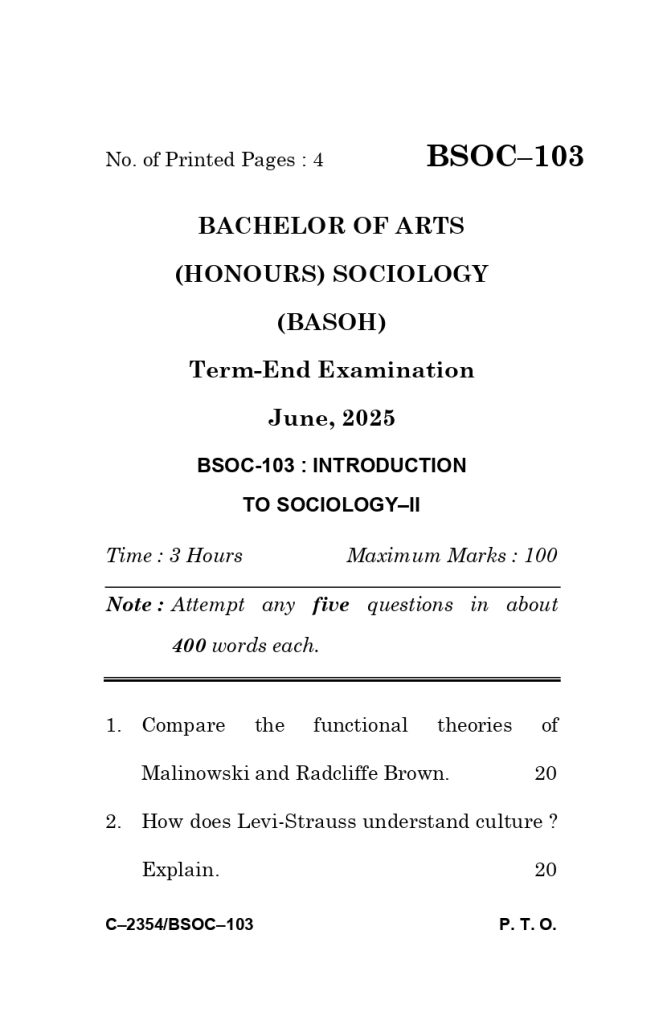
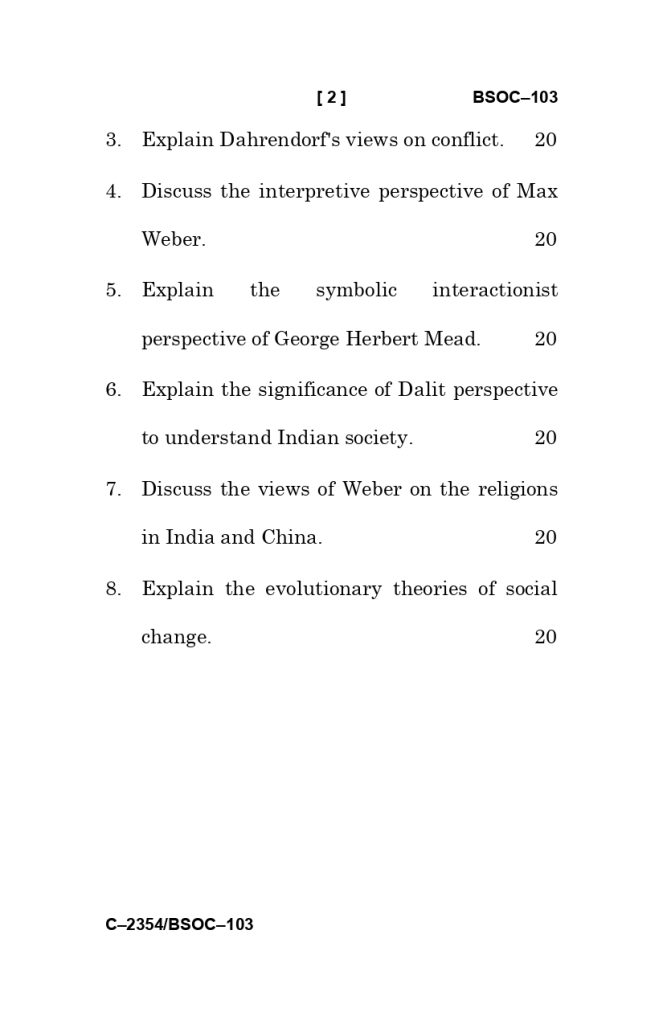
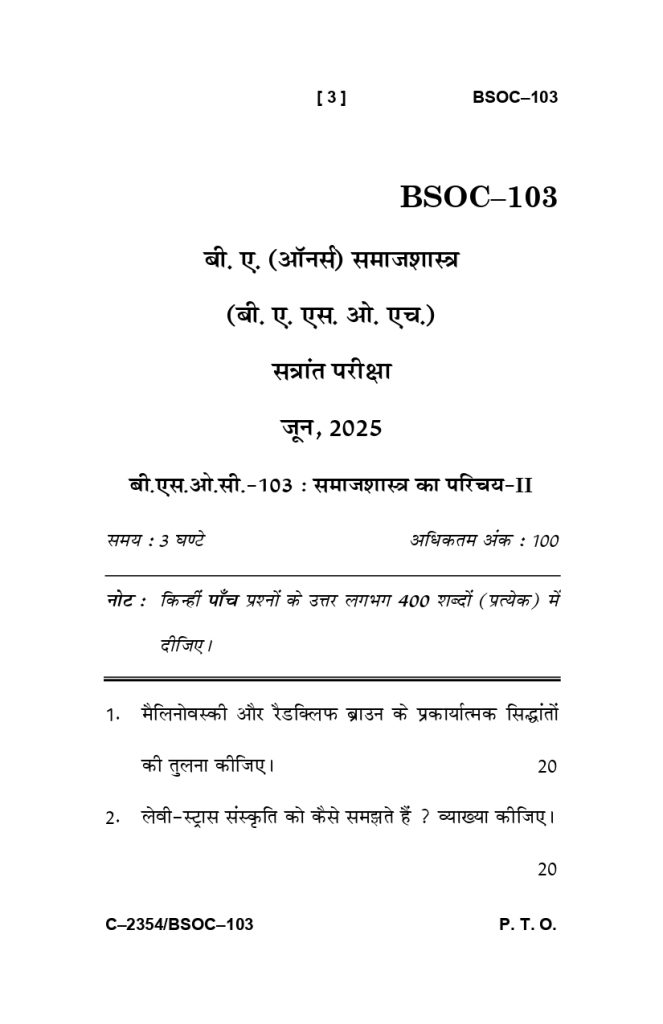
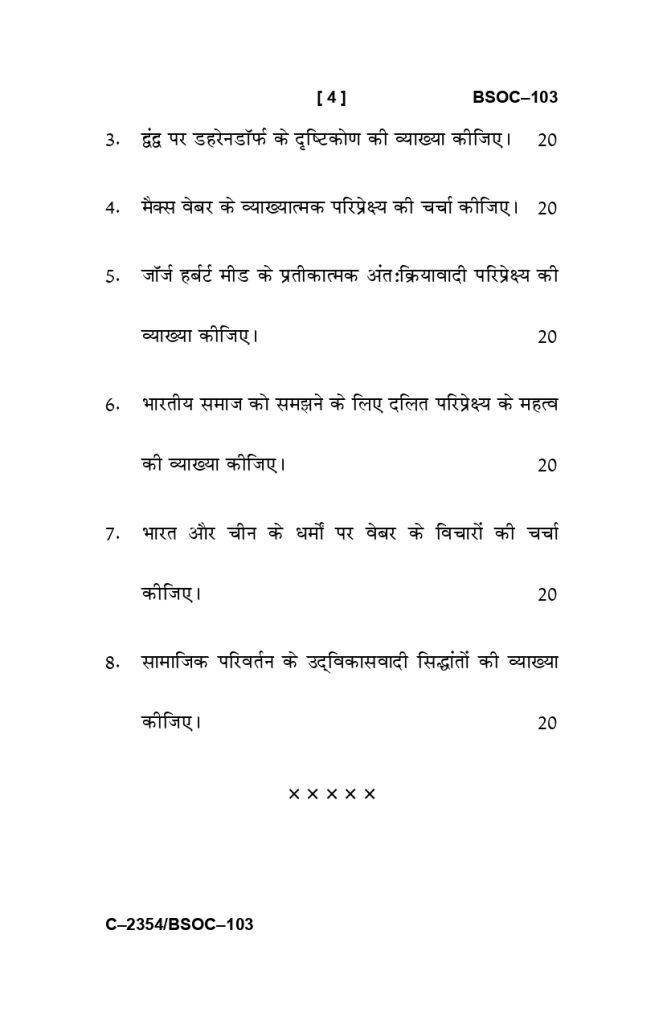
Want Solutions of the BSOC 103 question paper of June 2025?
Students who wish to get complete solutions for the BSOC 103 question paper, or personalized support for writing theories, structuring answers, or understanding thinkers, can reach out to our team. We help learners with note-taking, structure, past papers, and annotations so that they can prepare for their exams confidently and effectively.BSOC 103 question paper June 2025 - Pattern Overview
Make an attempt at any five questions carrying equal marks. All were long-answer questions, in which the student was to write 400-450 words, organized by means of the definitions, contribution of theorists, examples and brief conclusions. Exam Pattern Table - BSOC 103 June 2025| Section | Type of Question | Marks | What Examiners Expect |
|---|---|---|---|
| Q1 | Functionalism – needs, institutions, roles | 20 | Logical headings + correct concepts |
| Q2 | Culture as a system of signs | 20 | Levi-Strauss + binary oppositions |
| Q3 | Conflict theory (Dahrendorf) | 20 | Power (authority), interests, results |
| Q4 | Interpretive outlook of Max Weber | 20 | Meaningful action, ideal types |
| Q5 | Symbolic interactionism (G. H. Mead) | 20 | I–Me, self, role-taking |
| Optional | Kinship, marriage, myths, reproduction, social order | 20 | Coherent arguments + examples |
Fundamentalism - The Heart of Question 1 (BSOC 103)
The June 2025 paper stated that it began with the basics of functionalism, which focuses on the way in which society continues to survive by meeting their individual and collective needs.Basic Orientation - Individual Needs & Social Needs
Functionalism sees society as a system in which all parts of society have a function. Needs can be grouped as: Biological Needs:- Food, shelter, clothing
- Protection, reproduction
- Economic cooperation
- Social control
- Allocation of roles
- Collective identity
- Belief systems
- Rituals
- Emotional stability
- Community bonding
- Need
- Institution
- Economic security
- Economy
- Care, identity
- Family
- Emotional support
- Religion
- Social order
- Law and norms
The Institutions as "Self-Contained Wholes".
Functionalism considers institutions as entire structures that have:- Roles
- Norms
- Values
- Sanctions
Psychological Functions - Rituals & Magic
Malinowski emphasised the role that rituals play in lowering anxiety in uncertain situations.- Rituals - emotional balance
- Magic - sense of control
- Beliefs - strengthen solidarity
Social Roles - Structural Universals & the Maintenance of Social Forces
The BSOC 103 paper required the students to make connections between social roles and structure. Key Points to Include:- Every role has expectations
- Roles maintain social order
- Role performance is taught through socialisation.
- Role conflict and role strain influence behaviour
- There are universal roles in all societies
Question 2: Culture is a System of Signs (Levi-Strauss)
The structuralist approach to culture as a system of signs was introduced by Claude Levi-Strauss. The June 2025 question stressed:- Culture is NOT simply behaviour
- Culture = symbols + meanings
- Cultural rules organise thinking
- Humans categorise the world in terms of signs
Characteristics of Culture as Sign System
Symbolic Codes:- Language, laws of kinship, rituals, taboos.
- Deep unconscious principles are common to all humans.
- Nature vs Culture
- Raw vs Cooked
- Male vs Female
- Life vs Death
Culture Starts Where Nature Stops
This famous idea explains the transformation of human beings through biological processes:- Biological reproduction - social reproduction (rules of marriage)
- Natural growth - cultural upbringing (the norms)
- Body rituals - symbolic meanings of society
Marriage & Exchange: Levi Strauss View
Marriage is, according to Levi-Strauss:- It is a transaction between groups
- Creates stable alliances
- Ensures social continuity
- Organises kinship
Why Scoring in BSOC 103: Culture Questions
- Theories are predictable
- Easy to create headings
- Examples can be simple
- Clear structure = high marks
Question 3: Conflict Theory
Conflict theory, which considers society not as a harmonious structure but as a place of competing interests.Why Conflict is Key to Social Change
According to Ralf Dahrendorf:- Conflicts prevent stagnation
- Conflict is Normal, not Pathological
- Authority relations - create tension
- Groups of people who share common interests and who challenge domination
- Organized groups can demand redistribution
- Clear authority relations
- Awareness of mutual interests
- Capacity for group organisation
- Positive Outcomes
- Negative Outcomes
- Structural reforms
- New contradictions
- Redistribution of power
- Temporary instability
- More participation
- Group hostility
Question 4 Max Weber's Interpretive Perspective
Max Weber is the one who proposed the interpretive approach to sociology, and its focus is on the meaning behind action.Social Action - Meaning as the Key
Weber argued:- Sociology must be concerned with meaningful action
- Individuals behave according to intentions
- Meaning guides behaviour
- Action is subjective & understandable
- Direct understanding (understanding the expression immediately)
- Explanatory understanding (understanding motives)
- Both forms are necessary in order to explain behaviour.
Ideal Types
Weber used the ideal types to simplify complex realities. Examples:- Bureaucracy
- Protestant ethic
- Types of authority
Types of Social Action
| # | Type | Meaning |
|---|---|---|
| 1 | Instrumentally rational | Goal-driven |
| 2 | Value rational | Ethical belief-driven |
| 3 | Affective | Emotion-driven |
| 4 | Traditional | Habit-driven |
Rationalisation & Bureaucracy
Weber explained modern society using :- Increasing calculation
- Formal rules
- Efficiency
- Organized authority
Religion & Meaning
Weber studied:- India
- China
- Judaism
- Protestantism
Question 5 - symbolic interactionism (G. H. Mead)
Symbolic Interactionism by George Herbert Mead is the interaction and expression of symbols as the way society is made. The June 2025 BSOC 103 question paper asked students to explain the meaning, action, and development of the self.Symbols as the Base of Communication
Meaemphasized:- Humans communicate using big symbols
- Words, gestures, and expressions assume a meaning
- Symbols help individuals to anticipate other people's responses
- Interaction helps to shape identity and behaviour
- Communication is not merely the exchange of words -- it is a basis of social life.
Stages of Action
Mead described four stages:- Impulse - Immediate reaction
- Perception - Identification of the situation
- Manipulation - Considering alternatives
- Consummation - Execution of finalising the action
Development of Self - "I" and "Me"
The most important concept is this:| # | Component | Meaning |
|---|---|---|
| 1 | I | Creativity, spontaneity, unpredictability, self |
| 2 | Me | Socialized, rule-following self influenced by others |
Role Taking - Understanding Expectations
Role-taking enables people to:- See themselves from the point of view of others
- Understand expectations
- Coordinate behaviour
- Participate in society productively
- Child imitates simple roles
- No complete comprehension of elaborate expectations
- A child learns multiple roles
- Understands rules, co-operation, and group behaviour
Why BSOC 103 Is A TheoTheory-Heavy High-Scoring
Many students become intimidated by the number of theorists in the BSOC 103 course. However, this paper is actually one of the most predictable papers in the Sociology Honours programme because: Theories rarely change- IGNOU Repeat thinkers frequently
- Answers are rewarded for headings, not stories
- Examiners prefer frameworks (structure)
- Simple examples quickly earn marks
Thinkers for Quick Recall: Concept Map
Functionalism - Malinowski, Radcliffe-Brown| Topic | Key Concepts |
| Needs | Institutions, Harmony, Solidarity |
| Structuralism – Levi-Strauss | Symbols, Binary Oppositions, Myths, Marriage Exchange |
| Conflict Theory – Dahrendorf | Authority, Interests, Group Organisation, Outcomes |
- Meaning
- Social action
- Ideal types
- Rationalizationon
- Symbols
- Role-taking
- "I" and "Me"
- Self as social
How to Write Sociology Answers That Will Please the Examiners
To score well in the BSOC 103 question paper, students should keep the answers: Structured: Make use of headings such as Definition - Features - Examples - Conclusion. Conceptual: Focus on ideas, not emotionally telling stories. Crisp: Short sentences make things more understandable. Comparative: Whenever possible, make comparisons between thinkers. Exam-oriented: Always add a 2-3 line conclusion. These five habits lead to immediate improvements in the quality of the answers.Timeline - How To Prepare BSOC 103 In 7 Days
| # | Day | Topics to Study |
|---|---|---|
| 1 | Day 1 | Malinowski – functional needs |
| 2 | Day 2 | Radlitz-Brown – social structure |
| 3 | Day 3 | Levi-Strauss – culture as a sign system |
| 4 | Day 4 | Dahrendorf – conflict theory |
| 5 | Day 5 | Max Weber – interpretive sociology |
| 6 | Day 6 | Mead – symbolic interactionism |
| 7 | Day 7 | Practice 5 years’ previous papers |
How to Get an 80 and Above for BSOC 103
- Use a Minimum of 8-10 Headings in every long answer
- Explain to me - in your own words - theorists
- Use brief examples (from everyday or easy situations)
- Do NOT write stories, be conceptual
- Provide a concluding paragraph for each answer
- Practice writing definitions in a sentence
- Keep handwriting neat and spelling clean
- Sociology is rewarded for structure and memorisation.
Comparison Table: Functionalism vs Conflict Theory vs Symbolic Interactionism
| Aspect | Functionalism | Conflict Theory | Symbolic Interactionism |
| Focus | Stability & needs | Power, inequality, change | Everyday interaction |
| Key Thinkers | Malinowski, Radcliffe-Brown | Dahrendorf | Mead |
| View of Society | System of functions | Arena of conflict | Process of interaction |
| Change | Occurs slowly | Essential & constant | Micro-level shifts |
| Method | Observation of roles & institutions | Analysis of relations of authority | Study of symbols & meanings |