When we study the BCOS 183 question paper, we often look for clarity. We want to know what the exam expects, what concepts are repeated in the exam, and how we can write answers that score full marks. As a team that has been helping the IGNOU learners for quite some time, we analysed the June 2025 paper quite deeply in order to break down every section, every pattern and every scoring opportunity. This guide presents you with a clear, readable, and structured view that any student could follow easily. If anyone needs IGNOU help or wants more previous papers, they can visit our official page here: here: https://www.unnatieducations.com/ignou
BCOS 183 Question Paper June 2025
Many students look online for resources like BCOS 183 solved question paper, detailed write-ups from the BCOS 183 question paper June 2025, topic-wise BCOS 183 Important Questions, and full BCOS 183 question paper solution guides. These terms show great interest from the learners in order to get clarity, structured explanations, and easy-to-read content before their term-end exam. So, we designed this blog to accommodate the same kind of doubts with easy and comprehensive coverage.
See the full question paper video (BCOS 183 question paper)
BCOS 183 (Computer Application in Business) - Exam Pattern of June 2025
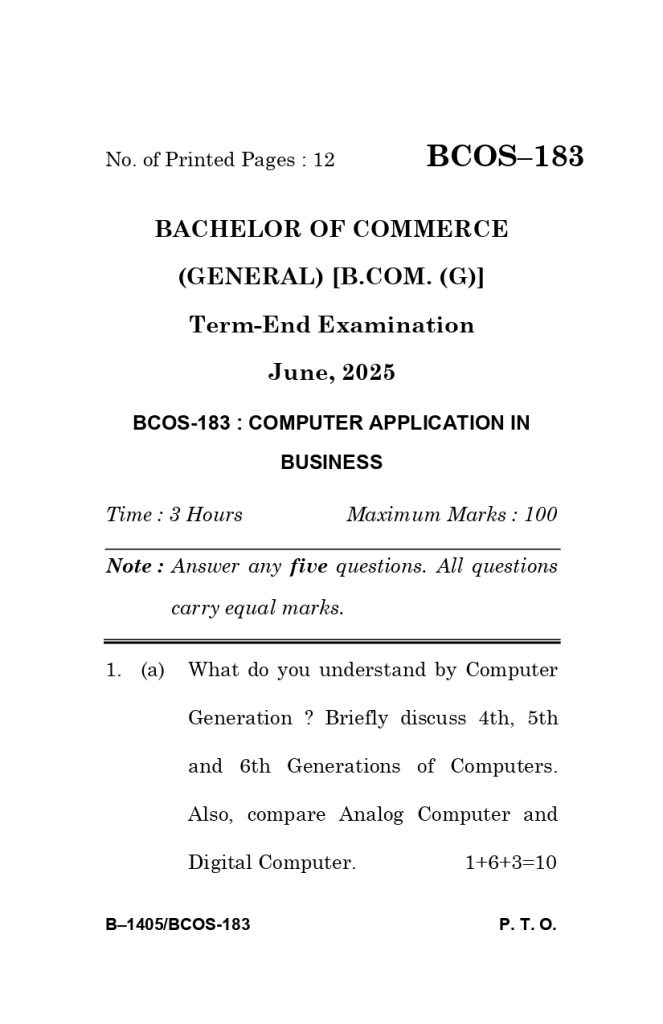
The BCOS 183 question paper continues its classic IGNOU design: eight main questions, out of which learners answer any five. Each question is of equal marks, and each of them is a combination of theory, comparison-based questions, and practical explanations. The uploaded paper clearly uses this approach, in which questions cover:- Computer Generations and Comparison
- Depreciation accounting techniques
- OS, DSS, MIS, NEFT, RTGS, networks, CAPTCHAs, GDPR etc.
- Ratio calculations, capital budgeting, spreadsheet concepts, mail merge, Business tools (YouTube & Adsense)
BCOS 183 Question Paper June 2025 Sample Pages
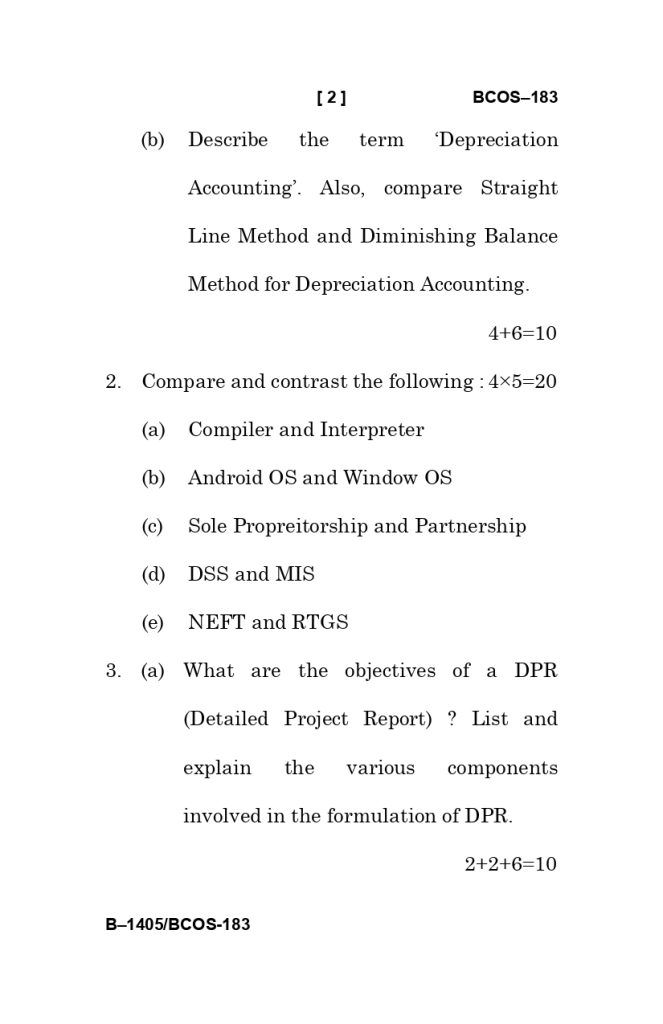
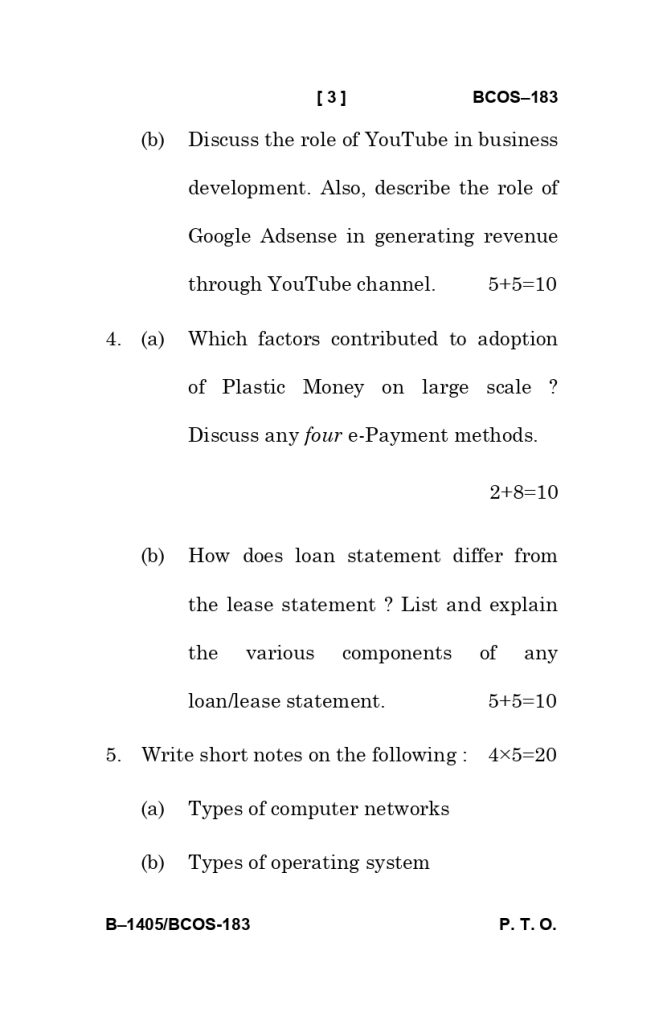
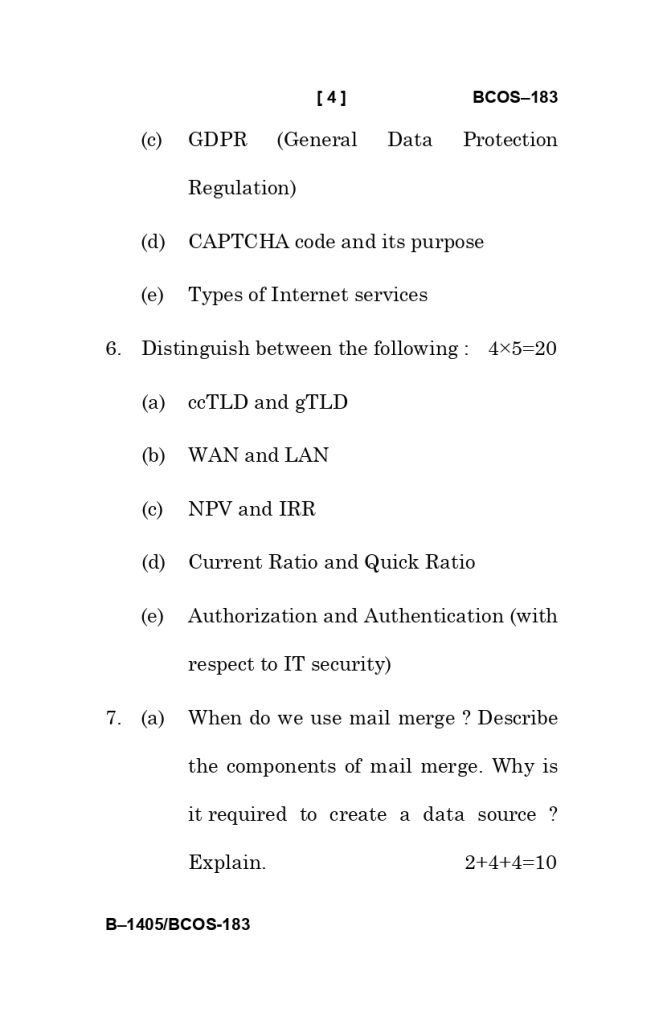
BCOS 183 - Course Code and Why It is Important
Students often wonder why course codes are relevant. For IGNOU, course codes such as BCOS 183 will serve as an identifier for:
- Subject grouping
- Programme structure
- Credit mapping
- Exam pattern referencing
This particular code means Computer Application in Business, which is a subject that is all about the digital tools, computing basics, applications built for business, and basic IT-related concepts.
Understanding Computer Generations (BCOS 183)
Computer generations refer to the development of technology over time. Each generation is a major upgrade to hardware, processing, memory, and system architecture.
4th Generation Computers
- Based on microprocessors
- IBM PCs, Apple systems
- Increased memory & magnetic Disk use
- Speeds moved into the microseconds
- Portable, smaller, and faster
5th Generation Computers
- Based on AI concepts and sophisticated chips
- Intelligent processing
- Natural language enhancements
- Higher computational power
6th Generation Computers
- Uses neural networks (ANN)
- High storage efficiency
- Advanced processing speeds
- Improved automation
Comparison: Analog Vs Digital Computers (Table 1)
| Basis | Analog Computer | Digital Computer |
|---|---|---|
| Data Type | Continuous values | Binary (0 & 1) |
| Accuracy | Less precise | Highly accurate |
| Output | Graphical/smooth readings | Numeric/symbolic display |
| Use Case | Scientific simulations | General applications |
Accounting of Depreciation in BCOS 183 (Course Topics Analysis)
Depreciation Accounting means assigning the cost of a fixed asset during its lifespan. It helps to ascertain the true financial position and also ensures that the costs are matched with the revenues or income.Straight Line Method (SLM)
- An equal amount of depreciation each year
- Formula: (Cost-Scrap Value)/Useful Life
- Suitable for assets that are used uniformly
Diminishing Balance Method (DBM/Written Down Value)
- Depreciation decreases each year.
- Charged on book value remaining
- Suitable for assets that lose value at a faster rate
Significant Comparisons in BCOS 183 (June 2025)
Compiler vs Interpreter
- The compiler compiles the entire program at a go
- An interpreter to translate line by line
Android OS vs Windows OS
- Android: Mobile-based, open source
- Windows: desktop-based keyboard-driven)
Sole Proprietorship vs Partnership
- Sole: One owner, control of the company, limited capital
- Partnership: shared responsibility, increased resources
DSS vs MIS
- DSS: semi-structured decisions, flexible
- MIS: reporting routine, structured, standardized
NEFT vs RTGS
- NEFT: batch settlement - suitable for small/medium value
- RTGS: on-the-spot, minimum value ₹2 lakh
Breakdown of DPR (Detailed Project Report)
A DPR is an overall plan that is developed prior to the implementation of a project. Objectives- Assess feasibility
- Estimate costs
- Identify risks
- Provide an implementation road map.
| Component | Description |
|---|---|
| Executive Summary | Overview of the project |
| Promoter Details | Experience & capability |
| Market Analysis | Demand study |
| Technical Feasibility | Technology & process |
| Financial Planning | Cost, funding, projections |
| Management Plan | Structure, manpower |
| Timeline / Implementation | Milestones |
| Social / Environmental Impact | Compliance & benefits |
Role of YouTube & Google AdSense in Business Growth
(Reference from Question 3(b) ) Businesses use YouTube for:- Brand visibility
- Product demonstrations
- Building trust: workshops with tutorials
- Cost-efficient outreach
- Ad placements
- Revenue sharing
- Engagement-based earnings
- Traffic monetisation
Plastic Money & E-Payment Methods (BCOS 183 Topic)
Plastic money is one of the digital cards that are used in place of physical currency. Why Adoption Increased- Convenience
- Rewards & cashback
- Security features
- Growth of digital banking
- Debit Cards
- Credit Cards
- Mobile Wallets
- Internet Banking Tools (NEFT, RTGS, IMPS)
Loan Statement Vs Lease Statement
(Reference from Question 4(b) )Loan Statement
- Ownership remains with the borrower.
- Includes principal + interest
- Recorded as a liability
- Fixed repayment tenure
Lease Statement
- Ownership stays with the lessor.
- Payment (includes rent + lease charges)
- Flexible terms
- Considered a business expense
Short Notes from BCOS 183 (June 2025)
(Reference from Question 5 )Types of Computer Networks
- PAN, LAN, MAN, WAN, SAN, VPN
Types of Operating Systems
- Batch, Multiprogramming, Multitasking, Time-sharing, Real-time, Distributed, Network OS
GDPR
- Data protection law
- Rights: access, portability, erasure
- High penalties for failure to comply
CAPTCHA
- Verifies human users
- Prevents bot attacks
- Types: text, image, audio, reCAPTCHA
Internet Services
- Email, Cloud Sharing, VoIP, Browsing, Social Media, E-Commerce
Differentiate Between (BCOS 183 Exam Topics)
(Reference from Question 6 ) Key differences include:- ccTLD vs gTLD
- WAN vs LAN
- NPV vs IRR
- Current Ratio vs Quick Ratio
- Authorisation vs Authentication
Mail Merge Concepts in BCOS 183
(Reference from Question 7(a) ) Mail merge is used while sending personalised documents in bulk, e.g., notices or invitations. Components- Main document
- Data source
- Merge fields
Ratio Analysis & Digital Concepts
(Reference from Question 7(b) )Net Profit Ratio
Profit earned following all expenses.Gross Profit Ratio
Demonstrates profit before operating expensesIdentity Theft
Stealing personal digital information.E-Wallets
Digital Wallets Used For Online TransactionsOpen-Source Software
Freely available software with code modification.Spreadsheet Concepts (BCOS 183 Practical Theory)
(Reference from Question 8(a) )Functions vs Formulas
- Functions are predefined
- Formulas are the user-defined expressions
Formula vs Array Formula
- Array formulas process multiple values at once
Absolute vs Relative Addressing
- Absolute: Fixed cell reference
- Relative: moves according to the location
Functions of an Operating System
(Reference from Question 8(b) ) An operating system is responsible for hardware management, memory management, process management, input/output management, security, and file system management.BCOS 183 Chapter-wise Weightage Trend
Students do well to know which topics are repeated often. By studying past papers, we observe that there would be more weightage on:
- Operating systems
- Networks
- Depreciation accounting
- Business digital tools
- Capital budgeting
Common Mistakes That Students Make
- Writing answers that don't have headings
- Overlooking the basis of comparison
- Not explaining examples
- Employing extremely brief definitions
- Missing Formulas in Ratio Questions
How to Prepare BCOS 183 Quickly
- Solve the last 5 years of papers
- Watch quick revision videos
- Practice writing structured answers
- Concentration on comparisons and short notes
BCOS 183 - Important Learning Outcomes Students Should Focus On
Many IGNOU learners often jump directly into solving the BCOS 183 question paper, but they miss the core learning outcomes of the subject. When we know the kinds of outcomes, the preparation becomes easier and quicker.
Ability to comprehend the basics of computing
Students should be able to explain some basic topics like generations of computers, OS features, compilers, interpreters, types of networks, etc.
Skills for using computing in business situations
The subject expects the students to be able to relate computer applications to accounting, financial ratios, depreciation, creation of DPR, and MIS reports.
Skills and knowledge to read and interpret digital tools
Learners should be familiar with e-payment methods and Internet services, CAPTCHA function, GDPR rules, and spreadsheet formulas.
Ability to use structured business logic
BCOS 183 helps in developing analytical thought using ratio analysis, IRR, NPV, data processing, and structured documentation.
When students prepare their answers to outcomes, their answers are more complete and score-ready.
Importance Chart of Chapter-wise for BCOS 183
Below is a visual breakdown of the importance of each chapter under IGNOU exams (this is based on June 2025 and previous exams):
| Chapter / Concept | Expected Weightage | Why It Matters |
|---|---|---|
| Computer Fundamentals | High | Definitions & comparisons |
| Operating Systems | High | Very common 10–20 marks |
| Computer Networks | Medium | Always asked for short notes |
| Depreciation Accounting | High | Repeated every year |
| Ratio & Capital Budgeting | Medium | Formula-based scoring |
| DSS / MIS | Medium | Application of business theory |
| Internet Services | Medium | Frequently used concepts |
| e-Payments | Medium | Trending topic for business |
| DPR | High | Detailed theory question |
| YouTube / Adsense | Medium | Modern digital business |
This table provides students with a tool that gives them a quick box of clarity that perfectly matches search intent.
BCOS 183 – Why Does IGNOU Repeat Some Questions Often
-
During the review of past papers, we realized that there are several BCOS 183 concepts that show up again and again.
-
They get repeated by IGNOU for a reason:
-
They represent key business computing knowledge.
-
Concepts such as types of OS, network, MIS, depreciation, IRR and NEFT / RTGS are among the basics of business technology.
-
-
They are easy to standardize in question papers.
-
Repeating concepts provides the opportunity to evaluate consistently over the years.
-
-
They correspond to the existing digital landscape of India
-
Topics such as e-payments, identity theft, YouTube monetisation and GDPR are all real practices in business.
-
-
They need clarity of concept, not memorization
-
These topics require understanding, not rote learning.
-
-
So, even if there is a change in the format of the paper, repetition of the topics makes it easy for students to bag marks easily.
Top tips to secure 70+ Marks for BCOS 183
-
IGNOU papers are rewarded for clarity, for their structure and for well-presented answers.
-
Based on our analysis of the paper in June 2025, here are strategies that help students maximise scores:
-
Always write headings and subheadings
-
Examiners are looking for visible structure. It helps them to check answers quickly.
-
-
Using tables of basis of comparison
-
IGNOU gives higher marks if compared in table form.
-
-
Add real-life examples
-
For example, when you are explaining NEFT, mention bank transfers.
-
While explaining about OS, mention Android or Windows.
-
-
Expand definitions into 2–3 sentences.
-
One-line definitions receive a low score. Three-line explanations give full marks.
-
-
For ratios, always clearly indicate formulas.
-
Even if your numerical example is incorrect, formula marks are awarded.
-
-
For written answers, write point-wise.
-
Simple bullet points allow the examiner to read faster.
-
-
These strategies are very effective in improving the scoring outcomes.
Technology Concepts in BCOS 183 Explained for Easy Memory
BCOS 183 is full of techy definitions. Below is a cheat sheet in an easy-to-understand format for students.Operating System (OS)
A system software to manage files, memory, hardware, users and computer communication.Compiler
Converts the whole program into machine code at one go.Interpreter
Translating line by line of code.VPN
A secure and encrypted connection over the internet.AI-based systems
Used in 6th generation computers that are providing automation and Intelligent decision making.Encryption
A technique for securing data by making it unreadable. This is a quick sheet that learners can refer to in exams to recall definitions.FAQs
What is BCOS 183 in IGNOU?
BCOS 183 is a core subject in the B.Com (General) programme of study, which covers computer applications that are used in business. It explains digital tools, operating systems, networks, accounting software, logic and business IT systems. Students study it to gain basic computer knowledge that is necessary in today's workplaces.How can I study the BCOS 183 question paper effectively?
Start by preparing chapter-wise concepts and then review previous papers. For instance, practice the method of depreciation and the OS classifications using quick notes. This is very helpful in understanding the pattern, and it also helps you to gain confidence as the questions are repeated in a similar format.Is the BCOS 183 paper of June 2025 hard?
Not really. The June 2025 paper is in a predictable format with theory-based questions. Students who prepare some comparisons, some definitions and short notes find it manageable. Understanding topics such as networks, DPR, DSS and RTGS makes the exam very simple and score-friendly.Which of the topics are most significant for BCOS 183?
Important topics are operating systems, computer generations, depreciation methods, networks, DSS and MIS, NEFT vs RTGS and capital budgeting. These topics are frequent and, on aggregate, have 20-40 marks, thus providing a solid scoring base for students.Where can I find more IGNOU papers?
Students who would like to have more previous papers and solved guides may visit our resource library https://www.unnatieducations.com/ignou. It gives easy access to authentic materials to support preparation and revision.Conclusion: Final Thoughts on BCOS 183 Question Paper
When we analyse the BCOS 183 question paper, we realise the exam rewards clarity, structured answers, and conceptual understanding. The June 2025 paper emphasizes the importance of comparisons, functions of operating systems, networks, depreciation, and business IT tools in doing well in scoring. By practising previous papers and having a look at topic summaries, students can come to the exam with full confidence and get a good score.
If anyone needs more support or any more IGNOU papers, then they can always visit our help page.