BEGC 107 Question Paper June 2025 – Complete Guide for IGNOU BA English Honours Students
The way to prepare for a literature exam isn't to memorise poems or plays. It is about understanding what the examiner expects and giving answers in the right structure. This detailed guide on the BEGC 107 Question Paper June 2025 explains the exam pattern, question intent, answer strategy, and common mistakes—without dumping model answers or promotional noise. We've written this for students who want clarity, not confusion, and marks, not guesswork.
Quick Answers: BEGC 107 Question Paper June 2025
Is BEGC 107 difficult ? It is hard to score if answers remain purely descriptive. The paper rewards the proper use of literary terms within argument-based writing. How many of the questions are compulsory ? Section A is compulsory. You must do 4 short notes, 2 medium answers, and 3 long essays. Does the word limit in IGNOU matter ? Yes. Word limits indicate depth. Writing too much tends to result in a loss of clarity and marks. What scores best in Section C ? A clear thesis with structured arguments and a focus on a conclusion. Are quotations mandatory ? No. Short references to a scene or text are good enough.
Understanding the Course Structure of BEGC 107
BEGC 107 specialises in British Poetry and Drama in the 17th and 18th centuries, a time when massive literary, political, and social transformations were witnessed. The course covers major poets such as John Milton, John Dryden, Alexander Pope, and numerous dramatists such as John Webster. Understanding the socio-cultural background of this period—the English Civil War, the Restoration period, and the rise of neo-classicism—becomes critical to finding comprehensive answers. The course code BEGC stands for Bachelor's Degree in English (Generic Core), while 107 stands for its place in the curriculum sequence. This paper is usually written in the second or third year of the BA English Honours programme and builds on the foundations of literature studied in earlier years.
BEGC 107 Question Paper June 2025 – Quick Overview
Here's how the official exam is structured at a glance: 3 hours of exam time, maximum marks: 100. The paper is divided into three compulsory sections: A, B, and C.
| Section | Question Type | Word Count | Marks | Total Questions | Questions to Attempt |
|---|---|---|---|---|---|
| Section A | Short notes | 100 words each | 5 marks each | 6 questions | Any 4 |
| Section B | Medium answers | 200 words each | 10 marks each | 4 questions | Any 2 |
| Section C | Detailed essays | 350 words each | 20 marks each | 7 questions | Any 3 |
What's inside the paper (real topics - real questions)
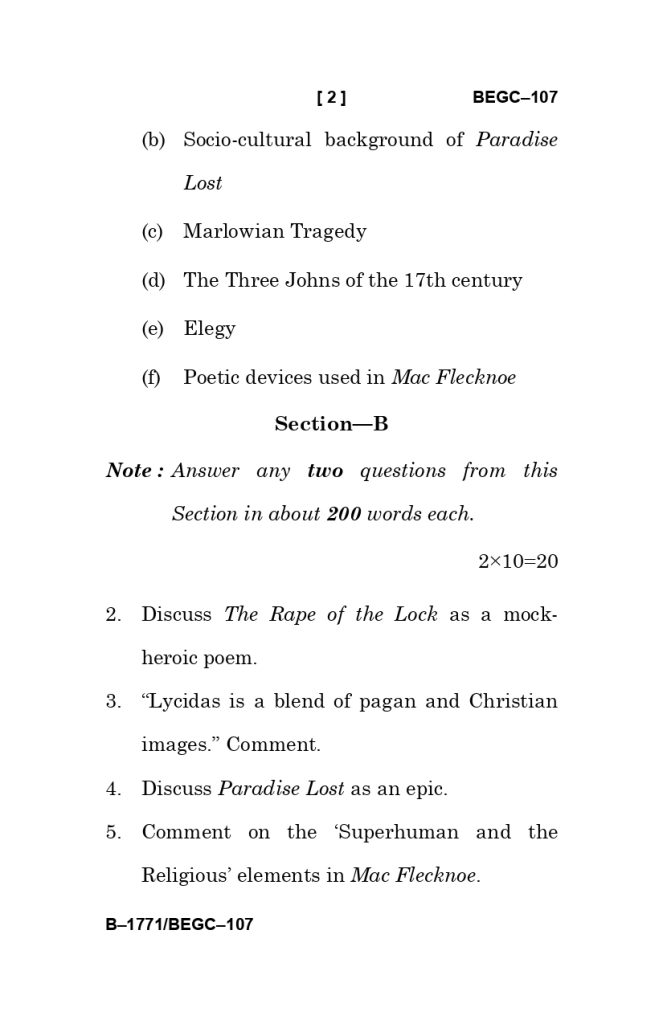
- Section A short notes include themes such as neo-classical poetry, Paradise Lost background, Marlowian tragedy, elegy, and poetic devices in Mac Flecknoe.
- Section B asks specific analytical questions such as mock-heroic elements, epic elements, pagan vs. Christian images, and satirical/religious themes.
- Section C goes bigger: character analysis (Belinda), Augustan poetry traits, Mock-epic satire, Tragedy of Transgression (Duchess of Malfi), Comparative poems, Restoration literature (Dryden), and the rise of the English novel.
Why the BEGC-107 Paper Seems Hard for Students
Let's be blunt—the vast majority of students don't lose marks because they "don't know literature." They lose marks because they:
- Answer a 20-mark question with a short note.
- Give a summary when the question wants an argument.
- Forget to use keywords such as "mock-heroic," "epic conventions," "satire," "transgression," or "Augustan."
- Waste time on one answer and choke on the last one.
Also, BEGC-107 is a mixed paper. It leaps over poetry + drama + literary history. So, if your revision is one-track-based, you feel that the paper is "random." It's not random—it's testing coverage.
BEGC 107 British Poetry and Drama Question Paper



Want BEGC 107 Question Paper Solutions?
Many students who understand the questions still find difficulty in framing an answer according to the evaluation criteria of IGNOU. Knowing what to write is important, but knowing how to structure literary analysis, integrate critical perspectives, and construct arguments coherently is equally important. Students who require comprehensive solutions or individualised assistance for BEGC 107 can contact our team at Unnati Education. We support learners with detailed notes, model answers, and exam guidance for IGNOU literature papers to ensure success. Our materials aren't generic study guides but carefully crafted responses with the analytical depth and presentation that examiners reward with top marks. For more IGNOU paper solutions or support, you may visit: https://www.unnatieducations.com/ignou.
BEGC-107 Question Paper June 2025 - Section-wise Strategy
Section A (Short Notes) - What does the examiner want? Short notes are not "mini-essays." They are: Compact definitions + 2-3 key points. A safe structure for 5 marks:
- Crisp definition.
- 2 key features.
- 1 example/connection to text/period.
- Micro conclusion (1 line).
Some examples of Section A prompts would be neo-classical poetry, Marlowian tragedy, and devices in Mac Flecknoe. Section B (200 words) - How to score clean Section B is where you demonstrate your ability to argue. You must not tell the story twice. If asked, "Discuss The Rape of the Lock as a mock-heroic poem," your answer should:
- Define mock-heroic (1–2 lines).
- List 3–4 epic conventions used.
- Describe how they develop satire (1-2 lines each).
- Conclude with "why it matters" (1-2 lines).
This is literally the difference between scoring 4/10 and 8/10. Section C (350 words) - The zone of scoring This is where toppers are separated. Section C wants a thesis, not just vibes. For a 20-mark answer, use:
- Intro (3-4 lines): Define the lens (mock-epic / transgression / Augustan).
- Body (6-8 points): Each point with micro-evidence.
- Mini counterpoint (2 equal lines): Displays maturity.
- Conclusion (3-4 lines): Restate thesis + wrap up.
Section C consists of questions such as Belinda's character, Augustan poetry features, Mac Flecknoe as satire, Duchess of Malfi as a tragedy of transgression, the role of Dryden, and the rise of the English Novel.
Most Important Topics for BEGC 107 Based On Previous Papers
Analysing previous papers shows recurring patterns in the topics that will help you focus your preparation:
Recurring Topics That Are Always Seen:
- Milton's Paradise Lost (epic characteristics, characterization of Satan, theological themes)
- Mock-epic poetry (The Rape of the Lock, Mac Flecknoe)
- Neo-classical/Augustan characteristics of poetry
- Literary Contribution of John Dryden
- Lycidas (pastoral elegy, imagery mixture)
- Political and cultural context of the 17th century
Frequently Tested Concepts:
- Mock-heroic vs. epic conventions
- Restoration drama characteristics
- Elements of metaphysical poetry
- Elegy as a poetic form
- Character Analysis (Belinda, Duchess of Malfi, Satan)
- Literary movements and periods
Emerging Emphasis Areas:
- Gender representation in literature
- Political dimensions of literary works
- Transition from verse to prose supremacy
- Politics-poetics interconnections
The IGNOU British Poetry and Drama question paper consistently tests your ability to contextualise works historically while analysing them literarily. Questions rarely ask for pure plot summary but instead make critical demands regarding themes, techniques, and cultural significance.
Answer Writing Strategy for Literature Papers
Great answers in literature need to possess specific structural and stylistic elements that separate them from mediocre ones:
- Always Start with Context: Begin by providing the context of the work—historical, biographical, or literary. For Paradise Lost questions, mentioning the political background of Milton and the composition of the poem during the Restoration immediately demonstrates a sophisticated understanding.
- Develop Clear Thesis Statements: For Section C in particular, you need a clear argument or interpretive position in your introduction. Instead of "This essay will discuss Belinda's character," write: "Belinda represents the contradictions of 18th-century femininity, celebrated for beauty while simultaneously reviled for vanity."
- Use Textual Evidence: The answer must make specific references to the text. Quote short phrases (properly with quotation marks) or describe certain scenes that illustrate your points. Vague generalities do not convince examiners.
- Incorporate Critical Perspectives: Referencing how other scholars have interpreted the text (feminist readings, new historicist approaches, psychoanalytic criticism) makes your answer more sophisticated. You don't have to agree with these views, but showing awareness is evidence of engagement with literary scholarship.
- Maintain Analytical Rather Than Descriptive Tone: Focus on "how" and "why," not "what." Don't just explain what occurs in the text; analyse why it occurs and what it means.
- Organise with Clear Paragraphs: Each paragraph should develop a single main idea with a topic sentence, supporting evidence, and a connection to your overall argument. Avoid rambling paragraphs that mix unrelated points.
- How to Conclude Effectively: Don't just repeat your introduction. Synthesise your arguments, suggest broader implications, or raise thoughtful questions encountered during your analysis.
- Watch Your Word Count: Expected word count and depth are both indicated by the description. A 100-word note can't possibly include everything about neo-classical poetry, but it should hit the most essential points efficiently.
Common Mistakes Students Commit in BEGC 107 Exams
Understanding common mistakes helps you avoid them:
- Plot Summary Instead of Analysis: Merely retelling what happens in Paradise Lost or The Rape of the Lock is a waste of space and fetches very few marks. Examiners assume you've read the work; they want to see your analysis of it.
- Ignoring Historical Context: Discussing these works without mentioning the historical moments results in shallow analysis. The English Civil War isn't background noise to Paradise Lost—it is basic to understanding the poem's political and theological concerns.
- Memorising without Understanding: Memorised notes reproduced without adapting them to the specific question asked are often treated as "not attempted." Each question requires a tailored answer to its specific focus.
- Poor Time Management: Spending 90 minutes on a perfect Section C answer and rushing through Section A in 5 minutes causes unnecessary mark loss. Allocate time according to the marks available.
- Neglecting Question Instructions: If a question asks to "compare and contrast," make sure your answer does both. If it asks for a discussion of "characteristics," provide several different features rather than writing extensively on just one.
- Weak Conclusions: Ending abruptly without summarising your arguments makes answers feel incomplete. Even small conclusions make a big difference in the overall impression.
- Overcomplicating Simple Questions: Section A calls for brief notes, not mini-essays. Trying to answer everything in 100 words leads to unfocused answers that don't address any aspect adequately.
For more IGNOU paper solutions or support, you may visit: https://www.unnatieducations.com/ignou.
Time Management Strategy for BEGC 107 Exam
Strategic time management ensures you cover all necessary sections with the right depth:
| Activity | Time Allocated | Purpose |
|---|---|---|
| First reading and planning | 10 minutes | Read the entire paper, select questions, and plan an approach |
| Section A (4 questions × 5 marks) | 45–50 minutes | Short notes – about 11–12 minutes for each question |
| Section B (2 questions × 10 marks) | 45–50 minutes | Medium answers – about 22–25 minutes per question |
| Section C (3 questions × 20 marks) | 75–80 minutes | Extended essays – around 25–27 minutes per question |
| Review and checking | 10–15 minutes | Check parts not answered, basic mistakes, or unclear sections |
- Initial Planning is Crucial: Spend the first 10 minutes reading all questions carefully and choosing which ones to attempt. This prevents mid-exam panic.
- Stick to Word Limits: Exceeding the word limit significantly wastes time. The 100, 200, and 350-word targets exist to suggest the expected depth.
- Prioritise Based on Confidence: After the compulsory Section A, try to solve the questions you are most confident about first. This builds momentum and ensures you secure marks in your strongest areas before fatigue sets in.
- Don't Let Perfectionism Paralyse You: It's better to do all the required questions adequately than to perfect two questions while leaving one unattempted. No marks are awarded for blank answers.
- Use Quick Outlines: Before writing Section C answers, create a quick outline (it doesn't have to be long, just 30 seconds)—list the main points and rough paragraph structure. This keeps your answer focused and organised.
Understanding Literary Periods Addressed in BEGC 107
The course covers two linked, but competing, periods: 17th Century (1600-1700):
- Metaphysical poetry (John Donne, George Herbert)
- Cavalier poets
- Epic tradition (Milton's Paradise Lost)
- Early Restoration drama
- Political and religious turmoil affecting literature
18th Century (1700-1800):
- Augustan Age neo-classicism
- Rise of the novel
- Satirical poetry (Pope, Swift)
- Sentimental comedy
- Enlightenment rationalism
Understanding the characteristics of these periods is useful to contextualise individual works and answer questions about literary movements, transitions, and cultural influences.
BEGC 107 Question Paper – See Full Question Paper Video
This video takes the paper apart step by step, demonstrating how to tackle various types of questions, organise literary analysis, use critical viewpoints, and be effective with time. We talk about common pitfalls, share tried and tested techniques for good openings and closures, and discuss how to shift your writing style to fit different word counts. For students who require detailed solutions, study materials, or literary analysis techniques, our video resources alongside written materials make for all-around exam preparation support. Contact our team or view our full solution videos for step-by-step solutions to every aspect of this difficult but rewarding paper.
Where to Get More IGNOU Help and Resources
Preparing for IGNOU literature examinations requires access to quality study materials, previous year papers, critical analyses, and expert guidance. At Unnati Education, we offer comprehensive support for all IGNOU programmes, such as BA English Honours, to make your academic journey smoother and more successful. For a full evaluation of IGNOU admissions, solved assignments, previous year papers, study notes, and materials for IGNOU exams, you must visit Unnati Education IGNOU Page. On our website, you have a complete resource library which is updated periodically with the most up-to-date papers, assignment solutions, and study guides for IGNOU evaluation standards.
Frequently Asked Questions
Is BEGC 107 difficult for June 2025 ?
It is difficult when answers are still in descriptive form. For instance, mock-heroic questions demand conventions, not a narrative of the story. A workable solution is a four-part structure: definition, features, textual reference, and conclusion. Try writing one structured essay weekly for improved clarity and confidence. How to write short notes for Section A? Consider Section A as precision writing. Define the term, list two features, put one example, and conclude. For example, an elegy answer will have to reference mourning, structure, and tradition. Action tip: Practise writing 100-word answers under the pressure of a timer. How are Section C questions selected ? Pick questions where you can form a thesis quickly. For example, if you can open with "This is a tragedy of transgression because...", then you likely have an argument. Avoid questions where you just remember the plot. Pick your analysis-friendly prompts. Do we really need long quotes ? No. Examiners are more interested in clarity than the length of quotes. Short references to scenes or techniques are better. For example, epic conventions can be mentioned adequately without quoting lines. Action step: Prioritise explanation over quote volume. How much time should the sections receive ? A good practical breakdown is 45 minutes for Section A, 50 for Section B, and 75 for Section C. If less time is available in Section A, later answers will suffer. Action tip: Keep track of how much time you spend per section when practising exams. For more IGNOU paper solutions or support, you may visit: https://www.unnatieducations.com/ignou.
Final Thoughts on BEGC 107 Question Paper June 2025
The BEGC 107 Question Paper June 2025 is not about fancy language. It is about literature writing for exams—specifically, using a clear definition, correct terminology, structured arguments, and aligned time management. When structure improves, marks come naturally. Before you submit your answer booklet, read your last paragraph once again. In literature exams, structure often matters as much as content—especially in the BEGC 107 Question Paper June 2025.