ECO 07 Question Paper June 2025 – Complete Guide for IGNOU Students
Statistics can feel like a bit of an overpowering situation when you first open the question paper. Numbers, formulas, and graphs all around. But here is the truth: ECO 07 is one of those papers where practice does indeed make perfect. We've seen students go from confusion to confidence just by knowing the pattern and knowing what to expect. The ECO 07 Question Paper June 2025 follows a familiar structure that rewards preparation. Students are allowed to choose five of the eight questions, which means there is flexibility on your part. You will be able to skip what you find more difficult and concentrate on what you know the most. The paper has a weightage of 50 marks out of 70, and calculators are allowed, so at least the arithmetic won't slow you down. Some of the questions want you to define or talk about concepts, while others require you to calculate. If you're more adept at one, you can balance your weaker aspects. That's the strategy we always recommend: play with your strengths, but don't leave the basics behind. For other IGNOU papers or support related to it, click: https://www.unnatieducations.com/ignou
ECO 07 Question Paper June 2025 – Quick Overview
Let's examine what the paper in June 2025 really looked like. This isn't just a random set of questions—it's a carefully designed exam involving testing your understanding of statistical methods, data handling, and analytical thinking.
| Aspect | Details |
|---|---|
| Total Questions | 8 questions |
| Questions to Answer | Any 5 |
| Total Marks | 50 marks |
| Weightage | 70% |
| Time Duration | 2 hours |
| Calculator Use | Simple calculator allowed |
| Language Options | English and Hindi |
| Question Types | Theory + Numerical |
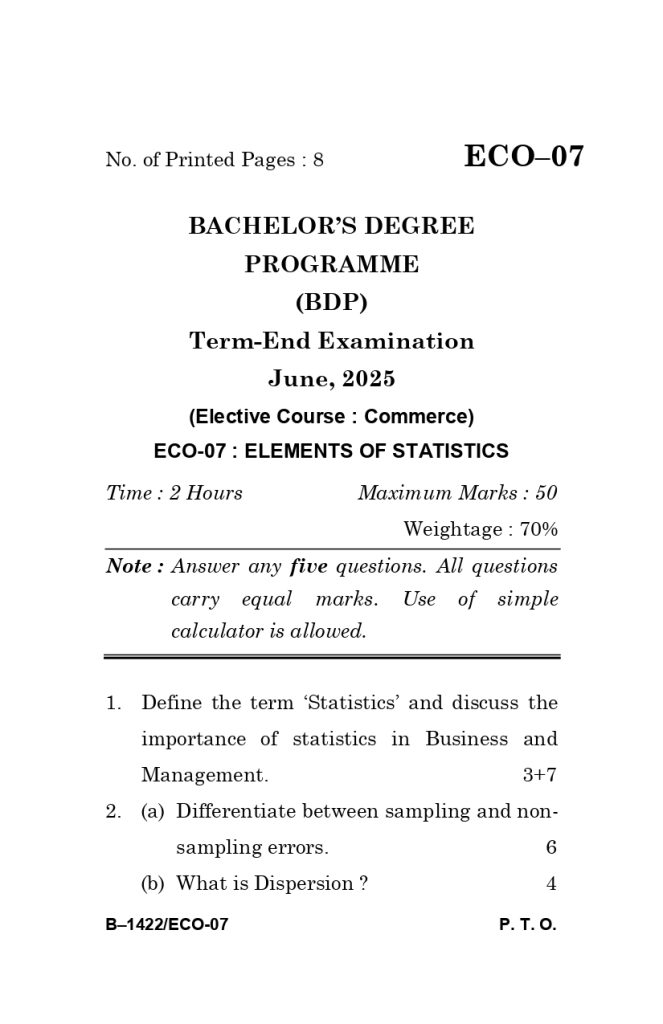
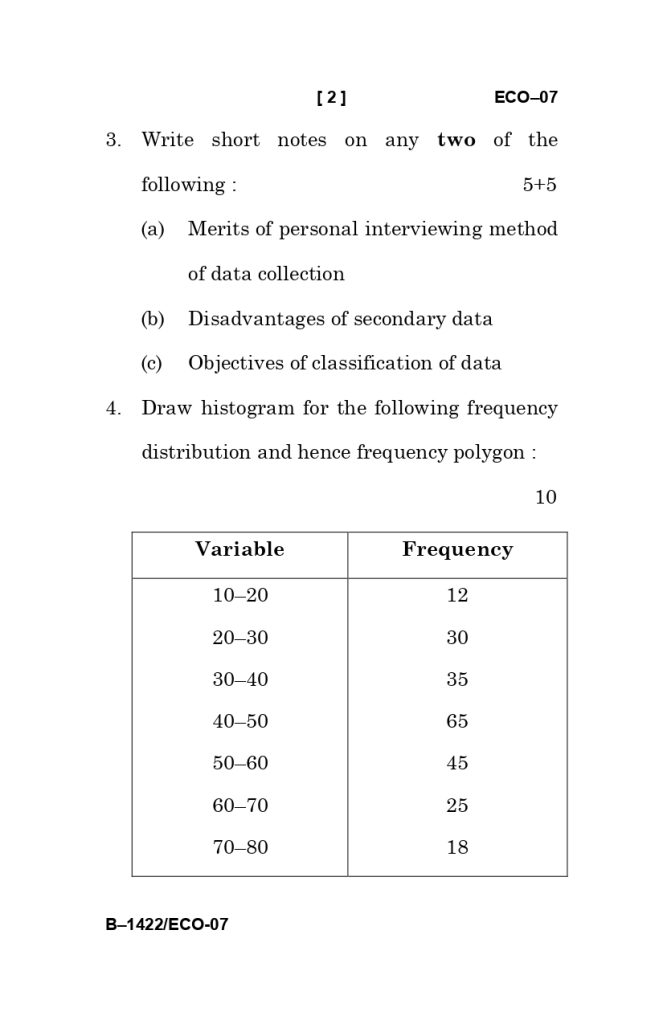
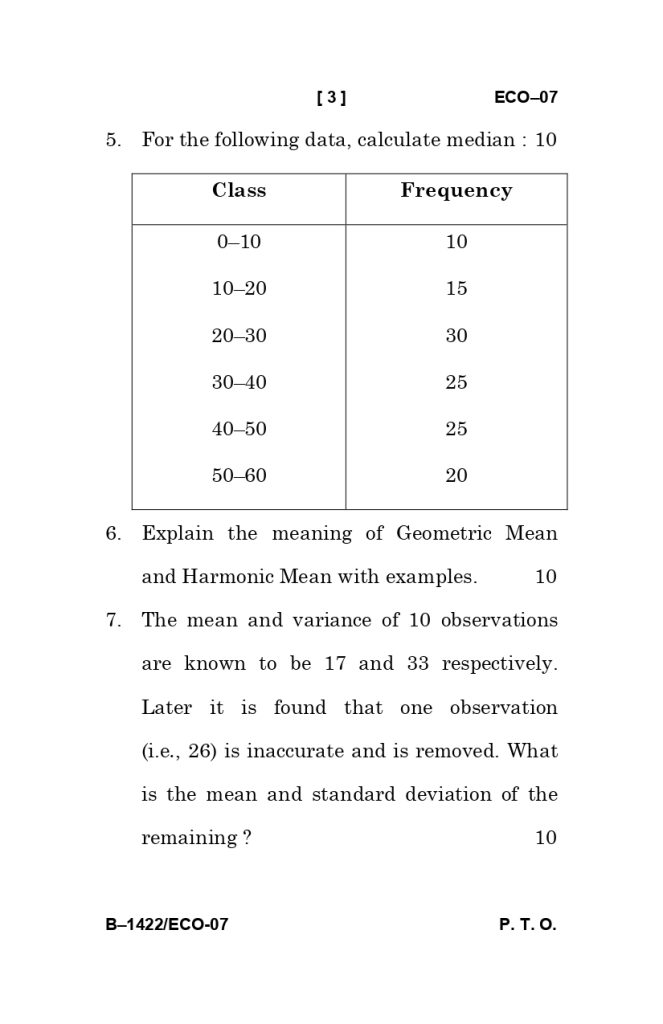
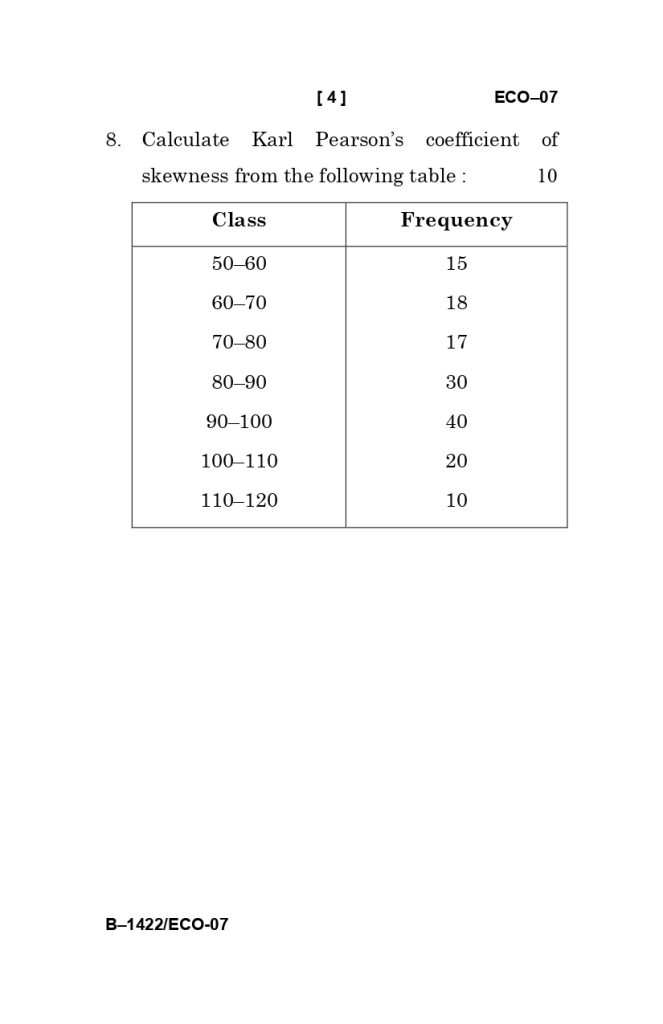
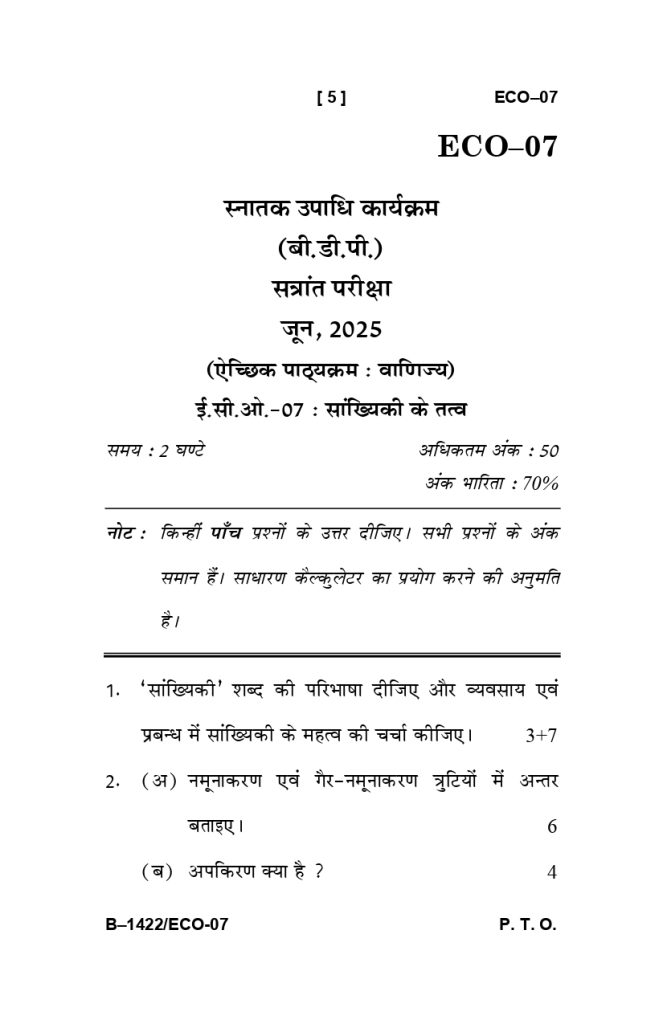
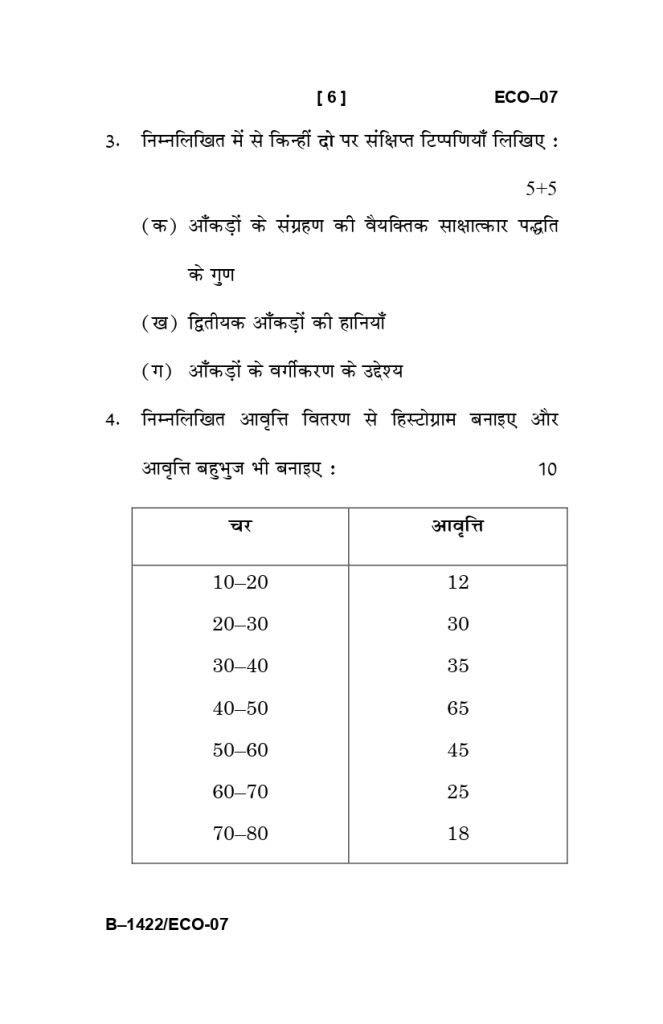
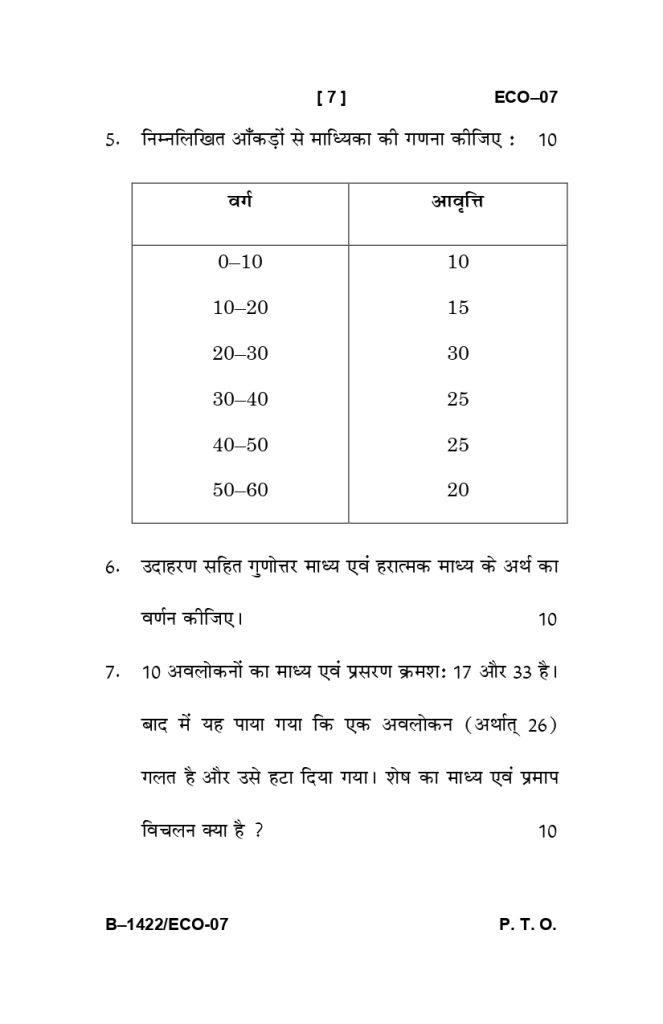
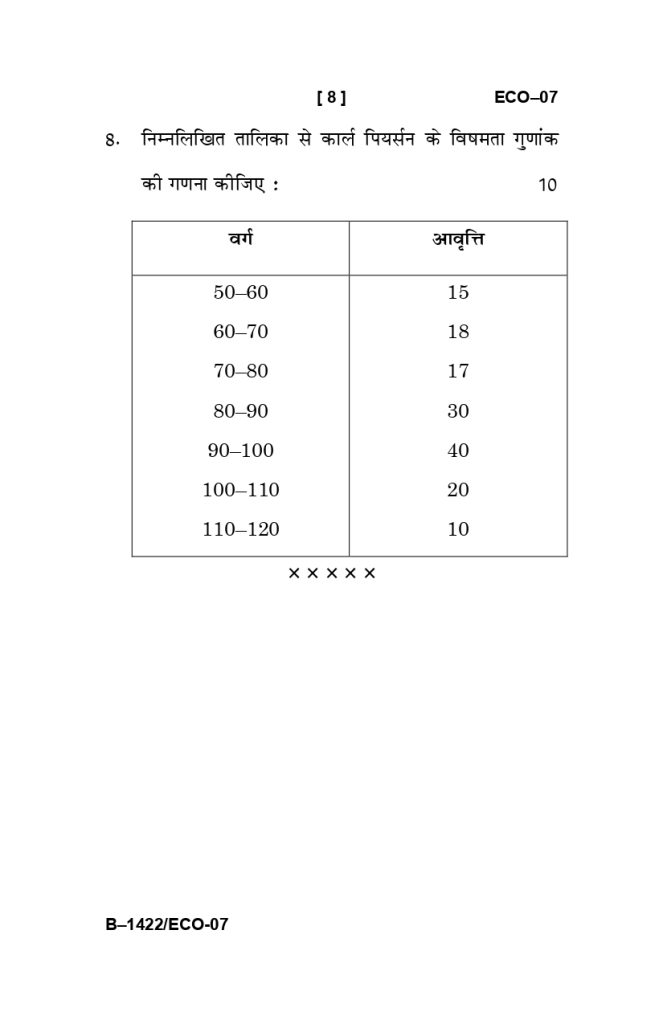
The paper starts with a basic question defining statistics and its significance in business and management. This is a classic opener—students who revised their definitions are usually able to answer this question with ease. Then there are questions on sampling errors, dispersion, methods of data gathering, and objectives of classification. The second part becomes more practical: constructing histograms, finding the median, geometric mean, harmonic mean, learning how to correct the mean and standard deviation when there is an erroneous observation, and calculating Karl Pearson's coefficient of skewness. What's interesting is the balance. You're not stuck with just calculations, and you can't just do theory. The paper provides you with space to breathe. If you are better at writing, then pick the theory questions. If you don't mind formulas, then go with the numericals. That's the beauty of this format.
ECO 07 Elements of Statistics Question Paper June 2025
Understanding the ECO 07 Solved Question Paper
Many students search for the ECO 07 solved question paper to see how answers should be structured. It's not enough to know the formula—you need to know how to present your work, where to show your steps, and how to write in a way that will get you full marks. When we solve papers for students, we are only thinking about making it clear. Every step matters. If you're determining the median, you don't just write down the final answer. You display the column of cumulative frequencies, identify the middle class, use the formula where all values are clearly labeled, and then you have the final result. Examiners look out for this logical flow. A correct answer without proper steps could lose marks. Theory questions are also very important. When asked to discuss the importance of statistics in business, don't just list them. Explain each point briefly. Relate it to real-world scenarios. Use examples where possible. Unless the question specifically asks for short notes, write in paragraphs, not points. This approach makes your answer look full and well thought out. For other IGNOU papers or support related to it, click: https://www.unnatieducations.com/ignou
Why ECO 07 Question Paper June 2025 Feels Challenging to Some Students
Statistics is not everyone's favorite subject. Some students are afraid of the formulas. Others have a hard time remembering which formula to use where. The biggest thing we've seen is confusion about similar concepts—like when to use mean vs. median, or how to tell the difference between sampling and non-sampling errors. Another difficulty is time management. Two hours may sound like plenty, but when you are trying to make calculations, draw graphs, and write out answers in theory, time flies. Students who fail to practice beforehand tend to rush through the final question or leave the question blank. Then comes the problem of incomplete understanding. Knowledge of a formula is not equivalent to the knowledge of how and when to use it. For example, in the problem about how to correct the mean and standard deviation if you eliminate an inaccurate observation, you have to think logically—you can't simply subtract the wrong value from the mean. You need to recalculate using the sum of observations. This type of conceptual clarity only comes with practice. Graphs and diagrams are another sticking point. Drawing a histogram or frequency polygon needs to be precise. You have to use a pencil, scale, and ruler. A rough sketch will not attract full marks. Students who do not practice these visual representations usually lose easy marks in the exam. For those looking for organized support or solutions with analysis, our team at Unnati Education provides personalized guidance covering these exact issues.
Question-Wise Breakdown of ECO 07 Question Paper June 2025
Let's go through what each question was asking and what students needed to do in order to score well on them.
- Question 1 asked the students to define the term 'Statistics' and discuss its importance in business and management. This is a basic question of 10 marks (3+7 split). The definition should be precise—statistics is the science of the collection, classification, presentation, analysis, and interpretation of numerical data. Then, for the discussion part, the students are supposed to cover points such as policy formulation, decision-making, planning, forecasting, market research, quality control, and risk analysis. Each point should be written in 2-3 sentences.
- Question 2 had two parts. Part (a) required students to distinguish between sampling and non-sampling errors. This entails a comparison—students should draw a clear distinction on the basis of meaning, occurrence, nature, measurement, control, and causes. This is an easy question for exams. Part (b) was a short-answer question of 4 marks on dispersion. A short definition followed by an explanation of why it is important would suffice.
- Question 3 offered a choice. With "Any two out of three" options provided (i.e., merits of personal interviewing, disadvantages of secondary data, and objectives of classification), students had to write down short notes. Each note was worth 5 marks. The main thing here is that you write focused, organized points and not a bunch of fluff.
- Question 4 was purely practical—to draw a histogram and frequency polygon for given data. This is a 10-mark question that gives as much importance to neatness and accuracy as correctness. Students had to do the following: plot class intervals across the x-axis, plot frequencies across the y-axis, create bars for the histogram, and connect mid-points for the frequency polygon.
- Question 5 asked students to find the median from a frequency distribution that is continuous. The process includes calculating a cumulative frequency column, calculating N/2, finding the median class, and applying the median formula. The answer should show each and every step clearly.
- Question 6 asked for explanations of the Geometric Mean and Harmonic Mean with examples. This is a 10-mark theory-cum-numerical type question. Students should be able to define each mean, give an idea of when to use it and the formula, as well as work through a simple example of each.
- Question 7 was a slightly tricky question. Given the mean and variance for 10 observations, students had to recalculate the mean and variance after dropping one observation from the data that had been observed incorrectly. The difficulty here comes in realizing that you have to find the sum and the sum of the squares first, modify them, and then recalculate the mean and the standard deviation. This type of question is more of a test of logic, less of a test of formulas.
- Question 8 involved finding Karl Pearson's coefficient of skewness from a frequency distribution. Students had to seek the mean, mode, and standard deviation first to use the formula for skewness. This is a multi-step issue that requires patience and accuracy.
The ECO 07 question paper solution becomes much clearer when you understand the logic behind each question type.
Important Topics for ECO 07 Based on Previous Papers
If you are preparing for the upcoming exam, then focus on the following topics. They have been mentioned repeatedly in different sessions and are viewed as areas of high priority.
| Topic | Why It Matters |
|---|---|
| Measures of Central Tendency | Mean, median, mode – these are basic. At least one full question is expected. |
| Measures of Dispersion | Range, variance, standard deviation, and coefficient of variation – these indicate the spread of the data. |
| Sampling Methods & Errors | It is important to understand various sampling techniques and error types. |
| Data Collection Methods | Primary vs secondary data, merits and demerits of both methods. |
| Classification & Tabulation | How to restructure raw data into meaningful data forms. |
| Graphical Representation | Histograms, frequency polygons, ogives – practice drawing these. |
| Correlation & Regression | Though not in June 2025, these appear often. Don’t ignore them. |
| Index Numbers | Construction methods, types, and applications in economics. |
| Skewness & Kurtosis | Measures of asymmetry and peakedness of distributions. |
These topics are the backbone of ECO 07. If you have a good grasp of these, then you're ahead of the game compared to most students.
Answer Writing Strategy for ECO 07
Knowing what is being asked is one thing. Another is to write answers that score full marks. Here's what you need to do when answering different types of questions.
- For definition-based questions, be concise. The lesson for defining a term includes: Define the term in 1-2 sentences and then add examples and/or applications of the term. Don't write long paragraphs for a 3-mark definition.
- For comparison questions (like sampling vs. non-sampling errors), use a tabular format as much as possible. If not, write in clear and parallel points. Start each comparison with "Sampling errors..." and "Non-sampling errors..." to maintain clarity.
- For theory questions that require discussion (e.g., the importance of statistics), write in paragraphs. You should have one heading per point ("Decision Making," for instance) followed by 2-3 sentences explaining this point. This structure makes your answer readable and organized.
- For numerical problems, always write your math. Write the formula first, fill in the values, and then solve stepwise. Do not skip intermediate steps. Even if your final answer is incorrect, you can still gain partial marks for correct methodology.
- For questions that are graphical, use a pencil and ruler. Label your axes. Write the title at the top. If you are drawing a histogram, make sure to connect all its bars. For a frequency polygon, use straight lines to connect midpoints. Neatness counts.
Students preparing for the elements of statistics important questions ought to practice writing out complete answers, instead of only visualizing how to solve the problem mentally. The way you present your answer can make a big difference to your final score.
Common Errors Made by Students in ECO 07
We've looked at hundreds of answer sheets over the years. Here are the most common mistakes that lose marks for students.
- Leaving out steps in computations: A lot of students will write the final answer only. Examiners can't give full marks without seeing the process.
- Using the wrong formula: Sometimes students use the formula for grouped data when individual observations are given in the question, or vice versa. Read the question carefully.
- Failing to label graphs correctly: A histogram that has no axis labels or title does not appear complete. Even if the drawing is okay, you may lose marks.
- Writing way too much in short questions: If a question is of 4 marks, don't write a full page. Be brief and to the point.
- Ignoring units: If the question relates to speed, income, or any quantity that can be measured, then include the unit with your final answer.
- Not doing enough questions: Some students spend too much time on one question and leave others empty. Keep in mind, you must try out 5 questions.
- Bad handwriting and presentation: If the examiner can't read the answer and can't follow your logic, then they will not be able to give full marks. Write neatly, use paragraphs, and leave spaces between questions.
- Not revising before handing in: Small mistakes, such as calculation errors or overlooked steps, can be identified if you check your paper before submitting it.
For those who would like in-depth feedback on their answers or wish to ascertain any weak areas, contacting our team can help provide clarity. We provide custom answer reviews and advice tailored to individual needs.
Time Management During ECO 07 Exam
Two hours for five questions translates to about 24 minutes per question. But not all questions take the same length of time. Theory questions can be written in less time, while numerical problems require careful calculation. Here's a breakdown of time for practical purposes:
- First 5 minutes: Read the entire paper. Identify which 5 questions you'll have a go at. Mark them.
- Next 20 minutes: Answer the question you are most confident about. This builds momentum.
- 15 minutes for each graphical question: Drawing takes time. Don't hurry, but don't spend too much time, either.
- Last 10 minutes: Check your answers. Check calculations. Make sure all questions are labeled correctly.
If you get stuck on a calculation, move on. Don't waste 10 minutes trying and pushing for an answer. Try the other questions and return to this if you have time. Some students might prefer to start with theory questions to give them confidence. Others like to do numbers first when their brain is fresh. Choose a course of action that works for you, but stick with your plan during the exam.
ECO 07 Question Paper – See Full Question Paper Video
Sometimes, it's not enough to read your solution. Watching someone solve the paper step-by-step allows you to understand the approach to the problem, the reasoning, and the way of presenting the solution. In this video, we walk through each question of the ECO 07 Question Paper June 2025. We explain the logic of each step, how to organize your answers, and what common mistakes to avoid. Watching the video alongside reading the solutions provides you with a complete understanding. If you prefer video explanations or are looking for a more hands-on way to learn, then this resource is invaluable. It's like having a tutor walk you through the whole paper. For other IGNOU papers or support related to it, click: https://www.unnatieducations.com/ignou
How to Use Previous Year Papers for Preparation
Past papers are gold. They show you the pattern, the topics that are frequently asked, and the level of difficulty. But just solving them isn't enough. Here's how to make good use of them:
- Step 1: Take the paper under time-pressured conditions. Sit down without distractions for two hours. This helps to build exam temperament.
- Step 2: Solve and check your answers using solved papers. No, don't just look at the ultimate answer. Compare your method, presentation, and logic.
- Step 3: Identify weak areas. If you did poorly on a particular type of question, then go over that topic carefully.
- Step 4: Rewrite the paper after a week. See if you can now figure it out better and faster.
- Step 5: Take notes of formulas and important information from each paper. This makes your quick revision resource in the run-up to the exam.
Students who consistently practice previous year papers claim to be more confident and manage their time well when it comes to the actual exam. It eliminates the fear of the unknown. For those who would like to avail proper support with solved papers of the last 4-5 years, our team at Unnati Education provides complete packages. We provide not just solutions but also detailed explanations, answer writing techniques, and personalized guidance. Be it full classroom-style teaching or just solved papers for you to study by yourself, we're here to help. Contact us
Where to Find More IGNOU Help
Preparing for IGNOU exams can be isolating. You're usually studying alone, without a regular classroom structure to follow. That's where the right support makes a difference. Our website is a comprehensive one for IGNOU students. We provide solved assignments, previous year papers, study notes, and tips for exams from different courses. Whether you're in BA, BCOM, BSC, or BAG, you'll find content to suit your needs. If you prefer personal guidance, then our team is at hand for one-on-one support. We help students to clear doubts, understand difficult concepts, and make their study strategies more effective. We've worked with hundreds of learners who've gone from struggling to scoring well, simply because they had the right guidance at the right time. Students who want complete answers to the ECO 07 question paper or need help with any other IGNOU course can contact us anytime. We're aware of the challenges facing distance learners, and we're here to make your path smoother.
Why Practical Questions Are More Important Than Theory
In ECO 07, practical questions are your scoring zone. Theory answers can vary—one student may write five points, another may write seven. Examiners are given freedom to award marks. But in numerical problems, there is either a right or wrong answer. If your method is correct and your calculation is correct, you get full marks. That's why we always say to students: prioritize numerals. You have to work on them until you can solve them without hesitation. Understand the logic behind each formula and know when to use which method. This helps to create a firm foundation. Theory is important, yes. But if you have to pick one area to invest your prep time in, then take a look at practicals. Once you're sure of yourself when it comes to calculations, you will naturally be able to tackle theory questions much more easily.
Developing Conceptual Clarity in Statistics
Statistics is not only about memorizing formulas, though. It's about knowing what those formulas are for. Why do we calculate the mean? What is the standard deviation actually telling us? When do we use geometric mean rather than arithmetic mean? With knowledge of the 'why' behind the 'what', statistics make sense. You're not just blindly using formulas—you're making informed choices about the nature of the data. For example, if you are asked to find the average growth rate over a number of years, then you will think of the geometric mean right away. If the speeds you're averaging are for the same distances, the harmonic mean is in order. This kind of conceptual clarity is the product of practice and reflection, not rote learning. Spend time understanding each concept very well. Don't rush through topics. When you truly understand something, you recall it for a longer time, and it is better.
Final Thoughts on ECO 07 Question Paper June 2025
The ECO 07 Question Paper June 2025 is a fair, balanced exam that rewards preparation. It's not there to fool you—it's there to test your knowledge of statistical methods and your ability to apply them. Success in this paper comes down to three things: understanding the concepts, regular practice, and a good presentation of your answers. You do not have to be a statistics geek. You just need to be consistent. Prepare yourself ahead of time. Don't wait until the last week. Solve previous year papers. Watch solution videos. Make notes. Revise formulas. Practice drawing graphs. Time yourself. Review your mistakes. If you are stuck or confused, don't hesitate to reach out for help. We're here to be your support throughout the way for IGNOU students. Whether you are looking for complete course classes or just solved papers, whether you want to clear up a single doubt or prepare from scratch, we've got you covered. Statistics may feel frightening at this point, but with the right mindset, it is one of the most satisfying subjects to learn. Every formula makes sense. There is a purpose for every calculation. And each one of the marks earned is a direct consequence of your effort. Stay focused. Stay consistent. And remember—you've got this.
Frequently Asked Questions
What is the exam pattern for ECO 07?
The ECO 07 exam consists of eight questions, out of which the students need to attempt any five. Each question carries the same marks (50 marks with a weightage of 70%). The exam takes two hours, and students are allowed to use a simple calculator. The paper contains both theory-based questions and numerical problems, providing flexibility in the selection of questions depending upon individual strengths.
How can I score well in the ECO 07 Question Paper?
Focus on concepts rather than memorizing formulas. Revise previous year papers in timed conditions to improve speed and accuracy. When answering questions that require numbers, always show your working out step-by-step. For theory questions, write in organized, well-written paragraphs. Use diagrams and graphs wherever needed and make sure that they are neat and labeled properly. Regular revision sessions and doubt elimination sessions also help to a huge extent.
Where can I find the ECO 07 solved question paper with detailed explanations?
Solved question papers with step-by-step solutions are available through our platform. We provide full answers to previous year papers, including June 2025, with an explanation for every question. On our website, students can access these resources or reach out to our team directly for personalized study materials and guidance according to their preparation needs.
Is ECO 07 a hard paper for IGNOU students?
ECO 07 is estimated to be of moderate difficulty. For students who practice regularly and understand the concepts, it is manageable. The challenge is sometimes in time management and applying the correct formula to the correct question. With correct preparation, practice on theory, and numericals, most students would be able to score well. The most important thing is to practice and get the concept behind the question pattern.
What does ECO 07 require students to know most?
Important topics include measures of central tendency (mean, median, mode), dispersion (standard deviation, variance), methods of sampling and errors of sampling, methods and errors of data collection and classification, graphical representation (histogram, frequency polygon), correlation and regression, index numbers, and skewness. These topics often show up in exams and provide the basis of statistical analysis presented in this course.
Can I pass ECO 07 by just doing theory questions?
While it's technically possible, it's not a good idea. Numerical problems carry a lot of marks and can be easier to score in, as the answers are objective in character. Theory questions call for more subjective evaluation, and full marks are more difficult to obtain. A fair strategy would be to try at least two or three numerical questions along with theory to score better as a whole.
How much time should I give to ECO 07 preparation?
Ideally, students should start preparing 4-6 weeks before the exam. Devote 1-2 hours each day to the study of concepts, solving problems, and practicing previous year papers. The final week should be spent on revision, formula memorization, and timed mock tests. Consistent preparation every day is more effective than last-minute studying, especially for a subject such as statistics that requires practice. Students seeking full solutions or step-by-step solutions for ECO 07 can be connected with our team at Unnati Education. We assist learners through solved papers, customized notes, doubt-clearing sessions, and full-fledged examination preparation assistance.