Strategic Management is like a lifeline for the MBA course, and for students of IGNOU, the MMPC 012 Question Paper is a crucial phase. It’s not just about memorizing definitions; it is about how businesses live, grow, and compete in a battlefield of constant change. We have analyzed it for you, specifically related to the term-end examination of June 2025 at Unnati Education. Whether you are getting ready for the December exam(s) or just looking through how you performed, you need to learn what is expected of this paper because that's how one scores big on it. We also know how difficult it can be to track down reliable resources. A lot of you spend countless hours on the internet looking for MMPC 012 solved question papers or finding an actual, clear question paper as per the strict IGNOU marking policy. Students often search for a trustworthy question paper solution to find out how questions should be answered. Moreover, having to understand the important question trends and prepare for the particular MMPC 012 question paper June 2025, becomes an ideal way to predict future exam patterns. We've gathered it all up here to make your prep easy. For more IGNOU papers or assistance visit: https://www.unnatieducations.com/ignou.
MMPC 012 Question Paper June 2025 – Quick Analysis
Before discussing the meat of the issue, let’s lay some groundwork. This is good for your mental set and setting out time.
| Feature | Details |
|---|---|
| Course Code | MMPC-012 |
| Course Title | Strategic Management |
| Exam Session | June 2025 |
| Maximum Marks | 100 Marks |
| Time Allowed | 3 Hours |
| Question Pattern | Attempt any 5 questions |
| Marks Per Question | 20 Marks each |
| Total Questions | 8 Questions |
Why the “MMPC 012 Question Paper” Looks Difficult to Students
Strategic Management at first seems like a theoretical subject with minimal technical mastery required. But then, students sit down to write the exam, and they struggle. It is the implementation of ideas that poses a problem. Compared with other examinations where you can just write definitions and that’s it, in MMPC-012 you must connect the theory learned to real-world business cases. The questions are intended to engage how you think. For example, you are not just asked “What is strategy?”; you have to discuss its characteristics with examples. This requirement for “examples,” “illustrations,” and some sort of “critical note,” is where a great many students lose marks. Nor does the strategic management literature lend itself to fuzzy thought — it’s filled with unambiguous language (i.e., “Strategic Intent,” “Resource-Based View,” and “Generic Strategies”). You can't speak in vagueness; you have to use the exact vocabulary of what they expect from you.
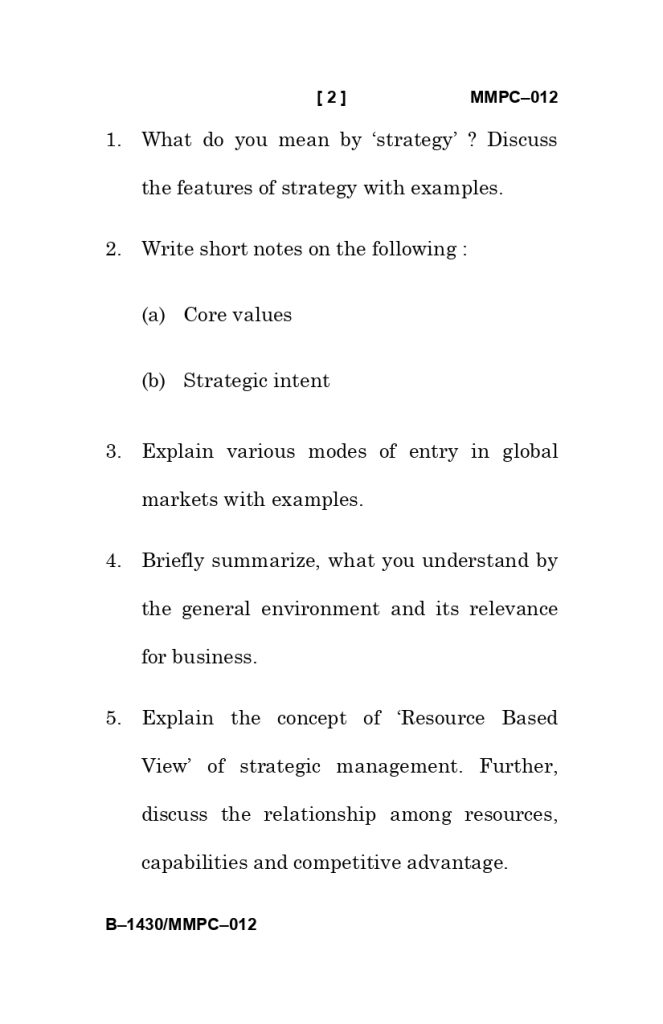
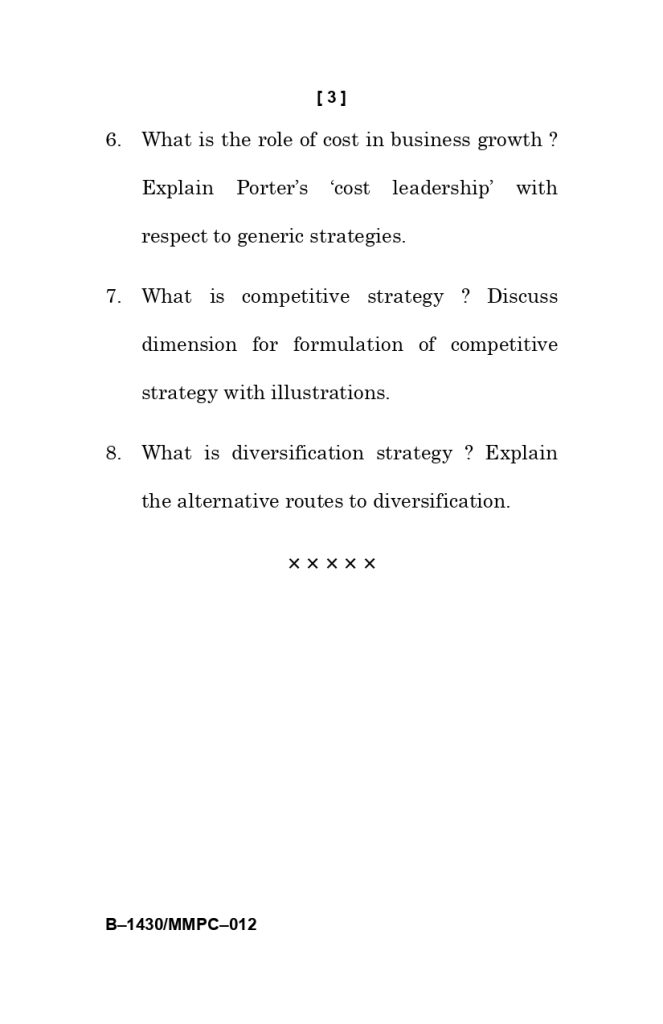
MMPC 012 Question Paper June 2025
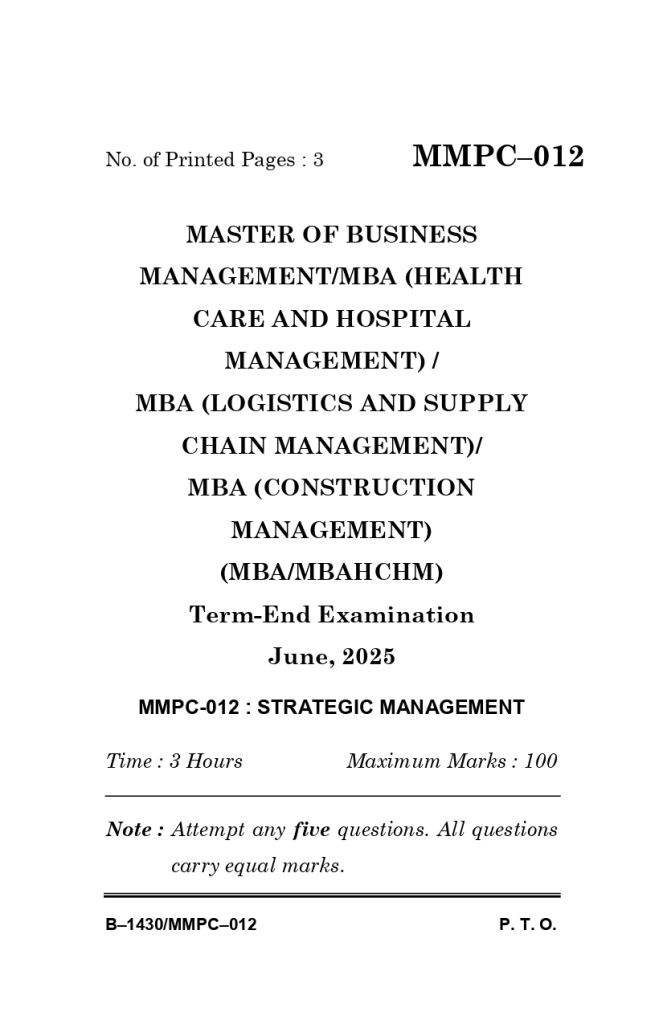
Need MMPC 012 Supporting Material & Solution Papers?
Knowing the question is the first step, but finding a good answer is much more challenging. For students looking for full solutions, guided notes, or 1-on-1 individual help with MMPC Past Paper 012, get in touch with our tutors now. We provide learners with notes, solved papers, and importantly, exam guidance so that you have the best study material available. For more such resources and expert help, you can check our website https://www.unnatieducations.com/ignou. We are committed to simplifying Your IGNOU Journey.
Why MMPC 012 Seems Easy For Students (The Trap)
A popular misconception is that Strategic Management is something "anyone would know, and I'm just using common sense." This is a trap. The concepts — growth, competition, cost, and so on — are familiar, but the academic treatment is rigorous.
- Common Language: We are accustomed to words like “strategy” and “targets” used every day, which makes the subject seem approachable.
- Open-Ended Questions: Questions are asked in a way that seems wide (e.g., “What is competitive strategy?”), so students think they can write common knowledge.
- Choice: 8 questions are given, but only 5 need to be answered; students are reassured that if a question is beginning to look hard, they can leave it and still get passing marks.
But in reality, the fact that this may ‘seem’ easy has only one result: producing average work, as students don’t go deep enough and don’t bring the models (e.g., Porter’s) and structured frameworks their assessors are looking for.
MMPC 012 Question Paper June 2025 – Analysis of Questions
We have analyzed the June 2025 paper so you can see exactly what was asked and how we suggest tackling these questions. Such an analysis is indispensable for the future outlook.
The Idea of Strategy (Question 1)
A basic question leads the paper: “By ‘strategy’ what do you mean? Explain the characteristics of strategy with examples." Analysis: This is a fundamental question. It is worth 20 marks, so a basic definition will not suffice. You will need to characterize your strategy as a detailed long-term tactic. Key Elements to Cover:
- Long-term Orientation: This is not about today, it’s about the future.
- Integrated Plan: It brings together internal strengths and external opportunities.
- Targeted: It is targeted to accomplish certain goals.
- The "Unnati" Tip: At all times respect the difference between Strategy and Tactics here so as to display more knowledge.
Brief Notes: Core Values and Mission (Question 2)
Short notes are great for scoring as they need a direct, crisp answer.
- (a) Core values: These represent the fundamental beliefs an institution holds. You have to show how something like “integrity” or “innovation” informs the decisions you make. Cite businesses who are doing the same; include names like Tata or Google.
- (b) Strategy Content: It is the obsession of an organization to win. This comprises Vision, Mission, and Objectives. You need to show the hierarchy of intention.
Modes of Entry in International Markets (Question 3)
“Discuss the types of entry into the international market with reference to an example.” Analysis: This one gauges your knowledge of international business strategy. Key Modes:
- Exporting: Low risk, low control.
- Licensing/Franchising: This is where McDonald’s got their start.
- JVs: Tie up with a local company (e.g., Hero Honda earlier).
- Wholly owned subsidiaries: Risky business, strict supervision. Solution: Draw a chart with the Risk (vs. Control) trade-off for each method.
General Environment and Business Relevance (Question 4)
“Key HRM Challenges Faced by Particular Sectors...” Comment: This request often asks for a short overview of the typical environment, linking to the PESTLE framework. Approach: You should avoid simply listing factors. Explain why they matter. For instance, how government Policy changes (Political) affect business Sustainability.
Resource-Based View (RBV) (Question 5)
“Explain ‘Resource Based View’… How is it related to resources, capabilities and competitive advantage?” Remarks: This is the theoretical heart of the subject. It redirects the focus from the external market towards a more internal company-centered approach. Key Concepts:
- Physical vs. Intellectual Resources: Land holdings vs. corporate identity.
- VRIO Framework: Is it Valuable, Rare, Inimitable, and Organized?
- Capabilities: How resources become productive.
Cost Leadership and Corporate Expansion (Question 6)
“How important is cost to growing a business? Explain Porter's 'cost leadership'...” Analysis: This links financial efficiency with strategic positioning. Porter Model: You need to explain Michael Porter's Generic Strategies in detail. Cost Leadership is not just “being cheap”; it’s ensuring your entire value chain operates at the lowest possible cost to make the product or service (e.g., Wal-Mart, Indigo Airlines).
Competitive Strategy Dimensions (Question 7)
“What is competitive strategy? Discuss dimensions for formulation...” Analysis: This is about how a company takes on its rivals.
- Focus: Cost/Product Differentiation, Niche Focus, and Innovation.
- Illustration: Apple (Differentiation) vs. Xiaomi (Price) to explain the difference well.
Diversification Strategy (Question 8)
“What is diversification strategy? Explain the alternative routes...” Analysis: This one wonders how companies expand beyond what they are now. Routes:
- Related Diversification: Moving into a new area that is similar (i.e., phone manufacturer making laptops).
- Unrelated Diversification: Going into an entirely different industry (i.e., Tata Salt and cars).
- Vertical Integration: Acquiring your supplier or distributor.
Key Areas Possibly Tested on MMPC-012 from Old Papers
We believe we have identified high-yield topics after reading the June 2025 paper and taking historical trends into account. If you have these down, then 70-80% of any exam paper is covered.
- Michael Porter’s Frameworks: There’s no avoiding Porter in this area.
- Five Forces Model.
- Generic Strategies (Cost Leadership, Differentiation, and Focus).
- Value Chain Analysis.
- Strategic Formulation vs. Implementation: Questions about differences in thinking (formulation) vs. doing (implementation). This extends to the 7-S Model.
- Environmental Scanning (SWOT & PESTLE): Questions on "General Environment" and "Internal Analysis" are always SWOT and PESTLE.
- Corporate Level Strategies:
- Growth: Expansion, Diversification.
- Stability: Pause/Proceed with caution.
- Retrenchment: Turnaround, Divestment, Liquidation.
For More IGNOU Solved Assignments or support don’t hesitate to contact us at: https://www.unnatieducations.com/ignou.
Unnati Education Answer Writing Reference
You’ll need a specific structure in order to score 15+ out of 20 on these questions. This is the blueprint that we instill in our students: The "Sandwich" Structure
- Introduction (2-3 Sentences): Define the topic of interest and illustrative terms. What is the significance of the topic in today's business world?
- Your Body Copy (Headings): Don’t write massive blocks of text. Break your answer into sub-headings.
- Example: For "Features of Strategy," make section headings on "Long-term Vision", "Resource Allocation', etc.
- Examples/Illustrations: As observed in the paper of June 2025, examples are required. Mention real companies.
- Apropos: "Reliance Jio has employed a Cost Leadership approach in its entry into the market".
- Wrong: “Businesses undercut other offerings to win.”
- Diagrams / Flowcharts: Examiners need a distraction from long paragraphs. Sketch an organization chart for "Strategic Intent," or a grid for "Porter’s Strategies."
- Critical Note/Conclusion: Recap and conclude. A "Critical Note" further develops the understanding of the concept by discussing constraints or dangers involved with them.
Common Mistakes Students Make
Here are the thousands of answer scripts we see, and these common errors end up bringing grades down:
- Disregarding the “Examples” Constraint: You were specifically asked for “examples” and/or “illustrations” in nearly every question of the June 2025 paper. Average marks will be gained if you write pure theory and nothing with real examples.
- Mistaking Strategy for Operations: Strategy is about what we want to be when we grow up; operations is about how we do it every day. Do not mix them up.
- Time Struggle: Working an hour for Q1 and a few minutes on the last four is not a recipe for success.
- Disorganization: An essay that consists of 4 pages without a single header is hard to read and gives the tester a difficult time finding your points.
- In Layman’s Terms: Rather than saying “The company wants to beat the others,” say “[The firm] is attempting to obtain a sustained competitive advantage.”
Time Management in the Examination
You have 180 minutes for 100 marks (5 Questions). This breaks down to 36 minutes per question. However, you need time to read the paper and review.
| Activity | Time Allocation |
|---|---|
| Reading & Selection | 10 Minutes |
| Question 1 | 32 Minutes |
| Question 2 | 32 Minutes |
| Question 3 | 32 Minutes |
| Question 4 | 32 Minutes |
| Question 5 | 32 Minutes |
| Review & Buffer | 10 Minutes |
Pro Tip: Adhere to this schedule religiously. If you run out of time for Question 1, leave some space and begin Question 2. It's better to get 5 correct answers than 3 completely correct and 2 missed.
MMPC 012 Question Paper – Video Analysis
Sometimes, reading isn't enough. To really understand the nuances, you have to see the paper and hear the explanation. We've prepared an extensive video analysis, in which we will lead you through the paper, discussing each question and model answers. Visit the video section of our website for more.
Where to Find More IGNOU Help
We are dedicated to your success in the MBA. Whether you are lagging behind in your homework, want to know the latest guess papers, or just get a clear insight about tough topics like Strategic Management, we’ve got it all covered from the basics to the advanced levels! For more details do visit our specifically designed IGNOU section at: https://www.unnatieducations.com/ignou
Frequently Asked Questions
Q1. Is MMPC 012 hard to get through? It's not that hard to pass if you know the 3-4 major frameworks. But, in order to earn top points, very specific strategic language and concrete examples must be used. Generic answers almost always produce ordinary scores. Q2. Are the questions in MMPC 012 exactly the same as last year? Yes, leadership content such as Porter’s generic strategies, SWOT Analysis, and Modes of Entry are repackaged repeatedly. The last 3-4 years' question papers should be analyzed very well. Q3. What is the length of my answer for a 20 mark question? For a 20 mark question, look at writing around 350-400 words (approx. 3 or so pages). But quality and structure (headings, bullet points) matter more than simply filling pages. Q4. Can I take any 5 questions in the exam? Yes, you can try your best for any 5 questions out of 8. This affords you the freedom to play to your strengths — and avoid what scares you. Q5. Do I have to draw any diagrams in the exam? While not required, diagrams (e.g., Product Life Cycle, BCG Matrix, or Porter’s Five Forces) would be very appropriate. They assist you in sharing complicated topics easily and leave an impression on the examiner.
Conclusion to MMPC 012 Question Paper June 2025
The MMPC 012 Solved Question Paper for June 2025 acts as a perfect indicator of what IGNOU wants from its MBA candidates. It goes beyond memorization and into strategy. You can convert this problematic subject into a high-scoring one if you focus on the basics such as strategic intent, Porter’s strategies, and Global Entry modes, and adhere to an answer format while writing it. We trust this clears up any confusion and leaves you with nothing but confidence on your way to crushing your next exams. Remember, strategy is about preparation. If you have any other questions, feel free to contact us.