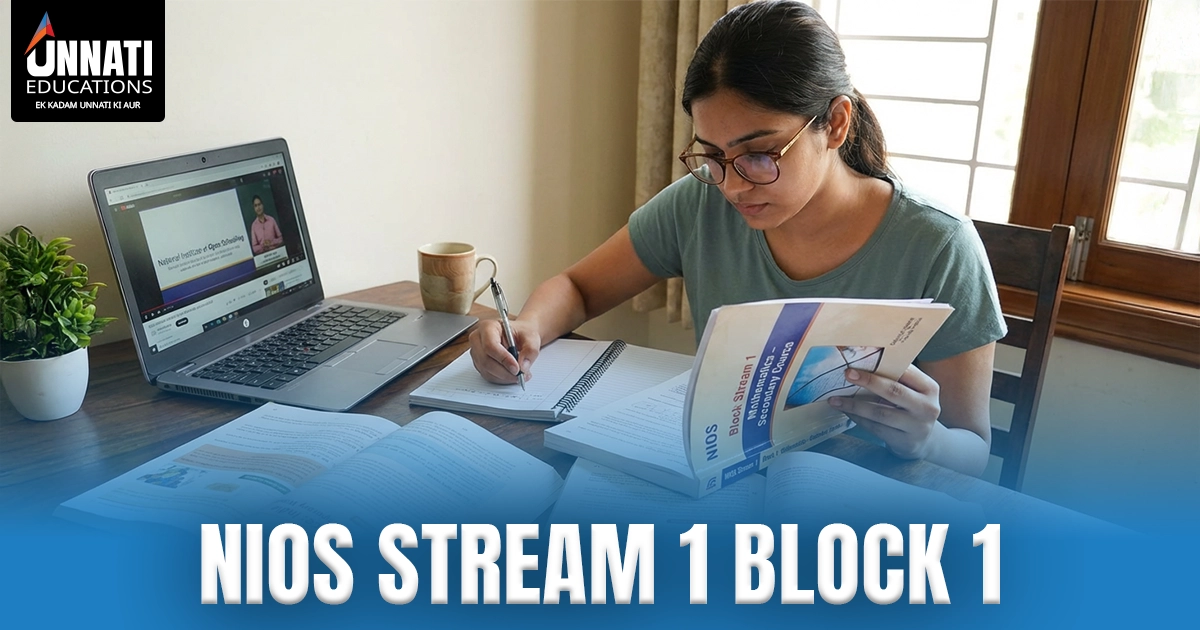
NIOS Stream 1 Block 1 is the first of two annual admission cycles for learners joining the National Institute of Open Schooling as fresh candidates at Secondary or Senior Secondary level. Register in this cycle and you sit the public examination held in April and May of the following year. That gap is the whole point of Block 1. It buys a learner close to a full academic year to study, complete assignments and revise, rather than compressing everything into a few months.
This page sets out who qualifies, what the admission window looks like, which subjects and course codes are on offer, how the assessment is structured, and where Block 1 differs from Block 2 and from Stream 2. Where a figure changes year to year, it is marked for verification rather than stated as fact.
Authored by Prateek Talwar | Reviewed by Rohit Sharma, Senior NIOS Counsellor | Last updated 14 July 2026
NIOS Stream 1 Block 1 Explained in Plain Terms
NIOS organises admissions into streams. Stream 1 is the main academic route, meant for learners enrolling with NIOS for the first time at Class 10 or Class 12. It is not the route for candidates seeking Transfer of Credit from a failed attempt at another board, nor for improvement candidates. Those learners fall under Stream 2 or the TOC provisions.
Stream 1 is split into two admission blocks so that a learner who misses the first window does not lose a year waiting for the next one.
| Cycle | Admission window | Public examination |
|---|---|---|
| Stream 1 Block 1 | Roughly mid-March to mid-September [VERIFY dates each session against nios.ac.in] | April and May of the following year |
| Stream 1 Block 2 | Roughly mid-September to mid-March [VERIFY] | October and November of the same academic year |
Both blocks issue the identical certificate. There is no difference in recognition, in the NIOS syllabus, in the question papers or in how a university or employer treats the result. The only variable is timing.
What the Block Choice Actually Buys You
A Block 1 learner registering in April has roughly twelve months before the examination. A learner registering in Block 2 in January has a few weeks. Neither is wrong, but they suit different situations. Block 1 favours the learner who wants a proper preparation runway, who is switching across from CBSE or a state board mid-year, or who is rebuilding after a difficult academic patch and needs time rather than pressure.
Block 2 favours the learner who wants to sit the examination in the same year they enrol and is prepared to work at pace. Our companion guide on NIOS Stream 1 Block 2 covers that cycle in the same detail.
Who Can Apply and What the Eligibility Rules Say
Eligibility depends on the level being applied for. There are two gates, an age gate and an academic gate, and both must be cleared.
Secondary Course, Class 10 Equivalent
- Age: minimum 14 years as on the cut-off date for the block. [VERIFY the exact cut-off date for the current session]
- Academic: a pass in Class 8 from a recognised board. A learner without a Class 8 certificate may submit a self-certification stating they have studied enough to undertake the Secondary course.
- No prior NIOS enrolment.
Senior Secondary Course, Class 12 Equivalent
- Age: minimum 15 years as on the cut-off date for the block. [VERIFY]
- Academic: a pass in the Secondary examination from a recognised board. This is not waivable and no self-certification substitutes for it.
- NIOS applies a gap rule between the year of passing Secondary and Senior Secondary certification. Confirm the current requirement with your Regional Centre before applying, since it affects candidates who cleared Class 10 very recently. [VERIFY]
The self-certification route at Secondary level is widely misunderstood. It is a genuine provision for learners who never sat Class 8 formally, not a loophole for skipping documentation. Regional Centres do scrutinise it, and a weak or inconsistent declaration slows verification down.
Admission Window and Key Dates
Registration is done online through the NIOS student portal at sdmis.nios.ac.in. The window opens in mid-March and stays open at the standard fee until a first deadline, after which late fees apply in escalating slabs until the window shuts in mid-September.
| Item | Status |
|---|---|
| Registration portal | sdmis.nios.ac.in |
| Window opens | Mid-March |
| Standard fee deadline | [DATA PLACEHOLDER: confirm from the current NIOS admission notification] |
| Late fee slabs | [DATA PLACEHOLDER: NIOS publishes three escalating slabs. Aggregator sites frequently carry stale amounts. Confirm on nios.ac.in] |
| Window closes | Mid-September |
| Examination | April and May of the following year |
| Date sheet released | Typically a few months before the examination [VERIFY] |
Fee amounts, cut-off dates and late fee slabs are the single most commonly wrong data on the internet for NIOS. Third-party sites copy figures from previous sessions and never update them. Read the current admission notification on nios.ac.in before you pay anything.
Documents to Have Scanned Before You Start
- Birth certificate or other valid age proof
- Class 8 marksheet for Secondary, or Class 10 marksheet and pass certificate for Senior Secondary
- Address proof, with a rent agreement alongside it if you are in rented accommodation
- Photo identity such as Aadhaar
- Passport-size photograph and scanned signature, in the file formats the portal specifies
Subjects and Course Codes at Secondary and Senior Secondary Level
NIOS uses a subject grouping system. Group A holds the languages and Group B holds the academic and applied subjects. A learner must pass at least five subjects to earn the certificate, including at least one and at most two languages from Group A, with the remaining three or four drawn from Group B. Up to two additional subjects may be taken, so seven is the maximum.
Secondary Course Codes
| Subject | Code |
|---|---|
| Hindi | 201 |
| English | 202 |
| Sanskrit | 209 |
| Mathematics | 211 |
| Science and Technology | 212 |
| Social Science | 213 |
| Economics | 214 |
| Business Studies | 215 |
| Home Science | 216 |
| Psychology | 222 |
| Indian Culture and Heritage | 223 |
| Painting | 225 |
| Data Entry Operations | 229 |
| Hindustani Music | 242 |
| Carnatic Music | 243 |
Senior Secondary Course Codes
| Subject | Code |
|---|---|
| Hindi | 301 |
| English | 302 |
| Sanskrit | 309 |
| Mathematics | 311 |
| Physics | 312 |
| Chemistry | 313 |
| Biology | 314 |
| History | 315 |
| Geography | 316 |
| Political Science | 317 |
| Economics | 318 |
| Business Studies | 319 |
| Accountancy | 320 |
Beyond these, the Senior Secondary scheme also carries Home Science, Psychology, Computer Science, Sociology, Painting, Environmental Science, Mass Communication, Data Entry Operations, Introduction to Law and Library and Information Science, along with several regional languages. Subject availability and codes vary by session and by Regional Centre, so confirm your intended combination in the current academic prospectus before locking it in.
Mediums of Instruction
NIOS study material and examinations are available in English, Hindi and Urdu, with several regional mediums offered depending on the subject. Not every subject exists in every medium. Choose the medium you actually think in rather than the one you believe looks better on paper. Learners who write in a second or third language routinely lose marks on explanation-heavy questions that they understood perfectly well.
How the Assessment Works
The examination structure is straightforward once you see the two components sitting alongside each other.
- Public examination: a written theory paper, typically 3 hours, held in the April and May session for Block 1 learners.
- Practical examination: applicable to subjects that carry a practical component, such as the sciences, and assessed separately from the theory paper.
- Tutor Marked Assignments: internal assessment submitted to the study centre. TMAs are compulsory, they count toward the final result, and they are the single most neglected source of marks in the system. [VERIFY the exact weightage and the subject-wise applicability in the current prospectus, since it differs between practical and non-practical subjects]
Public examinations run twice a year, in April and May and again in October and November. Block 1 learners appear by default in the April and May session. NIOS also permits subject-wise flexibility, so a learner may split subjects across sessions rather than attempting all of them at once.
Registered Stream 1 learners in both blocks become eligible for the On-Demand Examination System after their first public examination, which allows an examination to be booked when the learner is ready rather than waiting for a fixed session.
Validity of the Admission
An NIOS admission remains valid for five years from the date of registration, with multiple examination chances available inside that period. This is why a learner who does not clear a subject at the first attempt has not lost anything structural. They reappear in that subject alone at the next available session. [VERIFY the current number of permitted chances against the prospectus]
Block 1 Compared with Block 2 and Stream 2
Three terms get conflated constantly. They are not interchangeable.
| Stream 1 Block 1 | Stream 1 Block 2 | Stream 2 | |
|---|---|---|---|
| Who it is for | Fresh learners at Class 10 or 12 | Fresh learners at Class 10 or 12 | Learners who appeared at another recognised board but did not qualify |
| Admission window | Mid-March to mid-September | Mid-September to mid-March | Separate window announced by NIOS |
| Examination sat | April and May, following year | October and November, same year | October and November |
| Transfer of Credit | Not applicable | Not applicable | Available for subjects already passed |
| Certificate issued | Standard NIOS certificate | Standard NIOS certificate | Standard NIOS certificate |
If you passed Class 8 and have never sat a Class 10 board examination, you are a Stream 1 candidate. If you sat Class 10 with CBSE or a state board and failed, Stream 2 with Transfer of Credit is likely to serve you better, because it lets you carry forward the subjects you did clear.
Why Learners Choose NIOS Stream 1 Block 1
A Preparation Runway Rather Than a Sprint
The single largest advantage is time. A learner enrolling early in the Block 1 window has close to a year before the paper. That is enough to read the material properly, submit TMAs without panic, work through previous year question papers and revise twice.
Alignment with the Conventional Academic Year
Block 1 tracks the March to March rhythm that coaching schedules, tuition timetables and family planning are already built around. For a learner moving across from a conventional school, nothing about the calendar has to be relearned.
No Lost Year on a Mid-Year Switch
A learner who leaves CBSE, ICSE or a state board partway through the year can enter Block 1 and sit the examination on the ordinary timeline. That is often the difference between a delayed year and no delay at all.
Subject and Pace Control
Attendance is not compulsory. Subject combinations are not forced into rigid science, commerce or arts silos. A learner may pair Mathematics with Psychology, or Accountancy with Painting, if that serves their plan. Examinations may be spread across sessions.
National Recognition
The NIOS certificate is recognised nationally for higher education, for public and private sector employment, and for competitive examinations. It is issued by an autonomous institution under the Ministry of Education. This is not a marketing claim, it is the institutional position, and it holds for Block 1 and Block 2 alike.
Mistakes That Cost Learners Marks
These are the failure patterns we see most often, stated plainly because softening them helps nobody.
- Treating TMAs as optional. They are internal assessment marks that require no examination hall performance. Skipping them is throwing away the easiest marks on offer.
- Enrolling in Block 1 and then starting in January. The long window is an advantage only if it is used. Learners who register in April and open the book in January have simply bought themselves a worse version of Block 2.
- Choosing subjects socially. Picking a subject because a friend picked it, or because it sounds impressive, is a reliable way to lose marks. Choose on strength and on what the next stage of your plan actually requires.
- Assuming someone will remind you about the date sheet. Nobody will. Track nios.ac.in yourself from February onward.
- Trusting a third-party site for fees and deadlines. Verify every date and every rupee figure against the official notification.
Speak to the NIOS Desk
If you are weighing Block 1 against Block 2, or you are unsure whether Stream 1 or Stream 2 fits your case, message the NIOS desk on WhatsApp 9654279279. Have your last marksheet and date of birth to hand.
Frequently Asked Questions
What is NIOS Stream 1 Block 1?
It is the first of two annual admission cycles under Stream 1, the route for learners enrolling with NIOS for the first time at Secondary or Senior Secondary level. The window runs from roughly mid-March to mid-September, and learners who register in it appear for the public examination held in April and May of the following year, giving them a long preparation period.
Who is eligible for NIOS Stream 1 Block 1 admission?
For the Secondary course, a learner must be at least 14 years old and have passed Class 8 from a recognised board, or submit a self-certification of academic readiness. For the Senior Secondary course, a learner must be at least 15 and must hold a genuine Class 10 pass certificate from a recognised board. Confirm the current cut-off dates on nios.ac.in.
What is the difference between Block 1 and Block 2 in NIOS Stream 1?
The difference is timing alone. Block 1 admissions run from mid-March to mid-September and lead to the April and May examination of the following year. Block 2 admissions run from mid-September to mid-March and lead to the October and November examination of the same year. The syllabus, the assessment rules and the certificate issued are identical in both cycles.
How many subjects must I take in NIOS Stream 1 Block 1?
A minimum of five subjects is required to earn the certificate. At least one and at most two of these must be languages from Group A, with the remaining three or four drawn from Group B. Learners may add up to two additional subjects, taking the maximum to seven. Additional subjects appear on the marksheet but are not required to pass.
Are Tutor Marked Assignments compulsory in Block 1?
Yes. TMAs are the internal assessment component and must be submitted to your study centre. They contribute to the final result and are among the most reliable marks available, because they are earned outside the examination hall with the material in front of you. Verify the exact weightage for your specific subjects in the current NIOS academic prospectus.
Is the NIOS Stream 1 Block 1 certificate valid for higher education and government jobs?
Yes. NIOS is an autonomous institution under the Ministry of Education and its Secondary and Senior Secondary certificates carry national recognition. They are accepted for university admission, for competitive examinations such as NEET and JEE, and for employment in both the public and private sectors. The block you enrolled in makes no difference at all to how the certificate is treated.
What happens if I fail a subject?
You reappear in that subject alone at the next available examination session, without repeating the subjects you have already cleared. NIOS admission stays valid for five years from registration, and multiple examination chances are permitted inside that period. Registered Stream 1 learners also become eligible for the On-Demand Examination System aft