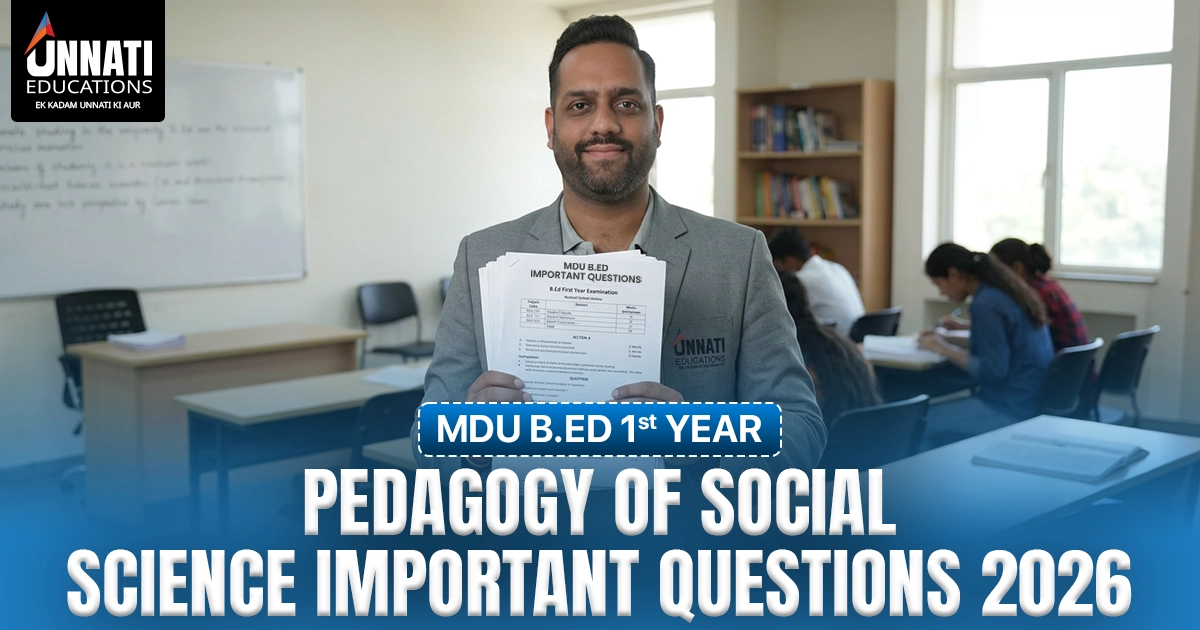
The B Ed Pedagogy of Social Science Important Questions set for 2026 has been built from a question by question study of five MDU Rohtak papers of Paper 17116, namely July 2021, July 2022, August 2023, June 2024 and May 2025. Each of those sessions can be checked in our B.Ed previous year Question Papers library.
Twelve questions have been shortlisted, mapped to Unit I to Unit IV and graded by how often each topic actually returned in the annual examination. Three of those questions are shown on this page and two of them are solved in full as a no-cost preview. The complete solved pack is delivered on WhatsApp.
Paper code 17116, Pedagogy of Social Sciences, is offered as Paper IV and V Group D Optional in the B.Ed. 1st Year annual scheme of Maharshi Dayanand University, Rohtak. The theory paper carries 80 marks in three hours and internal assessment is conducted separately by the institute.
B Ed Pedagogy of Social Science Important Questions 2026 at a Glance
| Paper code | 17116 |
| Paper name | Pedagogy of Social Sciences |
| University | Maharshi Dayanand University, Rohtak |
| Course and year | B.Ed. 1st Year, annual scheme |
| External theory marks | 80 |
| Duration | 3 hours |
| Medium | English or Hindi |
| Questions in the complete pack | 12, each with a model answer |
| Sessions analysed | July 2021, July 2022, August 2023, June 2024, May 2025 |
| Shown on this page | 3 questions, 2 of them solved in full |
| Delivery of the full pack |
Every answer in the pack is written from the prescribed Laxmi B.Ed. study material for Pedagogy of Social Science, so the terminology, the counts and the quoted educationists match what the MDU evaluator expects to see on the answer script.
MDU 17116 Exam Pattern and Marking Scheme
The structure of Paper 17116 has stayed consistent across all five analysed sessions, which is exactly why a frequency based guess paper works for this subject. The same pattern holds across the other B.Ed 1st year Question Papers of the annual scheme.
- You attempt five questions in all, one from each of Unit I, Unit II, Unit III and Unit IV, plus Question 1.
- Question 1 is compulsory. It is a short notes question with four sub parts of four marks each, so 4 x 4 = 16.
- Each unit offers a choice of two questions and you attempt one. Every unit question carries 16 marks, sometimes split as 4+12, 6+10 or 8+8.
- Word budget for time management, 15 mark answer around 400 words, 10 mark around 250 words, 8 mark around 200 words, 4 mark around 100 words and 2 mark around 60 words.
- Internal assessment is held separately by the college and is not covered by this paper.
Important Chapters and Units in Pedagogy of Social Science
Paper 17116 is divided into four units and you answer one question from each. Knowing which chapter sits in which unit is what stops a student from over preparing one unit and walking into the hall with no answer for another. This mapping follows the unit tags carried in the 2026 guess paper.
| Unit | Chapters that carry the marks | Weight in the paper |
|---|---|---|
| Unit I Foundations |
Aims and objectives of teaching Social Science. Values of teaching Social Science. Instructional objectives and Bloom's taxonomy of the cognitive domain. Correlation of Social Science with Economics, Civics, Geography and Natural Science. | 16 marks, one question of two |
| Unit II Planning and Analysis |
Pedagogical analysis, its meaning, its four pillars and a worked analysis of a prescribed topic. Lesson plan, its meaning, need, importance and the Herbartian formal steps. | 16 marks, one question of two |
| Unit III Skills and Materials |
Textbook, its meaning and the criteria for selecting a good Social Science textbook. Skill of explanation with a micro lesson plan. Teaching learning material covering the atlas, maps and e resources. | 16 marks, one question of two |
| Unit IV Methods and Evaluation |
Continuous and comprehensive evaluation, its concept, importance and process. Discussion method with merits and demerits. New approaches to assessment, the question bank and the open book examination. | 16 marks, one question of two |
| Compulsory Q1 Short notes |
Four sub parts drawn from across the units. Correlation with Economics, importance of the lesson plan, importance of the atlas and the question bank are the four that recur. | 4 x 4 = 16 marks, no choice |
Two chapters sit outside this core and still surface from time to time, the meaning and nature of Social Science, and curriculum with its principles and its critical appraisal. Keep them as reading, not as writing practice.
Pedagogy of Social Science Important Topics for the 2026 Exam
Twelve topics carry the paper. They are listed here in the order that the five year record justifies, highest return first, so that a student with two weeks left knows exactly where to start.
- Pedagogical analysis of a prescribed topic. Appeared in all five sessions, on Democracy, Population, the Constitution or Disaster Management. Usually 4 plus 12 marks. The single highest return topic in the paper.
- Lesson plan, need, importance and Herbartian steps. Appeared in all five sessions and also recurs as a short note in the compulsory question, so it pays twice.
- Aims and objectives of teaching Social Science. Appeared in all five sessions. Learn the distinction between an aim and an objective, it is asked as a rider.
- Correlation of Social Science with other subjects. Four of five sessions, almost always inside the compulsory short notes.
- Values of teaching Social Science. Four of five sessions. Do not confuse it with aims, the examiner checks that you separate the two.
- Textbook, meaning and criteria of selection. Three of five sessions and rising, seen in 2024 and 2025.
- Skill of explanation with a micro lesson plan. Three of five sessions, in 2023, 2024 and 2025. A live upward trend.
- Teaching learning material, atlas and e resources. Three of five sessions. The atlas also recurs as a short note.
- Question bank. Three of five sessions, both as a short note and as half of an 8 plus 8 question.
- Open book examination. Three of five sessions, in 2022, 2024 and 2025.
- Continuous and comprehensive evaluation. Two of five sessions but a live topic, and it returned in 2025.
- Discussion method with merits and demerits. Two of five sessions, in 2021 and 2024, so it is a due gap for 2026.
Items 1 to 5 are non negotiable. Items 6 to 10 protect you in Units III and IV. Items 11 and 12 are the gap topics that a frequency reading says are owed a return this year.
Three Sample Questions from the Pedagogy of Social Science Guess Paper
These three questions are lifted from the twelve carried in the complete pack, phrased the way MDU actually frames them, and the wording follows the B.Ed Pedagogy of Social Science Question Papers of earlier sessions. Two are solved below. The third is the one that decides most scripts, and its model answer sits inside the full document.
- Unit I, 16 marks. Explain the aims and objectives of teaching Social Science at school level. How do these aims differ from objectives? Solved below.
- Unit IV, 16 marks. What do you understand by Continuous and Comprehensive Evaluation? Write about its importance and process in Social Science. Solved below.
- Unit II, 4 + 12 = 16 marks. What is meant by Pedagogical Analysis? Describe the pedagogical analysis on the topic Disaster Management. Model answer in the complete pack.
Question 3 has appeared in every single one of the five sessions analysed, in one form or another, on Democracy, Population, the Constitution or Disaster Management. It is the highest yield answer in the paper and the longest to construct, which is why the full worked version is reserved for the paid pack.
Pedagogy of Social Science Sample Solved Answers as a No-Cost Preview
Both answers below are reproduced exactly as they appear in the complete document, so you can judge the depth, the structure and the quotations before you ask for the rest.
Preview 1. Aims and Objectives of Teaching Social Science
Meaning. Wesley reminds us that without the knowledge of aim, the educator is like a sailor who does not know his goal. An aim is a broad ideal, a journey towards a destination, while an objective is a narrow, specific and behavioural outcome achievable inside classroom conditions. Aims set the direction, objectives are the milestones along the route.
Main aims at school level.
- To explain human society. The child understands the physical, social, economic and political environment and learns how institutions came into existence.
- Acquisition of knowledge. Clear and organised knowledge lets the child think rationally and form individual opinion, which the Kothari Commission treats as the basis of good citizenship.
- Good citizenship. Independent India still carries caste, creed and regional bias, so preparation for democratic citizenship remains vital.
- Character building. Honesty, self effort and a sense of duty are built through active participation, not through mere information.
- Development of proper attitudes. Jealousy, prejudice and defiance are replaced by intellectual attitudes based on facts.
- Sense of belonging. Destructive activities such as strikes, riots and bandhs are checked by a sense of belonging to the country and to humanity.
- Habits and skills. Hard work, control over emotions and skills such as drawing graphs, charts, maps and models.
- Preparation for social change. Students are apprised of social structure and process so that they are ready for the change brought by science and collective economics.
- Proper use of leisure. Interest in History, Geography, Literature and Philosophy turns leisure time into learning time.
- All round personality. Compassion, cooperation, clear thinking, self dependence and tolerance, with overall development as the supreme aim.
Edwin's four group classification. Edwin of the U.S.A. grouped the aims as knowledge and understanding, desirable attitudes, training in desirable patterns of conduct, and basic skills.
Conclusion. The Secondary Education Commission of 1952 to 1953 and the Kothari Commission of 1964 to 1966 both echo these aims, democratic citizenship, vocational efficiency, personality development, leadership and modernisation, which together justify Social Science as the core school subject for nation building.
Preview 2. Continuous and Comprehensive Evaluation
Meaning. Continuous evaluation is the time to time evaluation of a student's learning and achievement, while comprehensive evaluation is the assessment of the overall personality of the student, including listening, speaking, reading and writing skills.
Continuous evaluation divides the whole curriculum into ten to twelve parts. Each part is taught and evaluated at the end of the stipulated time, with a complete record of scholastic and non scholastic achievement maintained through the year.
Four pillars of the concept.
- Objective based. The objectives cover political, national, social, cultural, economic and religious aspects, both scholastic and non scholastic.
- Comprehensive. It assesses the total personality, including all four language skills of listening, speaking, reading and writing.
- Continuous. It lets the teacher see the effect of teaching and improve it side by side rather than at the end of the year.
- Evaluation of scholastic achievement. Tools include essay type, short answer and objective type written examinations.
Importance. It makes students regular and punctual because every unit test counts and absence carries a risk. It promotes zeal and interest, so that class work and homework are done satisfactorily and there is no room for indiscipline.
It curbs the evil of mass copying, which has become a fashion among modern students and a real threat to the evaluation process. It reduces non academic problems by giving space to sports and co curricular activity, and it develops the all round personality of the learner, which is the true aim of education.
Process. Divide the year's syllabus into ten to twelve units and teach each unit thoroughly. Conduct unit tests, oral tests, projects and assignments after each unit.
Maintain a cumulative record of scholastic and non scholastic achievement, diagnose weaknesses through that record and provide remedial teaching, then combine the continuous record with a final comprehensive test at the year end to arrive at the grade.
Conclusion. CCE is the modern teacher's answer to the old defective single examination system, because it diagnoses weakness, removes the fear of mass copying and develops the whole personality of the Social Science learner.
WhatsApp 9355198199 to receive the complete solved pack of all twelve questions. Alternate B.Ed. desk, 9899436384.
What the Complete Solved Pack Covers
The full document runs to 26 pages and carries all twelve questions with model answers written to the marks to words limit, one question for every topic in the important topics list above.
- Compulsory question. All four short notes solved to the 60 word limit.
- Unit I. Three solved answers, including Bloom's taxonomy of the cognitive domain.
- Unit II. Two solved answers, including the full worked pedagogical analysis on Disaster Management with content analysis, behavioural objectives, methods, aids and evaluation devices.
- Unit III. Three solved answers, including a ready micro lesson plan on the skill of explanation.
- Unit IV. Three solved answers, including the discussion method with merits and demerits.
- Plus. The unit mapping, the year wise appearance record of every topic, the priority legend and the examiner notes on how marks are awarded in 17116.
Five Year Frequency Analysis, 2021 to 2025
This is the table the guess paper is built on, compiled by reading every mdu question paper of the last five sessions. A yes means the topic appeared in that session's Paper 17116.
| Topic | 2021 | 2022 | 2023 | 2024 | 2025 | Priority |
|---|---|---|---|---|---|---|
| Aims and objectives of teaching Social Science | Yes | Yes | Yes | Yes | Yes | High |
| Values of teaching Social Science | No | Yes | Yes | Yes | Yes | High |
| Pedagogical analysis, Democracy or Population or Constitution or Disaster | Yes | Yes | Yes | Yes | Yes | High |
| Lesson plan, meaning, need, importance and steps | Yes | Yes | Yes | Yes | Yes | High |
| Correlation with Economics or Civics or Geography or Natural Science | No | Yes | Yes | Yes | Yes | High |
| Textbook, meaning and criteria of selection | No | Yes | No | Yes | Yes | High |
| Skill of Explanation or Illustration | No | No | Yes | Yes | Yes | High |
| Newspaper or E Resources or teaching learning material | Yes | No | No | Yes | Yes | High |
| Open Book Examination | No | Yes | No | Yes | Yes | High |
| Question Bank | Yes | Yes | No | Yes | No | High |
| Continuous and Comprehensive Evaluation | No | Yes | No | No | Yes | High |
| Discussion Method | Yes | No | No | Yes | No | High |
| Bloom's taxonomy and instructional objectives | Yes | Yes | No | No | No | Medium |
| Meaning and nature of Social Science | Yes | No | No | Yes | Yes | Medium |
| Atlas and maps in Social Science | Yes | Yes | No | No | No | Medium |
| Skill of Stimulus Variation | Yes | Yes | No | No | No | Medium |
| Curriculum, meaning, importance and principles | No | No | Yes | No | No | Low |
| Critical appraisal of the existing curriculum | Yes | No | No | No | No | Low |
| Discovery Method or Survey Method or Grading System | No | No | Yes | No | Yes | Low |
Read the priority column this way. High means the topic repeated four or more times, or is a recent paper gap that is due to return. Medium means it appeared two or three times across the five papers. Low means it appeared once and should be kept only as a backup topic.
Topics You Can Safely Skip
Past paper analysis also reveals what does not pay for itself. Leave these to the end of your revision and touch them only if time is left over.
- Source Method, which shows up in K.U.K. campus papers but has not appeared in MDU 17116 in the last five years.
- Logical, concentric, spiral and chronological approaches of curriculum organisation, which have not been asked as full 16 mark questions recently.
- Story Telling Method, Project Method and Heuristic Method in full detail. Only the Discussion Method, the Discovery Method as a short note and the Skill of Explanation keep recurring.
- Administrative detail of the Indian Constitution beyond what a pedagogical analysis answer needs.
- Long historical timelines of the Indian freedom movement, which the prescribed book handles inside pedagogical analysis rather than as a standalone topic.
How MDU Examiners Award Marks in 17116
Structure earns marks in this paper, because scripts are scanned quickly. Four habits separate a 60 percent script from an 80 percent script.
- Open with a definition and a name. Begin every long answer with a one line definition credited to an educationist, for example L. B. Sands on the lesson plan or Bloom in the Taxonomy of Educational Objectives.
- Use exact counts. Bloom's six cognitive categories, Herbart's five formal steps and Edwin's four group classification are checked as numbers. Do not round them off.
- Give one Indian classroom example per concept. A Preamble lesson, a disaster management mock drill, a map exercise or a CCE unit test converts theory into pedagogy in the evaluator's eyes.
- Close with an applied conclusion. Two or three lines that return the theory to the role of the Social Science teacher, never a summary of what you just wrote.
Get the Complete B Ed Pedagogy of Social Science Important Questions Pack
Message the B.Ed. desk with your paper code, 17116, and the complete solved document is shared on WhatsApp. All twelve questions, all twelve model answers, the unit mapping and the examiner notes.
WhatsApp 9355198199 for the complete solved guess paper. You may also reach the alternate desk on 9899436384.
Frequently Asked Questions
Is this guess paper valid for the MDU 2026 annual examination?
Yes. The selection targets the MDU 2026 annual examination of Paper 17116, Pedagogy of Social Sciences, in the B.Ed. 1st Year annual scheme. It is compiled from the July 2021, July 2022, August 2023, June 2024 and May 2025 papers, and every answer follows the prescribed Laxmi B.Ed. study material for the subject, so the terminology matches what the evaluator expects.
How many questions do the B Ed Pedagogy of Social Science Important Questions cover?
Twelve questions are covered in the complete pack, mapped across the compulsory short notes question and Units I to IV. Three of those questions are shown on this page and two of them, aims and objectives and continuous and comprehensive evaluation, are solved in full as a no-cost preview. The remaining ten solved answers come in the complete document on WhatsApp.
Which question carries the highest weight in Paper 17116?
Pedagogical analysis. It has appeared in all five analysed sessions, on Democracy, Population, the Constitution or Disaster Management, and it is usually split as 4 plus 12 marks. It also takes the longest to construct because it needs content analysis, behavioural objectives, methods, teaching aids and evaluation devices. Its model answer is inside the complete pack.
Which chapters are most important in Pedagogy of Social Science?
Pedagogical analysis and the lesson plan in Unit II, and aims and objectives in Unit I, appeared in all five sessions from 2021 to 2025. Values of teaching Social Science and correlation with other subjects follow at four sessions each. Together these five chapters cover the compulsory question and at least two of the four unit questions.
Can a guess paper alone be enough to clear Paper 17116?
A guess paper concentrates your revision, it does not replace the syllabus. Because you attempt one question from each unit and every unit offers a choice of two, covering the high priority topics of all four units gives you a workable answer for each unit. Treat the medium priority list as your safety net if a paper takes an unusual turn.
Is this guess paper useful for CRSU, KUK or other Haryana universities?
The topics of Pedagogy of Social Science overlap heavily across Haryana B.Ed. programmes, so the content and the model answers remain useful. The frequency table, the paper code and the marking split are specific to MDU Rohtak. Students of CRSU, KUK and other universities should check their own paper pattern before relying on the priority ranking.
What is the marking scheme of Paper 17116?
The external theory paper carries 80 marks and runs for three hours. You attempt five questions, Question 1 being compulsory short notes worth 4 x 4 = 16 marks, then one question each from Unit I, Unit II, Unit III and Unit IV, each worth 16 marks. Internal assessment is conducted separately by your institute.
In which language should answers be written?
The medium of Paper 17116 is English or Hindi and you may answer in either. The model answers in the pack are written in English with the technical terms that the prescribed book uses. Students writing in Hindi generally retain the English pedagogical terms such as lesson plan, pedagogical analysis and cognitive domain, since evaluators recognise them instantly.
About the Reviewer
This page was reviewed by Sheetal Kirola, M.Ed., B.Ed Faculty, who checked the unit mapping, the marking split and the model answers of Paper 17116 against the MDU 1st Year annual scheme and the prescribed study material.
Disclaimer. Unnati Educations is an independent academic support platform and is not affiliated with, endorsed by or associated with Maharshi Dayanand University, Rohtak. All materials on this page are study aids prepared by Unnati Educations. Students must verify the paper code, the syllabus and the examination pattern from the official MDU website.